
Control Line: Scale
Bill Boss 77-06 269th Street New Hyde Park, NY 11040
Overseas correspondence
Every once in a while I have an opportunity to correspond with aeromodelers in other parts of the world. In recent months I've been in touch with modelers in Cuba, Russia and England. It's great to hear from any overseas hobbyist with an interest in Model Aviation magazine and the CL Scale column in particular.
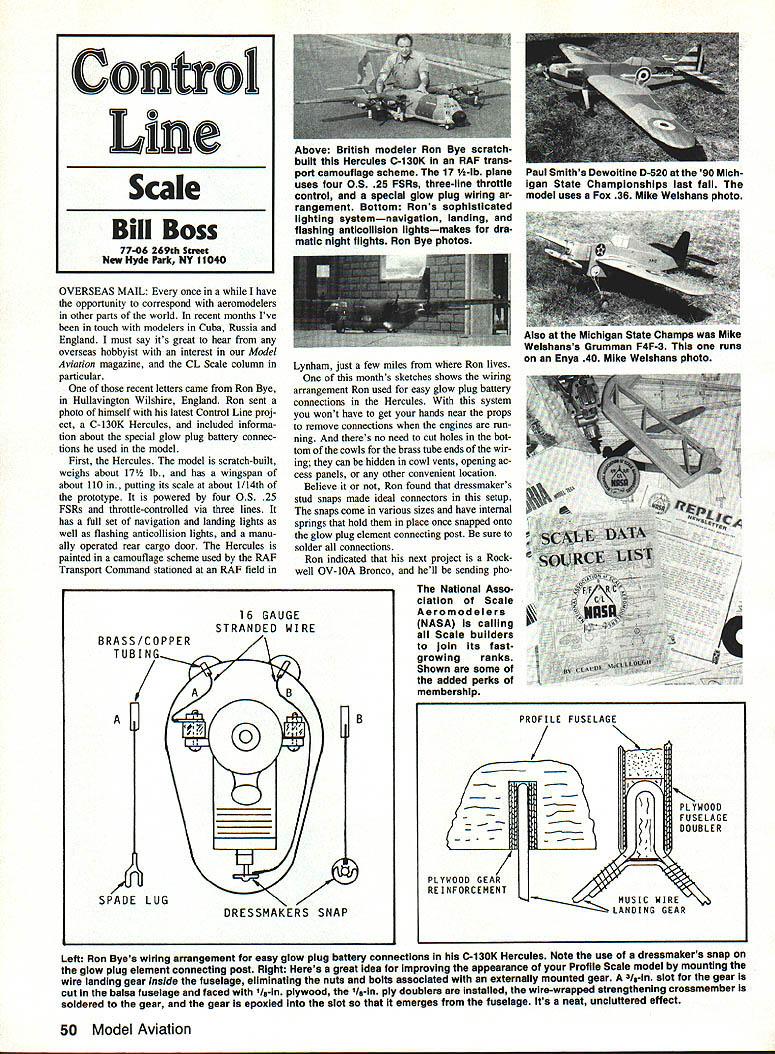
One recent letter came from Ron Bye, Hullavington, Wiltshire, England. Ron sent photos of his latest control-line project, a C-130K Hercules, and included information about special glow-plug battery connections used on the model.
Ron Bye's C-130K Hercules
The Hercules is scratch-built, weighs about 17½ lb., and has a wingspan of about 110 in., giving a scale of roughly 1/14 of the prototype. It is powered by four O.S. .25 FSR engines and is throttle-controlled via three lines. The model features a full set of navigation and landing lights, flashing anticollision lights, and a manually operated rear cargo door. Ron painted it in the camouflage scheme used by RAF Transport Command at an RAF field near Lynham, a few miles from where he lives.
Glow-plug battery connections
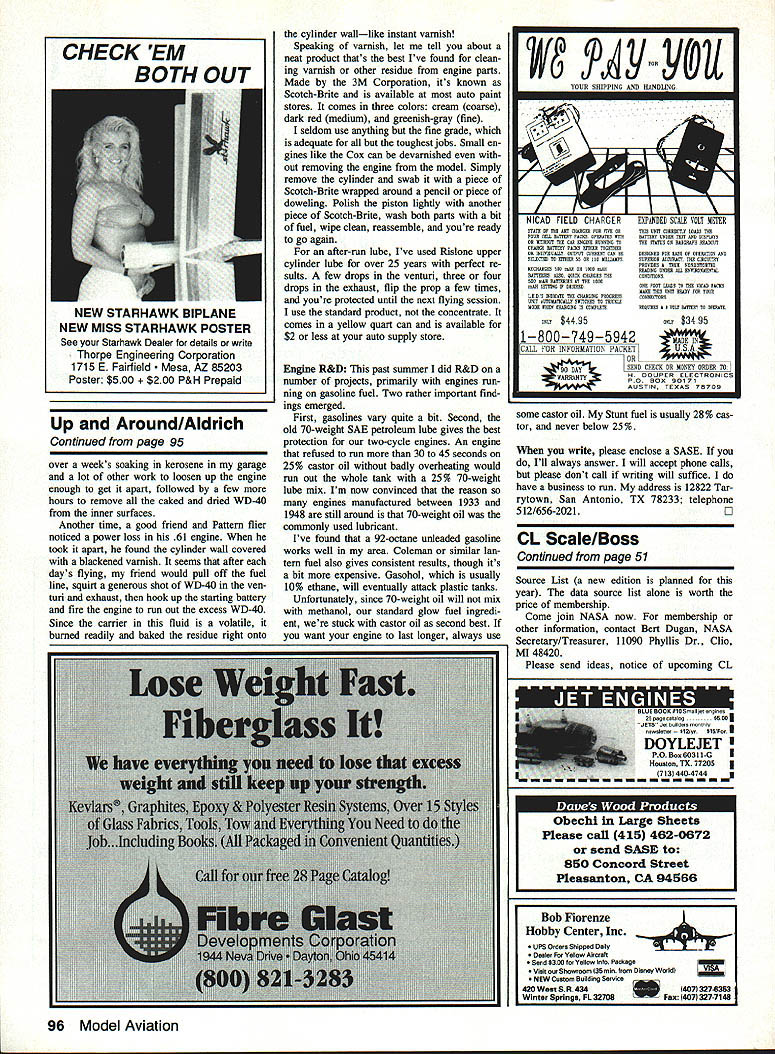
Ron provided sketches showing the wiring arrangement he used for easy glow-plug battery connections. With this system you won't have to get your hands near the props to remove connections when the engines are running, and there's no need to cut holes in the bottom of the cowls for brass-tube ends of the wiring. Connections can be hidden in cowl vents, opening access panels, or any other convenient location.
- Ron found dressmakers' stud snaps to be ideal connectors. The snaps come in various sizes and have internal springs that hold them in place once snapped onto the glow-plug element connecting post.
- Be sure to solder all connections for reliability.
- The system lets you disconnect the battery without reaching close to the props.
Ron indicated his next project is a Rockwell OV-10A Bronco and will be sending photos when work gets under way. He also thanked fellow NASA member Charles Vaughan for help with research documentation for the Bronco. Details on how to become a member of NASA appear later in this column.
Landing gear: hidden music-wire installation
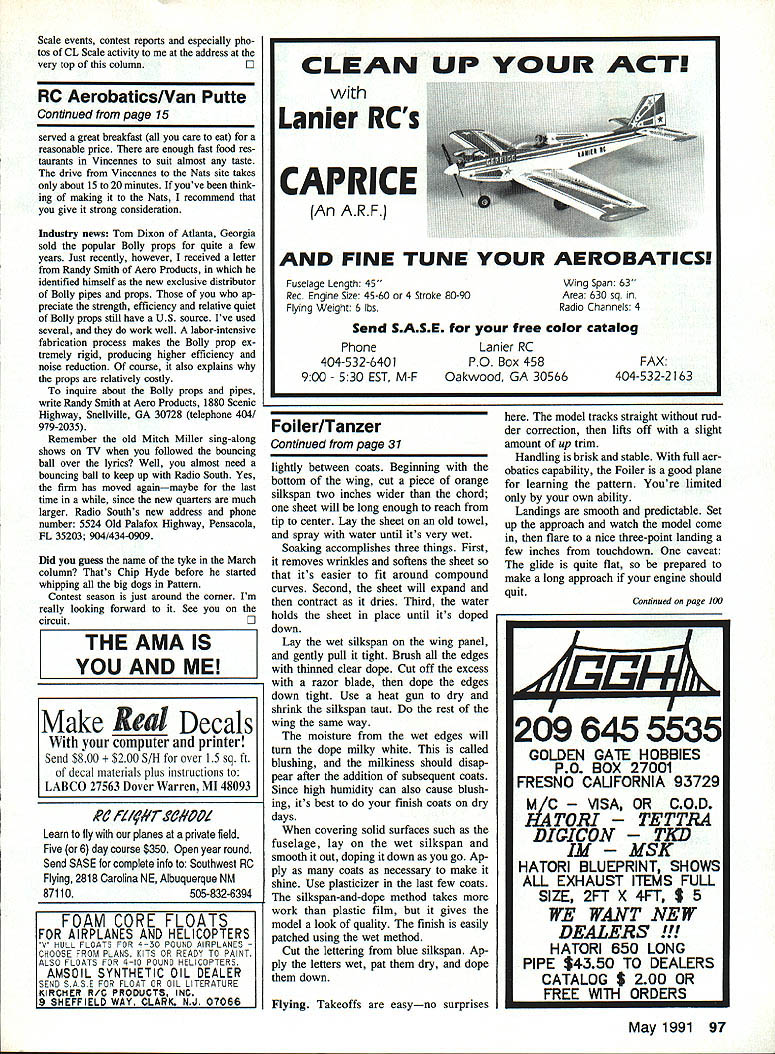
Eliminating visible nuts, bolts and similar devices used to hold music-wire landing gear in place can greatly improve the appearance of profile-scale models. The following method—originated by Don Hutchinson (Direct Connection newsletter) and strengthened by Bill Dahlgren (Stunt News)—mounts the gear inside the fuselage and extends it outside.
- Determine the scale location of the gear — fore/aft position and the rake.
- Cut a slot about 3/8 in. wide and about 1/4 in. high at the gear position in the balsa fuselage.
- Face the front and back edges of the slot with 1/8-in. plywood. The 1/8-in. plywood specification assumes use of 3/32-in. wire gear.
- Ensure edges are well glued so the gear wire slides easily between them.
- Install 1/8-in. plywood doublers and sand to final shape.
- Form the gear wire as required (see sketches for shapes).
- Add a strengthening crossmember: wrap copper wire and solder it in place. For a more finished appearance, fasten the crossmember with appropriate-size brass or copper tubing rather than simply wrapping wire.
- Smear some epoxy on the wire-side hole and slide the finished gear in place. Check that the model sits properly and adjust the fit as necessary.
- Turn the fuselage over, fill the hole with epoxy, and allow it to cure.
Book recommendation
Take a look at Military Aircraft Markings and Profiles by Barry C. Wheeler. The book is a history of military aircraft markings and camouflage from World War I to the present and includes over 850 full-color illustrations and photographs of 140 aircraft.
- Each illustration is a single side view accompanied by a description of the aircraft, the country in which it was used, and general information about the color scheme.
- Though not ideal for three-view color documentation, the profiles provide many schemes that can serve as starting points.
- The volume includes many Vietnam-era helicopter profiles.
I found my copy on special sale for under $20 at Barnes & Noble. ISBN: 0-8317-6002-2.
National Association of Scale Aeromodellers (NASA)
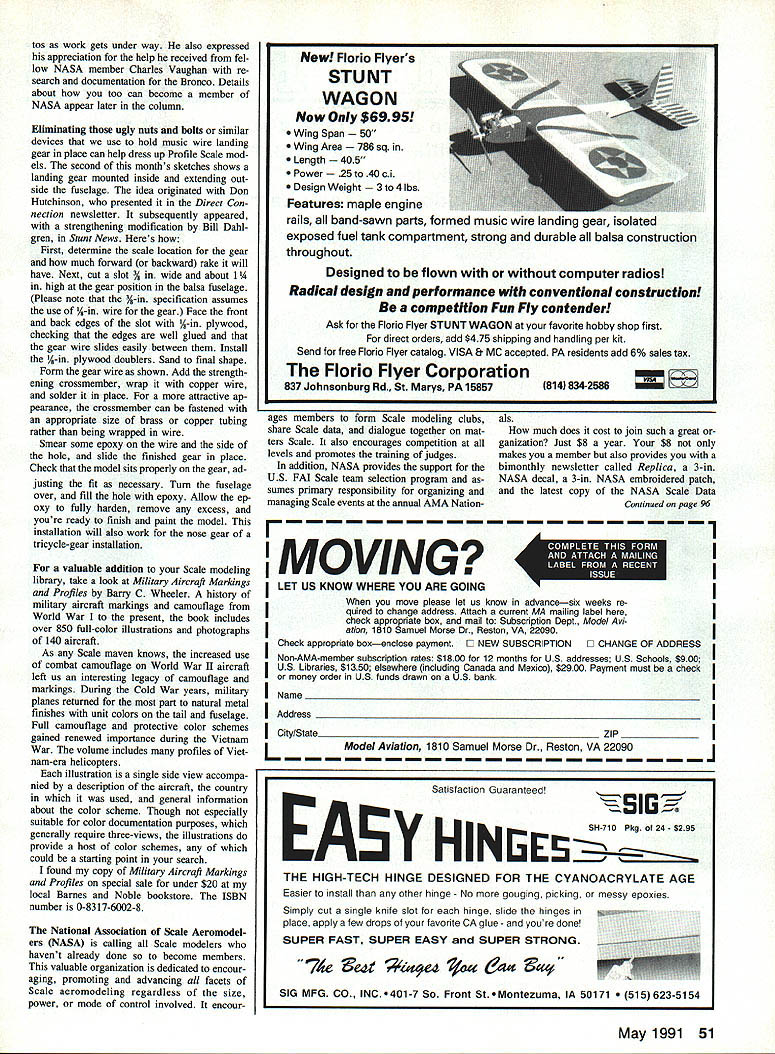
NASA is calling all Scale modelers who haven't already become members to join. This organization is dedicated to encouraging, promoting and advancing all facets of scale aeromodelling regardless of size, power, or mode of control. NASA encourages formation of scale-modeling clubs, sharing of scale data, dialogue among modelers, competition at all levels, and the training of judges.
NASA also provides support for the U.S. FAI Scale team selection program and is primarily responsible for organizing and managing Scale events at the annual AMA National.
- Membership: $8 per year.
- Benefits: bimonthly newsletter Replica, a 3-in. NASA decal, a 3-in. NASA embroidered patch, the latest copy of NASA Scale Data (a source list; a new edition is planned).
To join or for more information, contact: Bert Dugan, NASA Secretary/Treasurer 11090 Phyllis Dr. Clio, MI 48420
Contact
Please send ideas, notice of upcoming CL Scale events, and items of interest to: Bill Boss 77-06 269th Street New Hyde Park, NY 11040
Transcribed from original scans by AI. Minor OCR errors may remain.

