
Control Line: Scale
Bill Boss 77-06 269th Street New Hyde Park, NY 11040
Documentation
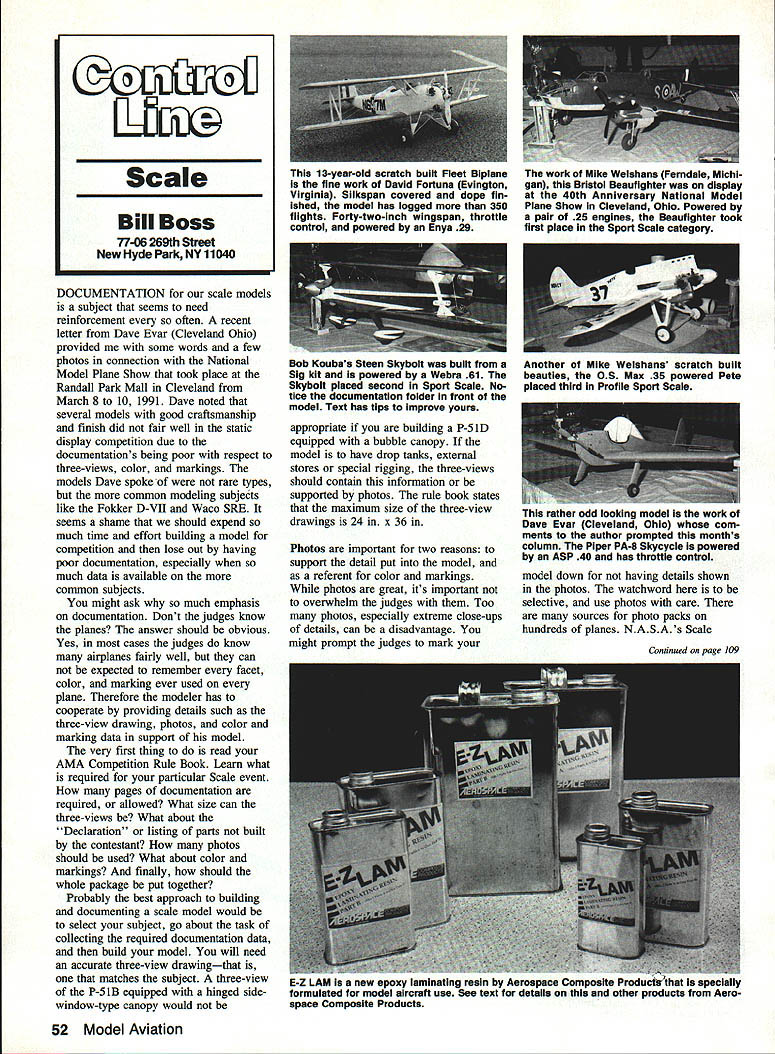
Documentation for our scale models is a subject that seems to need reinforcement every so often. A recent letter from Dave Evar (Cleveland, Ohio) provided me with some words and a few photos in connection with the National Model Plane Show that took place at Randall Park Mall in Cleveland from March 8 to 10, 1991. Dave noted that several models with good craftsmanship and finish did not fare well in the static display competition due to the documentation's being poor with respect to three-views, color, and markings. The models Dave spoke of were not rare types, but the more common modeling subjects like the Fokker D‑VII and Waco SRE. It seems a shame that we should expend so much time and effort building a model for competition and then lose out by having poor documentation, especially when so much data is available on the more common subjects.
You might ask why so much emphasis on documentation. Don't the judges know the planes? The answer should be obvious. Yes, in most cases the judges do know many airplanes fairly well, but they cannot be expected to remember every facet, color, and marking ever used on every plane. Therefore the modeler has to cooperate by providing details such as the three‑view drawing, photos, and color and marking data in support of his model.
The very first thing to do is read your AMA Competition Rule Book. Learn what is required for your particular Scale event. How many pages of documentation are required, or allowed? What size can the three‑view be? What about the "Declaration" or listing of parts not built by the contestant? How many photos should be used? What about color and markings? And finally, how should the whole package be put together?
Probably the best approach to building and documenting a scale model would be to select your subject, go about the task of collecting the required documentation data, and then build your model. You will need an accurate three‑view drawing—that is, one that matches the subject. A three‑view of the P‑51B equipped with a hinged side‑window‑type canopy would not be appropriate if you are building a P‑51D equipped with a bubble canopy. If the model is to have drop tanks, external stores, or special rigging, the three‑views should contain this information or be supported by photos. The rule book states that the maximum size of the three‑view drawings is 24 in. x 36 in.
N.A.S.A.'s Scale Documentation Source publication lists many of the plan, three‑view, and photo sources.
Photos
Photos are important for two reasons: to support the detail put into the model, and as a reference for color and markings. While photos are great, it's important not to overwhelm the judges with them. Too many photos, especially extreme close‑ups of details, can be a disadvantage. You might prompt the judges to mark your model down for not having details shown in the photos. The watchword here is to be selective, and use photos with care. There are many sources for photo packs on hundreds of planes.
Color and Markings
Color and markings can be proved by providing color photos or a color three‑view, such as those found in Profile Publications for Sport Scale models. In the case of a Precision model your three‑view may show the markings and provide the names of the colors of the plane as well as the markings. In this case you will have to try to document the color and markings with photos of the actual plane, or provide color paint chips such as the Federal Standard 595A or 595B colors. Whatever source you use, be sure that all color and markings used on the model are the same as on the prototype. This is the one area in static judging where differences stand out like the old sore thumb, and they can make the difference between a winning or losing model.
Declaration
Remember that a "Declaration" (Rule 4.6: a listing of parts not made by the builder) is required for Sport Scale models. This page is also a good place to list any deviations in the model from the three‑views.
Presentation
Your Scale documentation should be precise and presented in a neat binder or with a loose‑leaf type cover. Keep the presentation within the prescribed number of pages: eight for the Sport event, and 25 for the Precision event. It is a good idea to dedicate a portion of the first page of your documentation to a table of contents and particulars about your model such as power used, scale of the model, weight, your name and AMA number. This information helps the judges and identifies your documentation. A table of contents might read as follows: Declaration—Page 2; Three‑view—Page 3; Color and Markings—Pages 4 & 5; Photos—Pages 6 & 7. In this way the judges will know just where to look for the information for a particular area of judging. Typing the presentation also makes for easier reading and understanding. It is also suggested that the pages be installed in clear plastic page holders to keep the data clean and safe from handling wear and tear. Remember, your model should match your documentation; a few points missed in static judging can make the difference between winning or losing.
Thanks to Mike Welshans and Stan Alexander for many of the ideas on the subject of documentation that appeared in a recent issue of Replica, the N.A.S.A. Newsletter.
Workshop Hints
Workshop hints this month are by Kirk Kirkham and were found in Probable Cause, the newsletter of the Rocky Mountain Aeromodelers. Kirk says that perhaps some of these tips are things you have forgotten, or maybe they're things your mother never taught you.
- Lighter fluid — Even though you may have stopped smoking, this might be good stuff to have around for the removal of price tags from propellers, books, etc. A couple of drops loosens the tag so that you can peel it off; a couple more drops dissolves the residue.
- Ammonia — You want the kind without detergent. Soak your balsa in it to make laminated wing and stabilizer tips or to straighten a warped trailing edge. The ammonia doesn't harm the wood but makes it much more flexible than soaking in plain water will. It seems to hold its shape better when dry, too.
- WD‑40 — Spray this on tires, or anything else made of rubber, and blot off the excess. It seems to protect the rubber from oxygen. Those fragile Trexler tires, favored by Rubber Scale modelers, seem to last twice as long.
More hints from Kirk in next month's column.
New Product
Aerospace Composite Products has released the following information on its new epoxy laminating resin which is specially formulated for model aircraft uses. This two‑part 2:1 mix resin and hardener is blended for use with lightweight fiberglass, carbon fiber, or Kevlar cloth. Its low viscosity allows it to flow easily into the weave of the cloth. EZ LAM cures to a hard, high‑strength, gloss finish; it sands easily and is ideal for use with 0.58‑ounce fiberglass cloth over balsa‑sheathed foam wings, or with two‑ounce glass cloth over bare molded Styrofoam "foamie" type models. EZ LAM can be thinned with 99% isopropyl alcohol for applications where lower viscosity is desired.
Also available from Aerospace Composite Products is a no‑fray carbon fiber tape and Kev‑Cord, a new idea for control cables.
- No‑fray carbon fiber tape — This is a loose filament carbon fiber reinforcing tape which is trapped between two layers of thin tissue paper. Epoxy or polyester resins will easily soak through the tissue paper layers, saturating the carbon fiber, and bond the entire assembly in place. This carbon fiber tape is packaged in 1‑inch widths, 12 feet long and is ideal for reinforcement of wings, fuselages, or any other structure requiring high strength and light weight.
- Kev‑Cord — Kev‑Cord is composed of an eight‑strand braided Kevlar filament inner core surrounded with a high density vinyl jacket. This combination provides a no‑stretch cable protected from fraying by the vinyl coating. It can be used with pulleys, threaded through guide tubes (such as Ny‑Rod tubing), or used in tension, unsupported. Kev‑Cord is available in two sizes: 0.038 in. diameter (85 lb. tensile strength) or 0.054 in. diameter (215 lb. tensile strength), and is packaged in 20‑foot lengths.
For full details and price information, write to: Aerospace Composite Products, P.O. Box 16621, Irvine, CA 92714, or call 714/250‑1107.
Please send ideas, notice of upcoming CL Scale events, contest reports, and especially photos of CL Scale activity to me at the address at the very top of this column.
Transcribed from original scans by AI. Minor OCR errors may remain.

