
Control Line: Scale
Bill Boss 77-06 269th Street New Hyde Park, NY 11040
Introduction
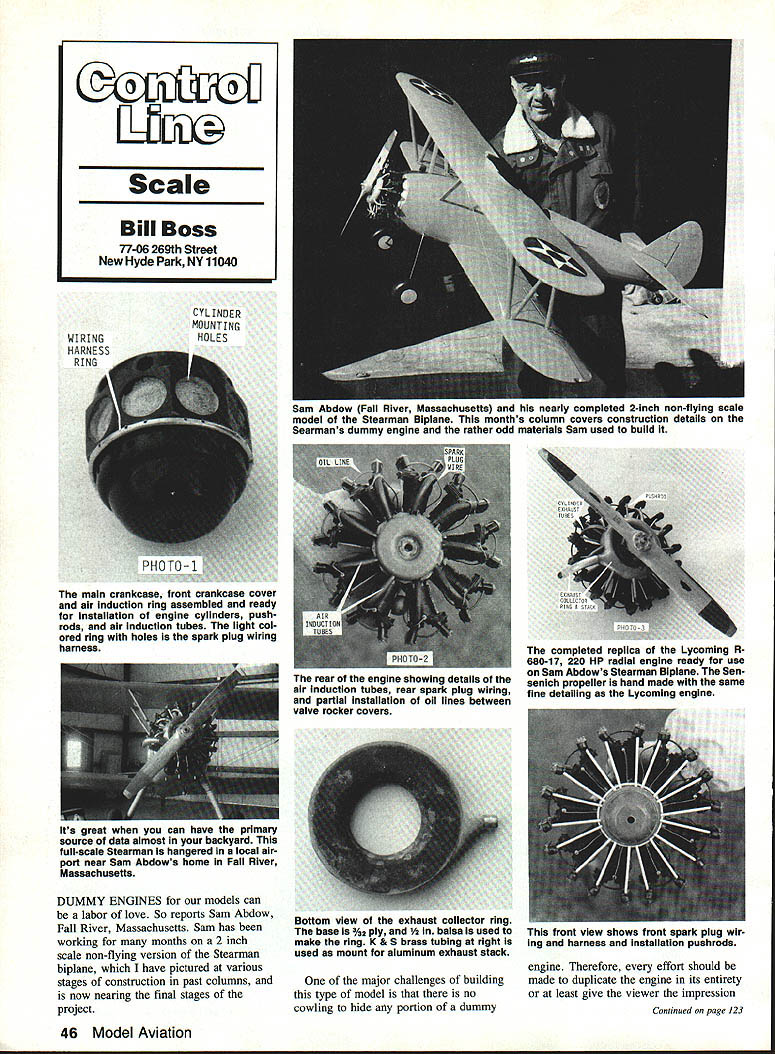
Dummy engines for scale models can be a labor of love. Sam Abdow of Fall River, Massachusetts, has been working for many months on a 2-inch scale non-flying version of the Stearman biplane. The model is now nearing completion after extensive work to simulate the nine-cylinder Lycoming R-680-17 220 HP radial engine. Because there is no cowling to hide the engine, every effort was made to duplicate the engine in its entirety or at least give the impression that the full engine is present.
Planning and Crankcase
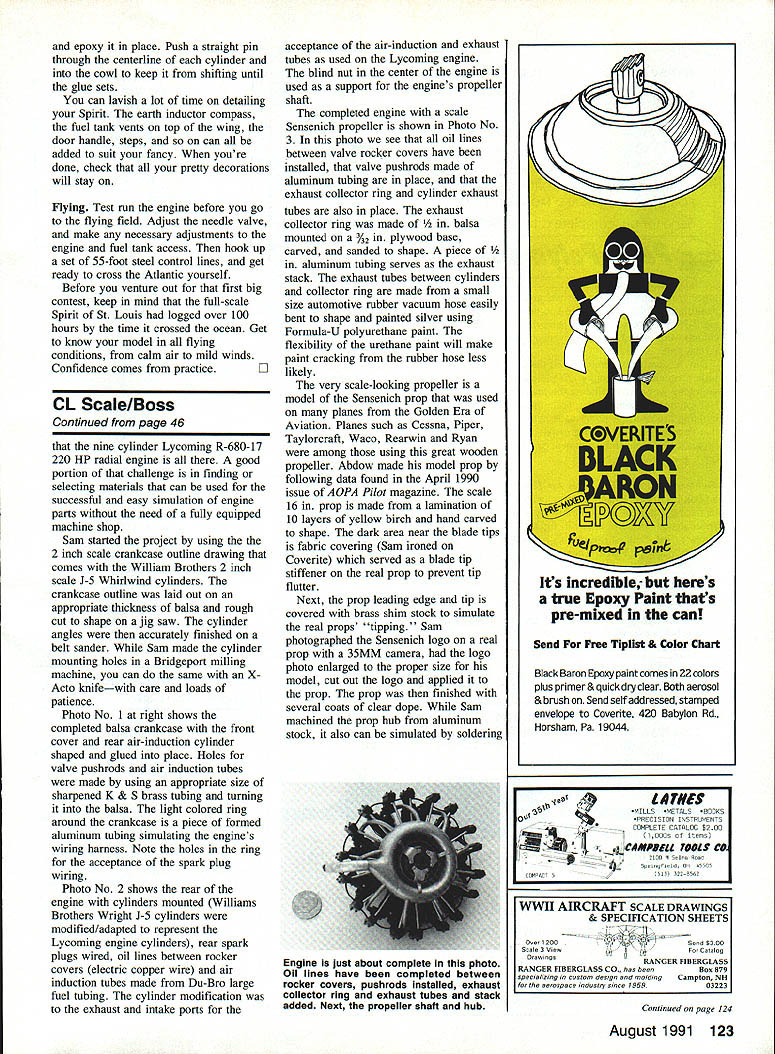
Sam began the project using the 2-inch-scale crankcase outline drawing that comes with the Williams Brothers 2-inch-scale J-5 Whirlwind cylinders. The crankcase outline was laid out on an appropriate thickness of balsa, rough-cut to shape with a jig saw and the cylinder angles accurately finished on a belt sander.
- Cylinder mounting holes were made on a Bridgeport milling machine; the same work can be done carefully with an X-Acto knife and patience.
- The completed balsa crankcase includes the front cover and rear air-induction ring. Cylinders were shaped and glued in place.
- Holes for valve pushrods and air-induction tubes were made using appropriately sized, sharpened K & S brass tubing turned into the balsa.
- A light-colored formed aluminum tubing ring around the crankcase simulates the engine wiring harness; note the holes for spark plug wiring.
Cylinders, Wiring and Induction
Williams Brothers Wright J-5 cylinders were modified and adapted to represent the Lycoming engine cylinders. Modifications to the exhaust and intake ports allowed acceptance of the Lycoming-style air-induction and exhaust tubes.
- Rear spark plugs were wired in place.
- Oil lines between the rocker covers were simulated with electric copper wire.
- Air-induction tubes were formed from Du-Bro large fuel tubing.
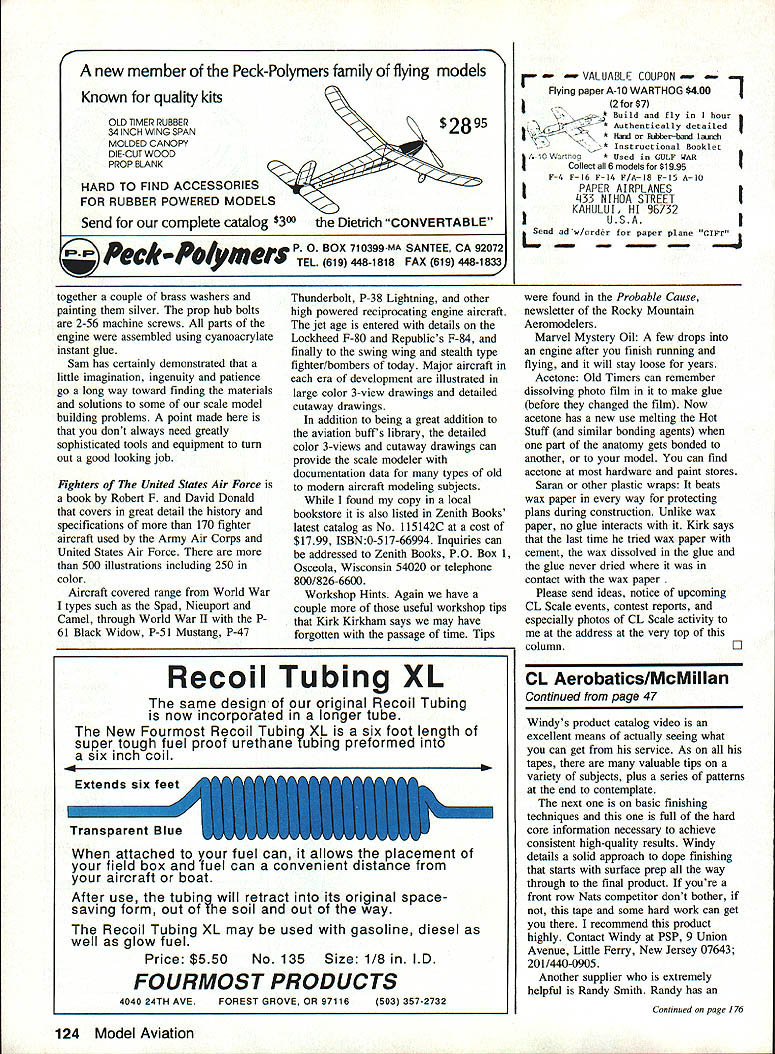
- A blind nut in the engine center serves as a support for the propeller shaft.
All parts of the engine were assembled using cyanoacrylate instant glue.
Exhaust and Collector Ring
The exhaust collector ring and cylinder exhaust tubes were fabricated and installed as follows:
- The collector ring was made from 1/8 in. balsa, mounted on a 3/32 in. plywood base, then carved and sanded to shape.
- A piece of 1/2 in. aluminum tubing serves as the exhaust stack.
- Exhaust tubes between the cylinders and the collector ring were made from small-size automotive rubber vacuum hose, easily bent to shape and painted silver.
- Formula-U polyurethane paint was used for the exhaust hoses; the flexibility of the urethane finish helps prevent paint cracking on the rubber hose.
Propeller
The scale prop is a model of the Sensenich propeller used on many Golden Era aircraft (Cessna, Piper, Taylorcraft, Waco, Rearwin, Ryan, etc.). Sam followed data from the April 1990 issue of AOPA Pilot to create the prop.
- The scale 16 in. prop was made from a laminate of 10 plies of yellow birch and hand-carved to shape.
- The dark area near the blade tips is fabric covering (Sam ironed on Coverite) used on the real prop as a blade-tip stiffener to prevent flutter.
- The leading edge and tips were covered with brass shim stock to simulate the real prop's tipping.
- Sam photographed the Sensenich logo on a real prop with a 35mm camera, enlarged the photo to scale, cut out the logo and applied it to the model prop.
- The prop was finished with several coats of clear dope.
- The prop hub was machined from aluminum stock; it can alternatively be simulated by soldering together a couple of brass washers and painting them silver. Prop hub bolts are 2-56 machine screws.
Materials and Techniques
Sam demonstrated that careful material selection and basic tools can produce convincing scale detail without a fully equipped machine shop.
- Use balsa for large, shapeable parts like the crankcase and collector ring.
- Use brass tubing for pushrod and induction holes, and formed aluminum tubing for harness rings or stacks.
- Use automotive vacuum hose for flexible exhaust runs and paint with a flexible polyurethane to reduce cracking.
- Small details such as wiring and oil lines can be simulated with copper wire and small-diameter tubing.
Conclusion
A little imagination, ingenuity and patience go a long way toward solving scale-model building problems. Sam Abdow’s 2-inch-scale Lycoming R-680-17 dummy engine shows that you don’t always need sophisticated tools to produce a convincing, well-crafted model.
Transcribed from original scans by AI. Minor OCR errors may remain.

