
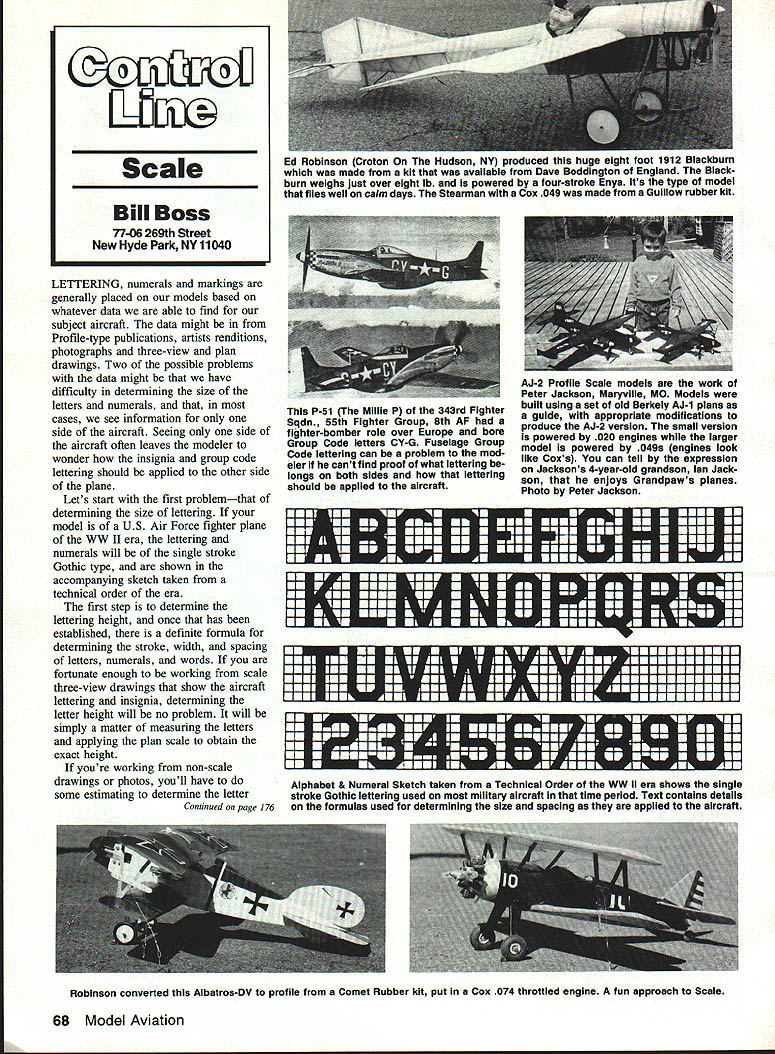
Control Line: Scale
Bill Boss 77-06 269th Street New Hyde Park, NY 11040
Lettering, numerals and markings — sources and problems
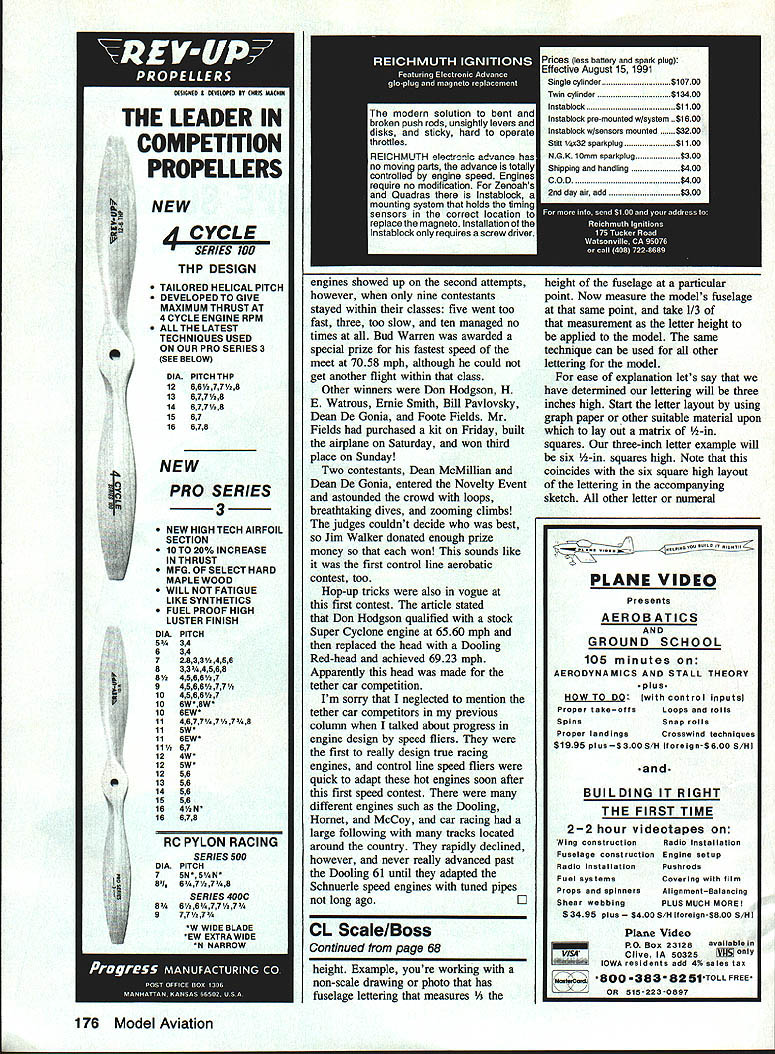
Lettering, numerals and markings are generally placed on our models based on whatever data we can find for the subject aircraft. Sources include profile-type publications, artists' renditions, photographs, and three-view and plan drawings. Two common problems are (1) determining the size of the letters and numerals and (2) seeing information for only one side of the aircraft, which leaves the modeler to wonder how the insignia and group-code lettering should be applied to the other side.
Determining letter height
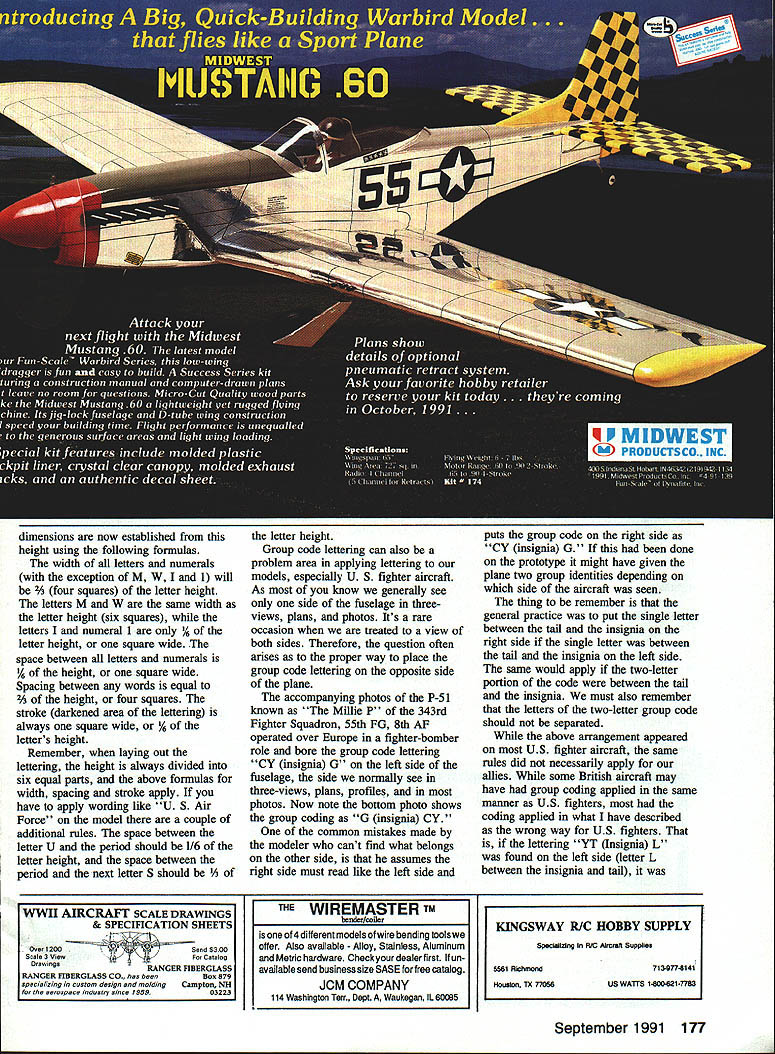
If your model is of a U.S. Air Force fighter of the WWII era, the lettering and numerals will be of the single-stroke Gothic type (see period technical orders). The first step is to determine the lettering height; once established, there is a definite formula for stroke, width, and spacing of letters, numerals, and words.
- If you have scale three-view drawings that show the aircraft lettering and insignia, determining letter height is straightforward: measure the letters on the drawing and apply the plan scale to obtain the exact height.
- If you're working from non-scale drawings or photos, you'll have to estimate the letter height. For example, if the drawing or photo shows fuselage lettering that measures 1/8 of the fuselage height at a particular point, measure the model's fuselage at that same point and take 1/8 of that measurement as the letter height to apply to the model. The same technique can be used for other lettering on the model.
Layout method and basic matrix
For ease of explanation, assume we have determined our lettering will be 3 inches high. Start the layout on graph paper or similar material using a matrix of 1/2-inch squares. A 3-inch letter will be six 1/2-inch squares high — this coincides with the six-square-high layout used in the technical sketch. All other letter and numeral dimensions are established from this height using the formulas below.
Letter, numeral and spacing formulas
Remember: divide the letter height into six equal parts. From that:
- Width of most letters and numerals (except M, W, I, and 1): 2/3 of the letter height (4 squares).
- Width of M and W: equal to the letter height (6 squares).
- Width of I and numeral 1: 1/6 of the letter height (1 square).
- Space between letters and numerals: 1/6 of the height (1 square).
- Space between words: 2/3 of the height (4 squares).
- Stroke (the darkened area of the lettering): always one square wide (1/6 of the letter height).
When laying out lettering, always divide the height into six equal parts and apply the above formulas for width, spacing and stroke.
Additional rules for abbreviations: for wording like "U. S. Air Force," the space between the letter U and the period should be 1/6 of the letter height, and the space between the period and the next letter (S) should also be 1/6 of the letter height.
Applying group code lettering (U.S. fighters)
Group-code lettering can be tricky, especially for U.S. fighters, because most photos and plans show only one side of the fuselage. This often leads modelers to assume the opposite side simply mirrors the shown side, which can produce incorrect or ambiguous markings.
General practice on most U.S. fighters:
- If a single letter is positioned between the tail and the insignia on one side, the single letter is placed between the tail and the insignia on the opposite side as well.
- The same rule applies if the two-letter portion of the code is between the tail and the insignia.
- The two letters of a two-letter group code should not be separated.
A common mistake is to mirror the left-side reading on the right side (e.g., left side: CY (insignia) G, mirror placed as CY (insignia) G on the right). That would give the aircraft two different group identities depending on which side is viewed.
Allied practice (contrast with U.S.)
The above U.S. practice did not necessarily apply to Allied aircraft. Some British aircraft had group coding applied similarly to U.S. fighters, but many applied coding in the opposite manner. For example, if the left side read YT (insignia) L (with L between the insignia and tail), the right side might read L (insignia) YT. Always verify with photos when possible.
Example: The Millie P
The P-51 "The Millie P" of the 343rd Fighter Squadron, 55th FG, 8th AF operated over Europe in a fighter-bomber role and bore the group code lettering "CY (insignia) G" on the left side (the side usually shown in photos and profiles). The bottom photo of the subject shows the group coding as "G (insignia) CY" on the opposite side.
One reason I chose "The Millie P" is that I built the plane over 30 years ago from a Jecko kit and later discovered, while preparing this column, that I had applied the CY–G lettering incorrectly on the right side of the model. Interestingly, the model placed in many contests (including Mirror Meets) and no judge pointed out the error. Thanks to Sam Abdow and my friend Pete Bianchini, a wartime pilot, for their thoughts and ideas on this month's subject.
Coverite — new products
Coverite announces new paint, film and fabric products:
- 21st Century Space Age Paint: Offered initially in 13 oz. cans. Claimed to be fuelproof overnight, recoatable within 30 seconds or any time in the future, totally dry in less than 15 minutes, and virtually run-proof due to Coverite's patented spraygun nozzle. The paint is extremely flexible, will not chip, crack or separate, and is insensitive to weather.
- 21st Century Space Age Film: A mechanically advanced polyester film coated with a Multi-Temp Adhesive. Can be applied with heat over a range of under 200°F to 400°F and can be repositioned without losing adhesive. Adheres tenaciously to wood and to itself and is unaffected by glow, diesel and gasoline fuels.
- 21st Century Space Age Fabric: Lightweight, tough and pre-painted with a factory finish resembling hand-rubbed lacquer. Adheres exceptionally to wood and to itself; can be trimmed with fabric, paint or decals without surface preparation; and is glow-, diesel-, and gasoline-fuelproof. No protective coating required.
Look for these new Coverite products at your local hobby outlet, or write to Coverite, 420 Babylon Road, Horsham, Pennsylvania 19044-1265 for full product details, colors, and costs.
Closing / Contact
Please send ideas, notices of upcoming CL Scale events, contest reports, and especially photos of CL Scale activity to me at the address at the top of this column.
Transcribed from original scans by AI. Minor OCR errors may remain.

