
Control Line: Scale
Bill Boss 77-06 269th Street New Hyde Park, NY 11040
On-board glow starter system (overview)
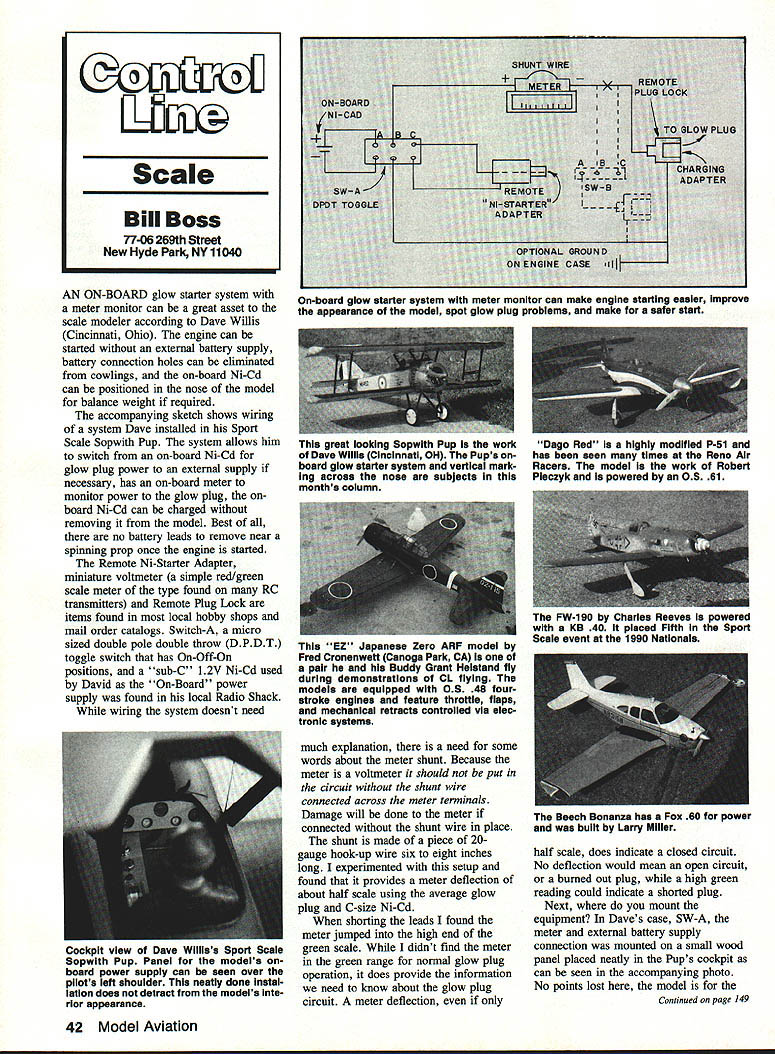
An on-board glow starter system with a meter monitor can be a great asset to the scale modeler. Advantages include:
- The engine can be started using the on-board battery (no external battery required).
- Battery connection holes in cowlings can be eliminated.
- The on-board Ni-Cd can be positioned in the nose to help with model balance.
- There are no battery leads to remove near a spinning prop once the engine is started.
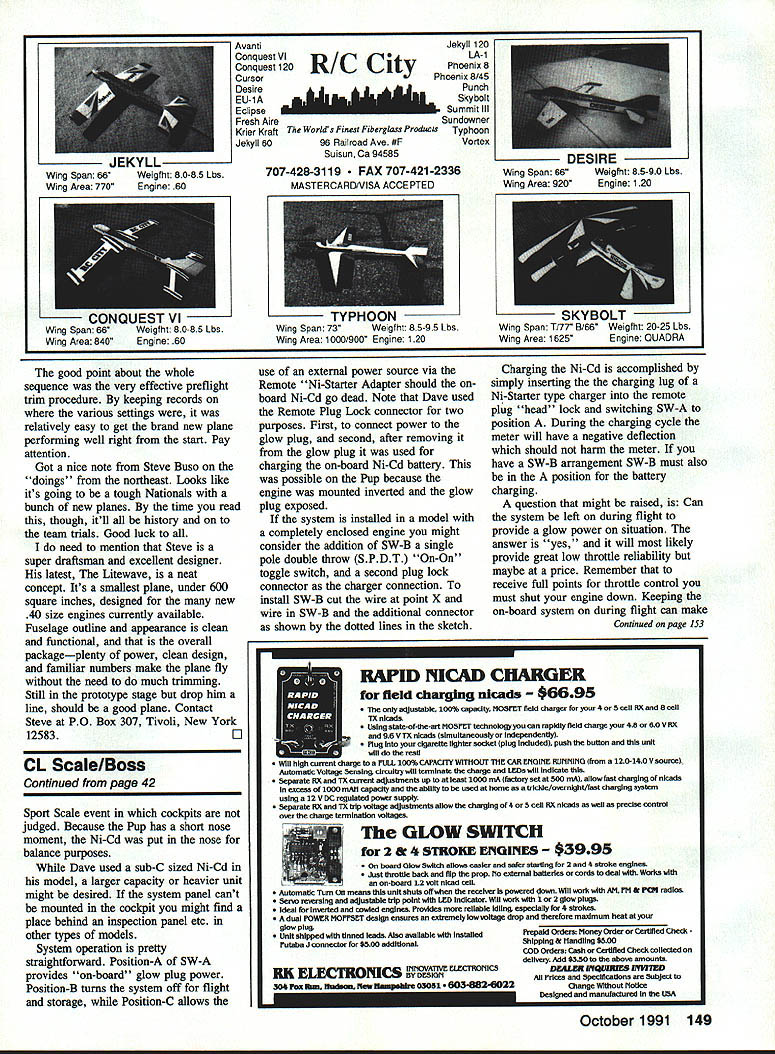
Dave Willis (Cincinnati, Ohio) installed such a system in his Sport Scale Sopwith Pup. The setup allows switching between an on-board Ni-Cd and an external supply, provides an on-board meter to monitor glow-plug power, and permits charging the on-board Ni-Cd without removing it from the model.
Components and parts
Common parts for this system (available from hobby shops or catalogs):
- Remote Ni-Starter Adapter
- Remote Plug Lock connector
- Miniature voltmeter (simple red/green scale type, like those in many RC transmitters)
- SW-A: micro-sized DPDT toggle switch (On–Off–On)
- SW-B (optional): SPDT toggle switch (On–On)
- Sub-C 1.2V Ni-Cd (on-board battery; larger capacity units may be used)
- 20-gauge hookup wire (for meter shunt)
SW-A and the small voltmeter, plus the external battery connection, can be mounted on a small wood panel in the cockpit or behind an inspection panel, depending on the model.
Meter shunt and meter use
Because the meter is a voltmeter, you must connect a shunt wire across the meter terminals before putting it into the glow-plug circuit. If the shunt is not in place the meter may be damaged.
- Shunt: a piece of 20-gauge hookup wire about 6–8 inches long.
- With this shunt, typical glow-plug circuits will produce a meter deflection of about half scale (using an average glow plug and a C-size or similar Ni-Cd).
- Shorting the leads (full short) will move the meter into the high end of the green scale.
Interpreting the meter:
- No deflection = open circuit (possible burned-out plug).
- Deflection (even half scale) = closed circuit, glow-plug circuit is functioning.
- High green reading = possible shorted plug.
Wiring, mounting and operation
- SW-A positions:
- Position A: on-board battery supplies glow-plug power.
- Position B: system off (for flight and storage).
- Position C: external power via Remote Ni-Starter Adapter (useful if on-board Ni-Cd is dead).
- Dave used the Remote Plug Lock connector to:
- Connect power to the glow plug during starting.
- Provide the charging connection for the on-board Ni-Cd after removing the plug-lock from the glow plug (possible on his Pup because the engine was mounted inverted and the plug was exposed).
- If the engine is completely enclosed, add SW-B (SPDT On–On) and a second plug-lock connector for charging. To install SW-B, cut the wire at point X (per sketch) and wire in SW-B and the additional connector.
Charging the on-board Ni-Cd
- Insert the charging jug of a Ni-Starter type charger into the remote plug-lock connector and switch SW-A to position A.
- During charging the meter will show a negative deflection; this should not harm the meter.
- If SW-B is used, it must be in the correct position to allow charging.
Flight considerations
- The system can be left on during flight to provide continued glow-plug power and improved low-throttle reliability.
- However, keeping the on-board system on during flight can make shutting the engine down difficult unless a full cutoff device is used. Remember: for full points in throttle-control events you must be able to shut the engine down.
Micro-Mark catalog (tool note)
Micro-Mark, "The Small Tool Specialists," offers a wide assortment of small power tools for modelers. Their Micro-Mark power tools include small power planes, belt sanders, jigsaws/scroll saws, orbital sanders, and other shop tools. All are 12-volt DC with variable-speed control.
Send $1.00 to Micro-Mark, 430 Snyder Ave., Berkeley Heights, NJ 07922-1595 for their latest catalog.
Picture caution (photo handling tips)
Photos sent for column use are sometimes damaged inadvertently by the sender. Common causes:
- Writing or stamping on the back of photos before ink dries, which can transfer to the front.
- Ball-point pen pressure that can slightly break the photo emulsion.
To avoid damage:
- Use small stick-on address labels placed in one corner on the back of the photo. Pencil the photo number on that label if needed.
- Write or type photo data on a separate sheet with corresponding numbers.
A little care will preserve your photos and make them usable.
Contest Activity
Broken Arrow Stunt Contest — Lafayette Esquadrille
The Lafayette Esquadrille (St. Louis, MO area) is sponsoring its 4th Annual Broken Arrow Stunt Contest on October 6, 1991. This AMA-sanctioned contest will take place at Buder Park in Valley Park, Missouri (just west of St. Louis, north side of I‑44).
- Main events: PAMPA and Old Tyme Stunt.
- Sport Scale: profile and full-bodied models welcome.
- Awards: framed certificates to 3rd place in each event; special Red Max trophy for 1st place in Sport Scale.
For full contest details contact: Bob Arata 561 Goldwood Ballwin, Missouri 63021 Telephone: 314/391-0272
Column contest notices
There has been very little contest advertising or reporting recently. A mention in this column can help promote CL Scale events and encourage entries. Keep in mind the publication lead time is at least three months (this October column was submitted in late June). Please send contest notices, reports, and photos.
Please send ideas, notices of upcoming CL Scale events, contest reports, and photos of CL Scale activity to the address at the top of this column.
Transcribed from original scans by AI. Minor OCR errors may remain.

