
Control Line: Scale
Bill Boss 77-06 269th Street New Hyde Park, NY 11040
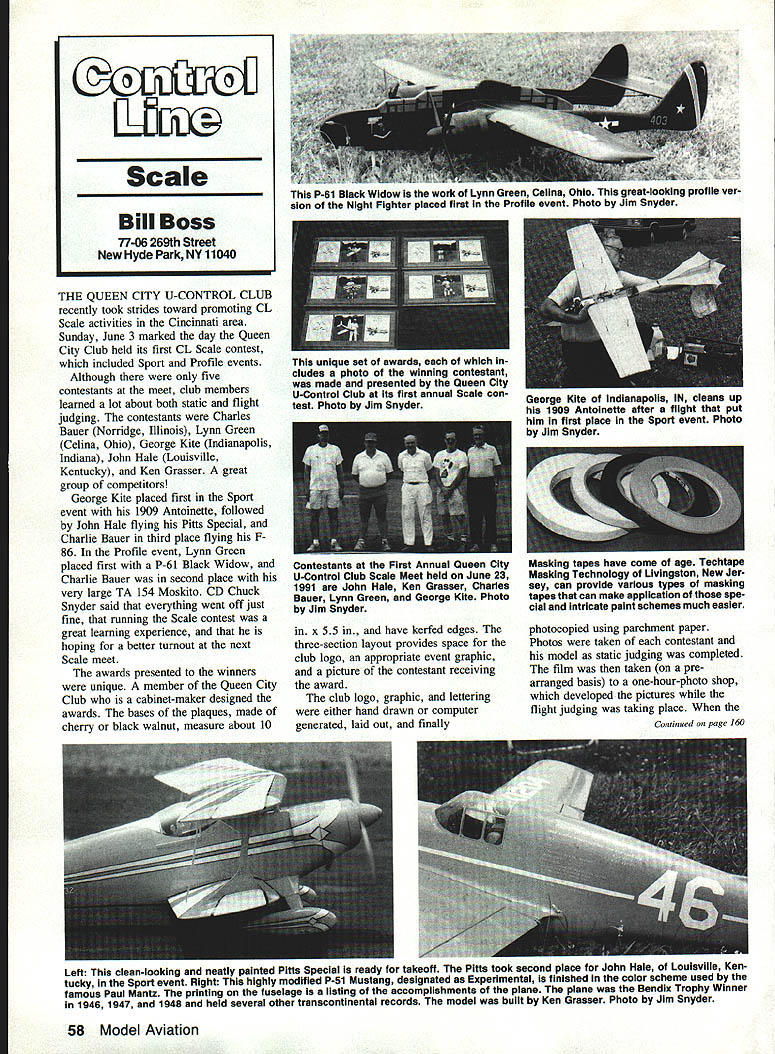
Queen City U-Control Club CL Scale Contest
The Queen City U-Control Club recently took strides toward promoting CL Scale activities in the Cincinnati area. Sunday, June 3 marked the day the Queen City Club held its first CL Scale contest, which included Sport and Profile events.
Although there were only five contestants at the meet, club members learned a lot about both static and flight judging. The contestants were:
- Charles Bauer (Norridge, Illinois)
- Lynn Green (Celina, Ohio)
- George Kite (Indianapolis, Indiana)
- John Hale (Louisville, Kentucky)
- Ken Grasser
Results:
- Sport: 1st — George Kite (1909 Antoinette); 2nd — John Hale (Pitts Special); 3rd — Charlie Bauer (F-86).
- Profile: 1st — Lynn Green (P-61 Black Widow); 2nd — Charlie Bauer (TA 154 Moskito).
Contest Director Chuck Snyder said that everything went off just fine, that running the Scale contest was a great learning experience, and that he is hoping for a better turnout at the next Scale meet.
Awards: A club member who is a cabinet-maker designed the awards. The bases of the plaques, made of cherry or black walnut, measure about 10 x 5.5 in. and have kerfed edges. The three-section layout provides space for the club logo, an appropriate event graphic, and a picture of the contestant receiving the award.
The club logo, graphic, and lettering were either hand-drawn or computer-generated, laid out, and photocopied onto parchment paper. Photos were taken of each contestant and his model as static judging was completed. The film was then taken (on a prearranged basis) to a one-hour photo shop, which developed the pictures while the flight judging was taking place. When the contest results were available, the appropriate photo was inserted in each plaque, and a 3/8-in piece of Plexiglas was secured to the top of the plaque with brass wood screws. In addition to giving the winners an unusual and personal award, the use of these plaques has saved the club over $400 so far in 1991.
Congratulations to the members of the Queen City U-Control Club for successfully running a CL Scale contest in their area and for sharing the award idea.
Techtape Masking Technology
Techtape Masking Technology, of Livingston, New Jersey, offers a special line of masking tapes for modelers. One or more of these tapes might be just what you need for lettering or insignia work on your next model.
Types of tape:
- Thin polyvinyl film with a rubber-based adhesive: extreme thinness produces sharp, clean paint separation lines with minimal paint edge build-up.
- Vinyl with an acrylic, low-tack adhesive: designed for situations demanding high conformability.
- Fine-line poly-backed tape with a specially extruded matte finish: designed for extremely fine line separation.
- Crepe fine-line tape: upgraded to a low-tack version.
All of these tapes are low-tack and solvent-resistant, and have been used successfully with nitro, butyrate, polyurethane, enamel, and epoxy paints. The author tested the tapes with Aerogloss and found them effective.
Available sizes:
- Polyvinyl thin-film: 72-yard rolls; widths 1/4 in and 3/8 in.
- Vinyl tape: 36-yard rolls; widths 3/16 in and 1/4 in.
Electronic Controls for CL Scale
The subject of electronic controls for CL Scale models has been explored several times in recent months. Many readers expressed interest in learning more or using electronic controls in their next model.
Dale Campbell, a well-known CL Scale modeler, has recorded a videotape in which he discusses converting an RC system to CL. The tape also shows how to make insulated lines and line connectors. Dale notes that the tape is not of high professional quality but covers the basic points of system conversion and line/connector make-up.
To obtain a copy, write or call:
- Dale Campbell, P.O. Box 1035, Newton, NC 28658
- Phone: 704/465-2227
Beachcomber Bookshop
Beachcomber Bookshop specializes in aviation history books and may be a good place to find odd or hard-to-find titles on World War I, World War II, or specific vintage aircraft. Their catalogs list used books and magazines, with descriptions of contents, condition, and price.
Catalogs:
- Catalog 2000: Exploits of the British Royal Air Force and the Battle of Britain; also lists U.S. Air Force and general aviation books and vintage aviation magazines.
- Catalog 5000: Listings of individual military aircraft from all nations; some civilian aircraft and old, bound aviation magazines (Air Progress, Air Combat, Air Power, Air Force).
- Aviation Unit Histories: Military aircraft unit histories from many countries (World War I and II periods), plus some civilian airline and air-racing listings.
Contact:
- Beachcomber Bookshop, P.O. Box 197, Cortaro, AZ 85652
- Phone: 602/744-0487
Nationals: Performance Notes
The slight acceleration advantage discussed was gained through a 20% lighter model and a larger propeller diameter. John's Top Flite prop was largest in both pitch (8.25 in) and diameter (11 in). John also used a unique pressure fuel system, which will be described in a later column.
In Profile Carrier, almost half of the models were MO-1s, although individual design characteristics varied. Most models exceeded the minimum required wing area of 300 square inches, but none exceeded 448 inches in span, even though larger models are easier to fly in Profile.
Carlos Aloise's excellent low-speed flight was described in the Nationals coverage. His model had the lightest wing loading (1.04 pounds per square foot) of any model to achieve more than 200 seconds in low speed.
Engine observations:
- K&B 5.8: used by 37% of the Open entries; very consistent with top speeds mostly between 81 and 85 mph.
- The four highest speeds (all over 90 mph) included:
- Two O.S. FSR .40 conversions (a Tune-Hill and one by Glenn Dye)
- Carlos Aloise's Super Tigre X .36
- Mark Warshawana's Super Tigre .36
Fastest time: 93.5 mph (19.24 seconds) by Dick Perry's MO-1 with Tune-Hill power, O.S. .48X carb, Fox R/C plug, and an APC 9.5-7.5 competition prop.
What does it take to win the Nationals? Does high speed or low speed dominate performance? There doesn't seem to be any clear pattern this year. In Profile Carrier, an event where low speed usually determines the winners, there was no single dominant factor. Of the top seven places, all were over 82 mph (high) and over 210 seconds (low). It required very good performance in both high and low speed to place in the top half. Both high-speed and low-speed performance were closely correlated with placing in the top half.
If you look at only high speed or low speed performance, the relative ranking of five of the top...
Transcribed from original scans by AI. Minor OCR errors may remain.

