
Control Line: Scale
Bill Boss 77-06 269th Street New Hyde Park, NY 11040
Contest Report
Once again the Garden State Circle Burners (GSCB) held a successful fall scale meet. The annual event took place September 22, 1991, in the Bendix Corporation parking lot opposite Teterboro Airport. The weather cooperated, providing a reasonably mild day with light winds. Contest Director George Gaydos, who has for years promoted CL scale and related activities in the eastern United States, ran the event.
This year's meet attracted 22 entries: six Precision Scale, eight Profile Scale (GSCB rules), and eight Sport Scale (six Open and two Juniors).
Precision Scale
- First: Ed Rhoads — Douglas Skyraider — 561 points.
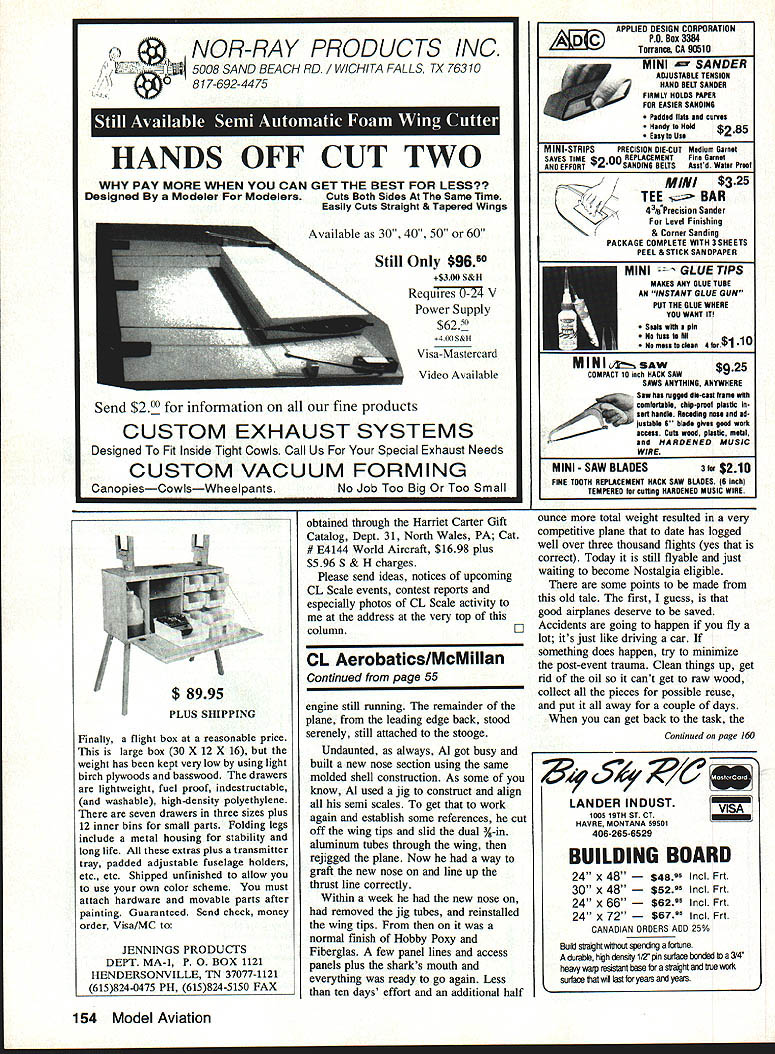
- Second: Bill Reynolds — American Airlines DC-3 — 540 points.
Both models are former National winners.
Sport Scale
- Highly contested: only 15 points separated the top four.
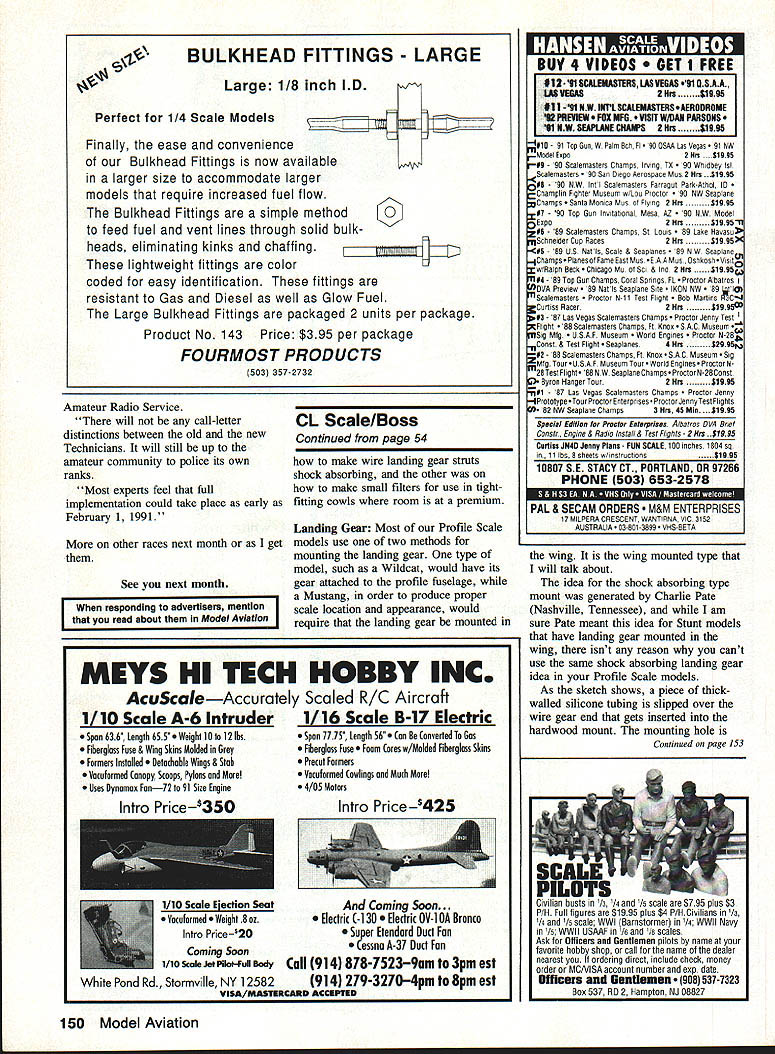
- First: Tom Hampshire (Belvidere, NJ) — WACO SRE (modified Sterling R/C kit) — 170 points. Tom is new to scale competition; documentation and coloring data were obtained from Bob Banks' Scale Model Research.
- Second: Jerome Blaszczyk — P-68 Victor — 166 points.
- Third: Joe Sroczynski — P-51 — 161 points.
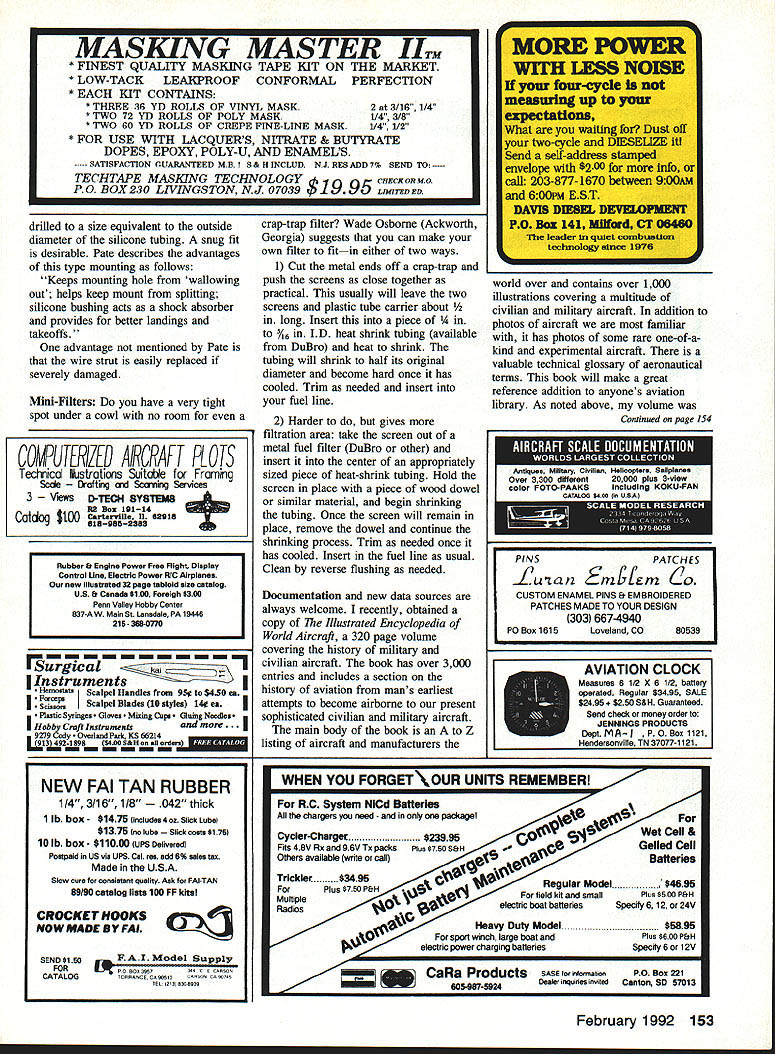
- Fourth: Ed Rhoads — Ju 87 Stuka — 155 points (landing gear problems limited performance).
Profile Scale (GSCB rules)
- First: George Gaydos — A-26 — 209 points.
- Second: Pete Hermans — P-39 — 206 points.
Junior Class
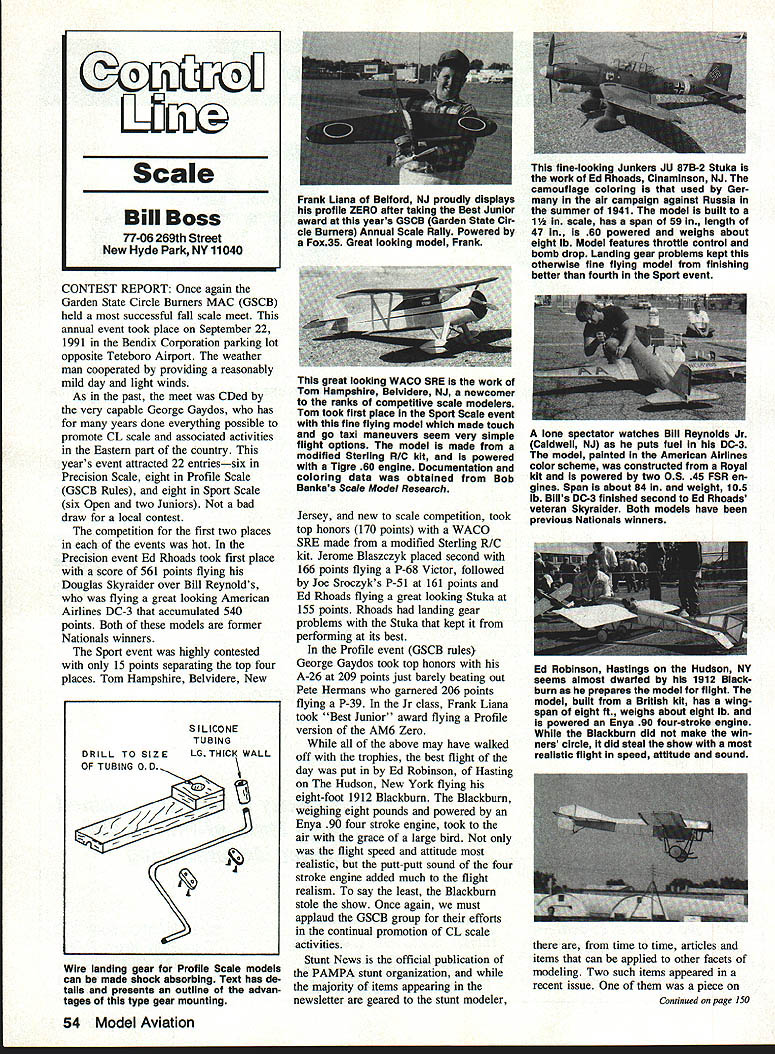
- Best Junior: Frank Liana — profile version of the A6M Zero.
Best Flight of the Day
- Ed Robinson (Hastings-on-Hudson, NY) flew an eight-foot 1912 Blackburn, weighing about eight pounds and powered by an Enya .90 four-stroke. The aircraft flew with the grace of a large bird; the speed, attitude, and putt-putt sound of the four-stroke added exceptional realism. The Blackburn stole the show.
Once again, we applaud the GSCB group for their continued promotion of CL scale activities.
Stunt News and Techniques
Stunt News is the official publication of PAMPA (the stunt organization). While most items are geared to stunt modelers, some articles apply to other facets of modeling. Two practical items appeared recently: how to make wire landing gear struts shock absorbing, and how to make small fuel filters for tight-fitting cowlings.
Landing Gear
Most profile-scale models use one of two landing-gear mounting methods. Some models (e.g., Wildcat) have gear attached to a profile fuselage; others (e.g., Mustang) require the gear to be mounted in the wing for proper scale location and appearance. The wing-mounted type is the focus here.
The shock-absorbing mount idea was suggested by Charlie Pate (Nashville, TN). A thick-walled silicone tubing sleeve is slipped over the wire gear and the assembly is inserted into a hardwood mount. Drill the mounting hole to match the outside diameter of the silicone tubing for a snug fit.
Advantages (per Pate):
- Keeps the mounting hole from "wallowing out."
- Helps keep the mount from splitting.
- Silicone bushing acts as a shock absorber, improving landings and takeoffs.
Additional advantage:
- The wire strut is easily replaced if severely damaged.
Mini-Filters
If you have a very tight spot under a cowl with no room for a standard crap-trap filter, Wade Osborne (Ackworth, GA) suggests two DIY mini-filter methods:
- Cut the metal ends off a crap-trap and push the screens as close together as practical. This usually leaves two screens and the plastic tube carrier about 1/2 in. long. Insert this into a piece of 1/4 in. to 1/8 in. I.D. heat-shrink tubing (available from DuBro) and heat to shrink. The tubing will shrink to about half its original diameter and harden as it cools. Trim as needed and insert into the fuel line.
- For more filtration area (harder to do): remove the screen from a metal fuel filter (DuBro or similar) and insert it into the center of an appropriately sized piece of heat-shrink tubing. Hold the screen in place with a wood dowel or similar mandrel and begin shrinking the tubing. Once the screen stays in place, remove the dowel and finish shrinking. Trim after cooling and insert into the fuel line. Clean by reverse flushing as needed.
Documentation / Reference
A useful new source: The Illustrated Encyclopedia of World Aircraft — a 320-page volume covering the history of military and civilian aircraft. It contains over 3,000 entries, an A–Z listing of aircraft and manufacturers, more than 1,000 illustrations, and a technical glossary of aeronautical terms. The book includes photos of common aircraft as well as rare and experimental types and makes a valuable addition to any aviation library.
Ordering information (as noted): Harriet Carter Gift Catalog, Dept. 31, North Wales, PA; Cat. # E4144 World Aircraft, $16.98 plus $5.96 S&H.
Contact
Please send ideas, notices of upcoming CL scale events, contest reports, and especially photos of CL scale activity to:
Transcribed from original scans by AI. Minor OCR errors may remain.

