
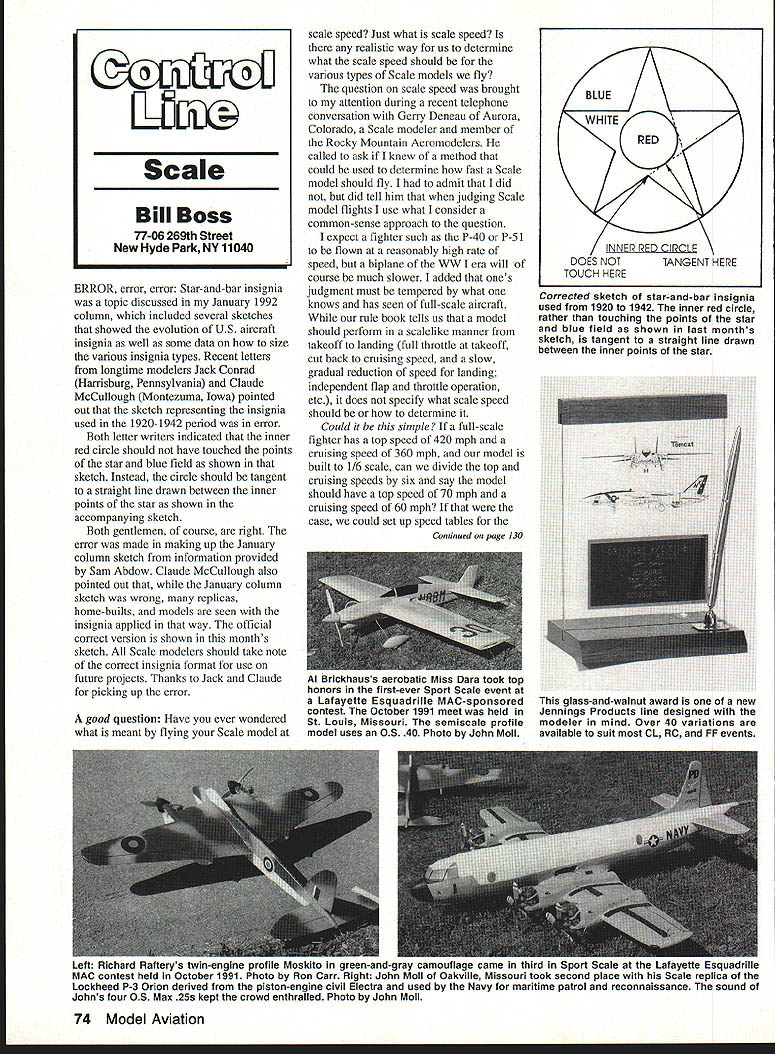
Control Line: Scale
Bill Boss
77-06 269th Street New Hyde Park, NY 11040
Correction: Insignia error
ERROR, error, error. The star-and-bar insignia was a topic discussed in my January 1992 column, which included several sketches showing the evolution of U.S. aircraft insignia and data on sizing the various insignia types. Recent letters from longtime modelers Jack Conrad (Harrisburg, Pennsylvania) and Claude McCullough (Montezuma, Iowa) pointed out that the sketch representing the insignia used in the 1920–1942 period was in error.
Both correspondents indicated that the inner red circle should not touch the points of the star and blue field as shown in that sketch. Instead, the circle should be tangent to a straight line drawn between the inner points of the star, as shown in the accompanying sketch.
Both gentlemen, of course, are right. The error occurred when preparing the January column sketch from information provided by Sam Abdow. Claude McCullough also pointed out that, while the January sketch was wrong, many replicas, home-builts, and models are seen with the insignia applied that way. The official correct version is shown in this month's sketch. All scale modelers should take note of the correct insignia format for future projects. Thanks to Jack and Claude for picking up the error.
Scale speed — what is it?
A good question: have you ever wondered what is meant by flying your scale model at scale speed? Just what is scale speed? Is there any realistic way to determine what scale speed should be for the various types of scale models we fly?
The question came up during a recent telephone conversation with Gerry Deneau of Aurora, Colorado, a scale modeler and member of the Rocky Mountain Aeromodelers. He asked if I knew of a method to determine how fast a scale model should fly. I had to admit I did not, but I told him that when judging scale model flights I use a commonsense approach.
I expect a fighter such as the P-40 or P-51 to be flown at a reasonably high rate of speed, while a World War I biplane will, of course, be much slower. One's judgment must be tempered by what one knows and has seen of full-scale aircraft. Our rule book tells us a model should perform in a scale-like manner from takeoff to landing (full throttle at takeoff, cut back to cruising speed, then a slow, gradual reduction of speed for landing; independent flap and throttle operation, etc.), but it does not specify what scale speed should be or how to determine it.
Could it be this simple? If a full-scale fighter has a top speed of 420 mph and a cruising speed of 360 mph, and our model is built 1/6 scale, can we divide the top and cruising speeds by six and say the model should have a top speed of 70 mph and a cruising speed of 60 mph? If so, we could set up speed tables for common scale sizes and use a stopwatch to time laps and grade speed performance. The new low requirement for the model builder would then be to provide flight statistics for the plane modeled.
Now that the stage is set, I would be glad to hear from anyone who has ideas on the subject. Perhaps we can develop something that will take the guesswork out of CL flight judging and settle a question long discussed.
Contest activity
#### Lafayette Esquadrille MAC — Broken Arrow Stunt contest In my October 1991 column I reported that the Lafayette Esquadrille MAC of Saint Louis, Missouri, a predominantly stunt organization, planned to include the Sport Scale event for the first time at its Broken Arrow Stunt contest.
Bob Areta of Ballwin, Missouri, CDed the contest, held on October 6, 1991, at Bader Park in Saint Louis. Although the Sport Scale event drew only a few contestants, Bob considers it a very successful beginning.
Results:
- 1st: Al Brickhaus, flying a semiscale profile aerobatic model called Miss Dara — took first by virtue of good documentation and an excellent flight performance, especially in choosing maneuvers the full-scale aircraft could perform.
- 2nd: John Moll — pleased the crowd with his P-3 Orion equipped with four O.S. Max .25s. There’s nothing more crowd-pleasing than the roar of four well-tuned engines buzzing around the circle.
- 3rd: Richard Raftery — flying a twin-engine profile Moskito in green-and-gray camouflage.
Bob indicated he has great hopes for future growth of the Sport Scale event at this yearly meet. Those in the Saint Louis area should take note of this new CL Scale activity by the Lafayette Esquadrille MAC. Watch the AMA Contest Calendar for the 1992-season contest.
#### Circle Masters Flying Club — Brookfield, Wisconsin The Circle Masters Flying Club of Brookfield, Wisconsin, notes that July 26, 1992, will be the date for its annual CL meet. In addition to the usual stunt events there will be competition in Sport and Profile Scale.
The meet will be held at the Dretzkan Park flying site and chalet located at Highway 145 and Bradley Road, Brookfield, Wisconsin. For full contest details write to: Arthur Weber 17560 Windemere Rd. Brookfield, WI 53045
It appears that interest in CL scale activity, always slow but sure, is picking up in many areas. Clubs such as the Lafayette Esquadrille and Circle Masters have added scale events to what previously were stunt-only meets, giving the scale modeling community a boost. We can only hope the trend continues. Who knows — someday we may again see local meets with 25 to 30 scale entries. All CL scale modelers in these areas are urged to support these two clubs in their upcoming meets.
Jennings Products — new trophies and items
Jennings Products of Hendersonville, Tennessee, has introduced new items that might fit special awards at local contests or dress up your workshop. Keeping in tune with scale, Jennings’ latest offerings include an aviation clock, a set of coasters, and new trophy designs.
- Clock: 6½ in. square, battery operated, replica of an altimeter — suitable for an aviation buff’s den or workshop.
- Coasters: set of four scale replicas — altimeter, gyro horizon indicator, airspeed indicator, and directional gyro.
- New trophy series: 1/4-inch glass panel set in an American walnut base and cap. The glass panel is silk-screened in black with a variety of designs depicting common modeling events. Your club logo can be used if desired. A black brass engraving plate with event, date, place, etc., is applied to the base.
In addition, Jennings offers a molded aircraft carrier/storage rack and sweatshirts that may be of interest. For full details and a free brochure write or call: Jennings Products P.O. Box 1121 Hendersonville, TN 37077-1121 Telephone: 615-824-0475
Closing
Please send ideas, notices of upcoming CL scale events, contest reports, and especially photos of CL scale activity to me at the address at the very top of this column.
Transcribed from original scans by AI. Minor OCR errors may remain.

