
Control Line: Scale
Bill Boss 77-06 269th Street New Hyde Park, NY 11040
JUST ADDED to the AMA Competition Regulations for 1992–93, the Control Line Profile Scale event is receiving a considerable amount of attention from clubs around the country. A topic of discussion in many club newsletters, it is being added as an extra event to many contests. While CL Profile Scale is being talked about as a fun event, there is also talk about what could be considered its serious side—the fearsome subject of documentation.
Documentation
In his "Hints From The Workshop" article in a recent issue of the Orbiting Eagles of Greater Omaha newsletter, Bob Furr commented on the Profile Scale event. Bob reminds us that, while the event is meant to be a lot easier for the average modeler in terms of the type of model and level of skill required for construction, the modeler must still pay attention to documentation for the airplane he builds. Not only will putting together proper documentation make building the model easier, but it can also improve the static judging score.
Bob points out that, at an absolute minimum, documentation must include a good three-view drawing and color scheme data. He suggests that this information can often be found at your local library or hobby shop. The three-view is usually the easiest to find. After obtaining the three-view, try to locate some color or black-and-white photos. If color prints are not available, a good written description of the color scheme will do.
Bob notes that gathering all documentation before building the model may seem like a lot of work, but it is easier to determine the exact model and color scheme before you begin to build than to modify a model that is almost complete. This philosophy—knowing what you're going to do before you do it—also applies to building any model.
If you cannot find the required documentation at your local library or hobby shop, a number of good services can provide three-views, color scheme data, or both. These sources include:
- Bob Banka's Scale Model Research
- Repla-Tech International
- Scale Plans and Photo Service
- Bob Holman Plans
Advertisements (with addresses) for these services can generally be found in Model Aviation and other model magazines. Also, see the Paul Matt three-view publications information below for an excellent additional source.
Bob indicates that he likes the Profile event because it allows for the possibility of building something that is both stuntable and scalelike. Any of the recent full-size aerobatic aircraft would make good subjects. These models fly well and have minimal detail for finishing purposes—unless you love to spend weeks detailing a model.
One of Bob's last thoughts on following your documentation: if you choose to copy an aluminum-skinned aircraft, your model should simulate the original surface. To accomplish this, you can use either a balsa-covered foam wing or a balsa-sheeted built-up wing structure. A fabric-covered wing with dips between the ribs would be distracting. The object is to follow the documentation as closely as possible, giving yourself every possible advantage in the static judging.
Profile construction tips
While Bob Furr spoke of documentation and the need to follow it closely, Tom Hampshire of the Garden State Circle Burners passes on a couple of building tips to improve the looks and strength of your profile Scale model.
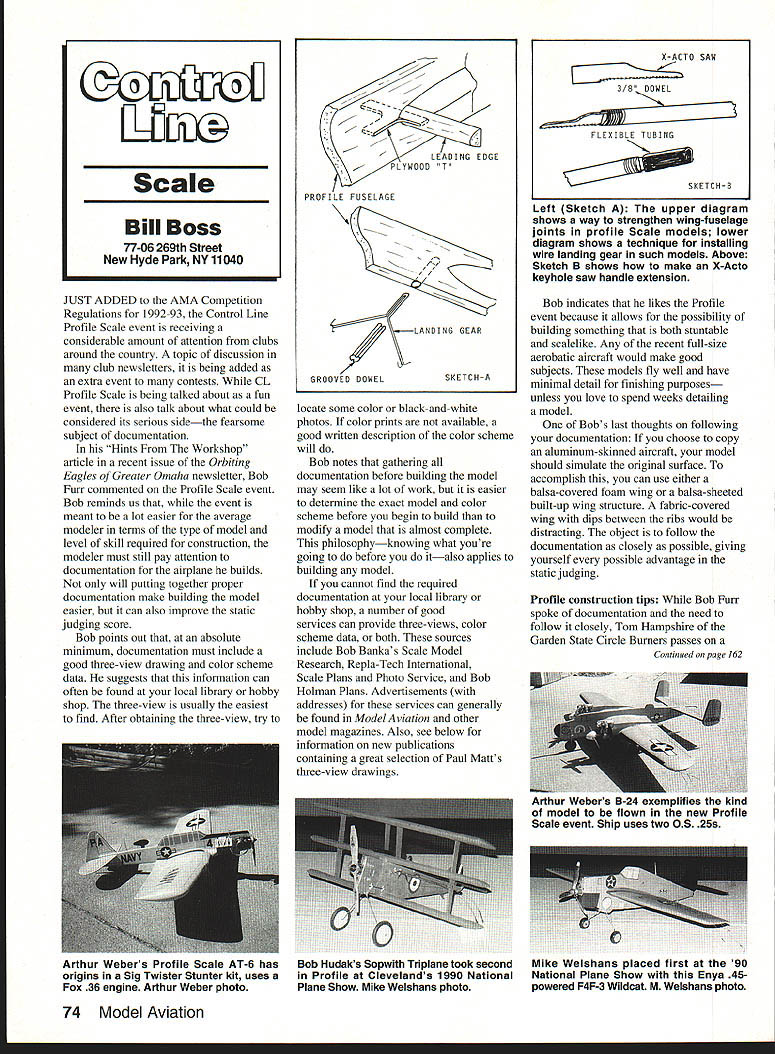
When building the wing of a profile model we usually make the leading edge in two sections, with the center joint located in the fuselage. Quite often this proves to be a weak spot in the model.
#### Strengthening the wing‑fuselage joint (Sketch A)
The upper drawing in Sketch A shows the way to strengthen the wing-fuselage joint. Make a plywood T-profile that is glued to the leading edge and butts into the fuselage. Also locate a grooved dowel in the fuselage to accept the wing dowel. With the T-profile and the grooved dowel installed, the joint has positive location and much greater shear strength.
#### Landing gear installation (Sketch B)
Sketch B shows a technique for installing a wire landing gear in such models. Cut a dowel lengthwise and groove it to accept the gear wire. Slip-tube the wire with tubing and glue the tube into the grooved dowel. Then glue the dowel assembly into the wing so the gear is supported by wood instead of by glue alone.
A word of caution: while this method of gear mounting might be adequate for aircraft with landing gear extending from the fuselage, it wouldn't look right on aircraft with gear mounted in the wing. As Bob Furr reminds us, follow what your documentation shows.
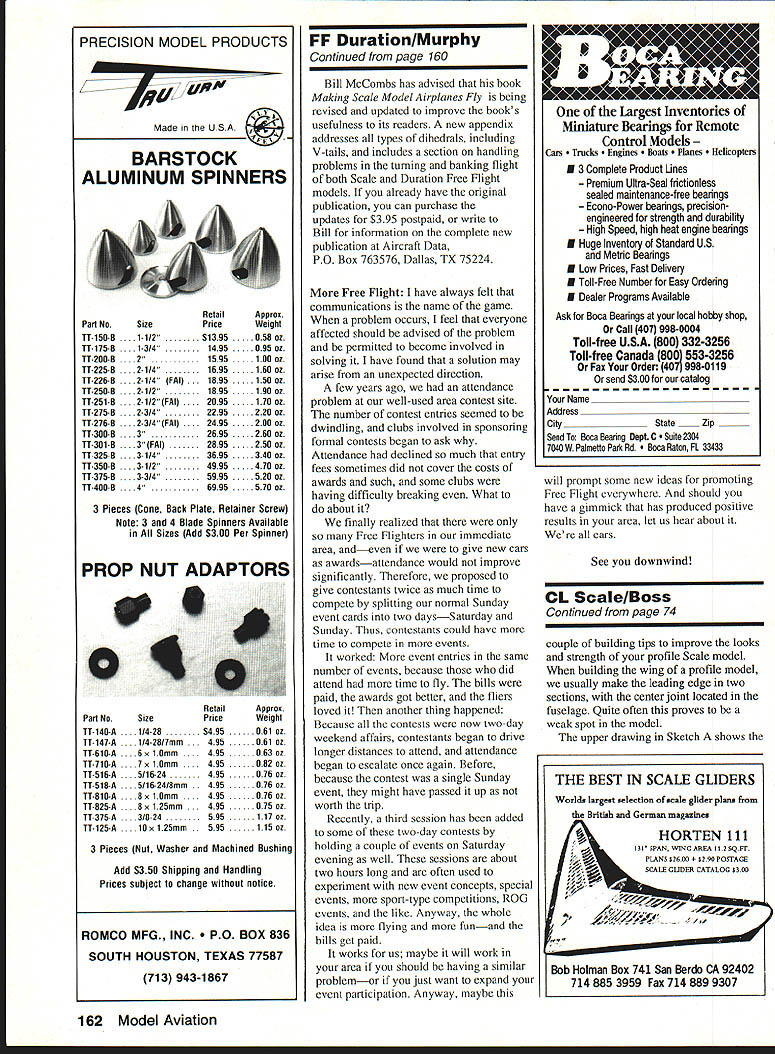
Above Sketch B is a note showing how to make an X-Acto keyhole saw handle extension to aid in cutting and shaping these small parts.
Paul Matt three-view books
Aviation Heritage Books by SunShine House has just made available a two-volume set of Paul Matt's Scale Airplane Drawings. The volumes contain over 325 pages of three-view drawings for 124 types of airplanes. Each highly detailed drawing is an accurate working print with all dimensions, specifications, airfoils, cross sections, templates, and color schemes included. The two books provide an excellent source of three-view drawings in the 8½ x 11‑in. format that is just right for our Scale model documentation needs.
The drawings are part of the collection of the internationally acclaimed Historical Album by Paul Matt. In addition to drawings, each book contains several detailed photos. The two-volume set includes drawings from Golden Age, World War I, World War II, classic, and modern eras — including some of the most popular and obscure airplanes ever produced. The softbound volumes sell for $24.95 each plus shipping charges of $3.50. The books may be ordered from:
SunShine House, Inc. P.O. Box 2055 Terre Haute, IN 47802 Or call: 1-800-899-0141
Workshop hint — saw extension
Sketch B shows a quick and easy way to make an X-Acto keyhole saw extension handle. Take a suitable length of 3/8‑in. birch dowel, and slot one end to a depth of about one-half inch. If you use the No. 15 saw blade for cutting the slot, you will have a snug fit. Insert the blade into the slot, wrap it with thread, and glue well. A light coating of five-minute epoxy will do fine.
This simple tool is ideal for reaching into a fuselage (or other hard-to-reach parts of a model under construction) to cut away unwanted balsa. A piece of flexible tubing slipped over the saw makes an excellent safety sheath. This item was found in Wing Tips, newsletter of the Mid-Hudson Modelmasters, and is the work of Jim Kamin, club VP and super cartoonist.
Please send ideas, notice of upcoming CL Scale events, contest reports, and especially photos of CL Scale activity to me at the address shown at the top of this column.
Transcribed from original scans by AI. Minor OCR errors may remain.

