
Control Line: Scale
Bill Boss 77-06 269th St. New Hyde Park, NY 11040
Single-function electronic throttle control
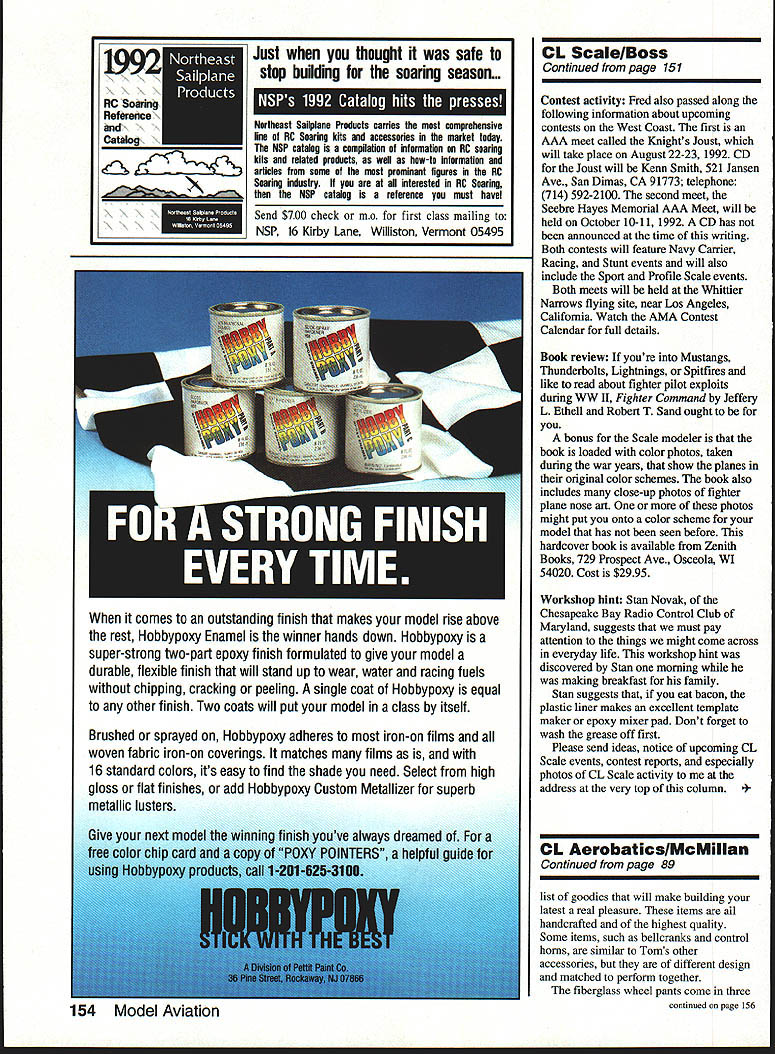
Electronic controls for our CL Scale models is a subject I’ve explored in past columns. This month I’ll discuss a single-function electronic control used by Fred Cronnenwett and several other Scale modelers on the West Coast. Fred says the system is great for Scale or carrier fliers who want to eliminate the three-line bellcrank and use only throttle operation in their model.
Fred notes these advantages of the system:
- A two-line handle and bellcrank (metal or nylon) can be used.
- Throttle control is smoother and more precise.
- The throttle can be controlled even with slack lines.
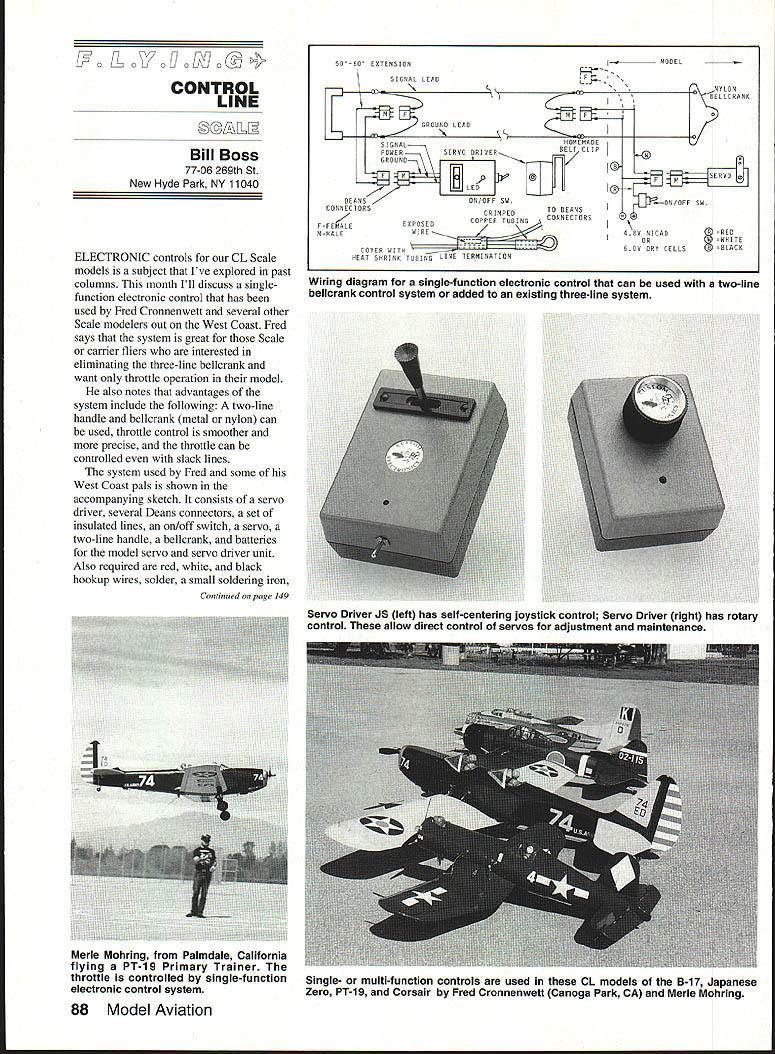
The system used by Fred and his West Coast pals consists of:
- A servo driver (the heart of the system)
- Several 3-pin Deans male and female connectors
- A set of insulated flying lines (nylon-coated stainless steel)
- An on/off switch
- A servo for the model
- A two-line handle and a bellcrank (nylon or metal)
- Batteries for the model servo and the servo driver unit
- Red, white, and black hookup wires (20‑gauge stranded)
- Solder, a small soldering iron, and heat-shrink tubing
While the initial cost of the full system is about $75, the servo driver (which represents almost half the system cost) can be used with many models.
The Servo Driver
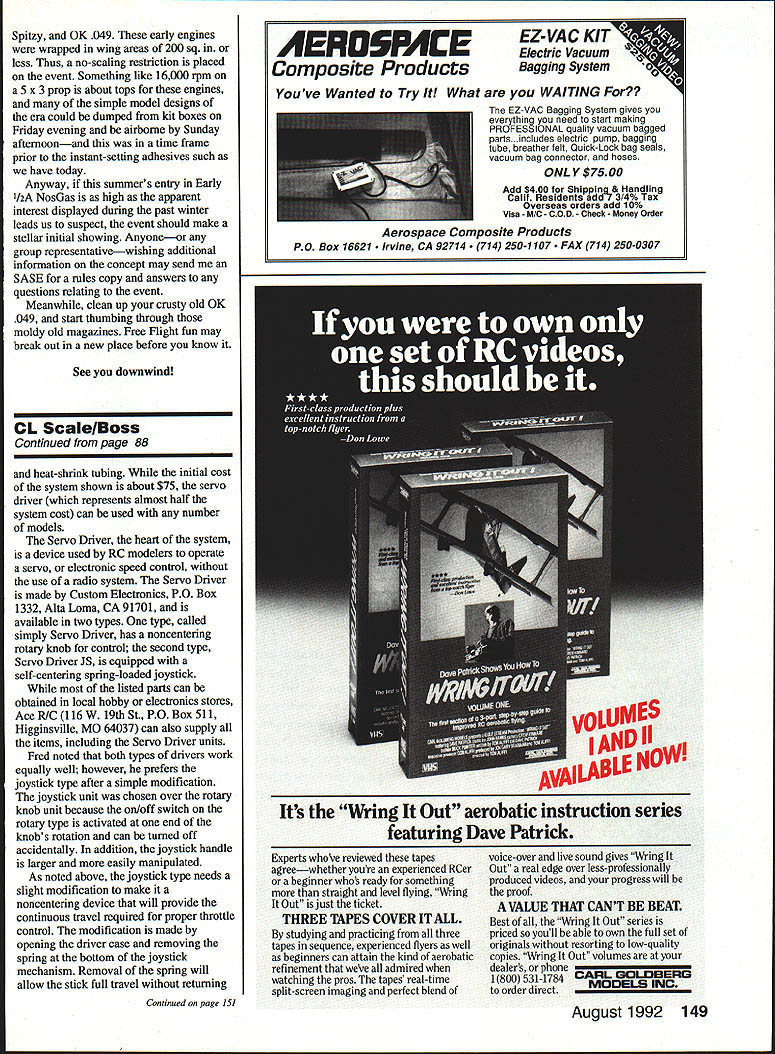
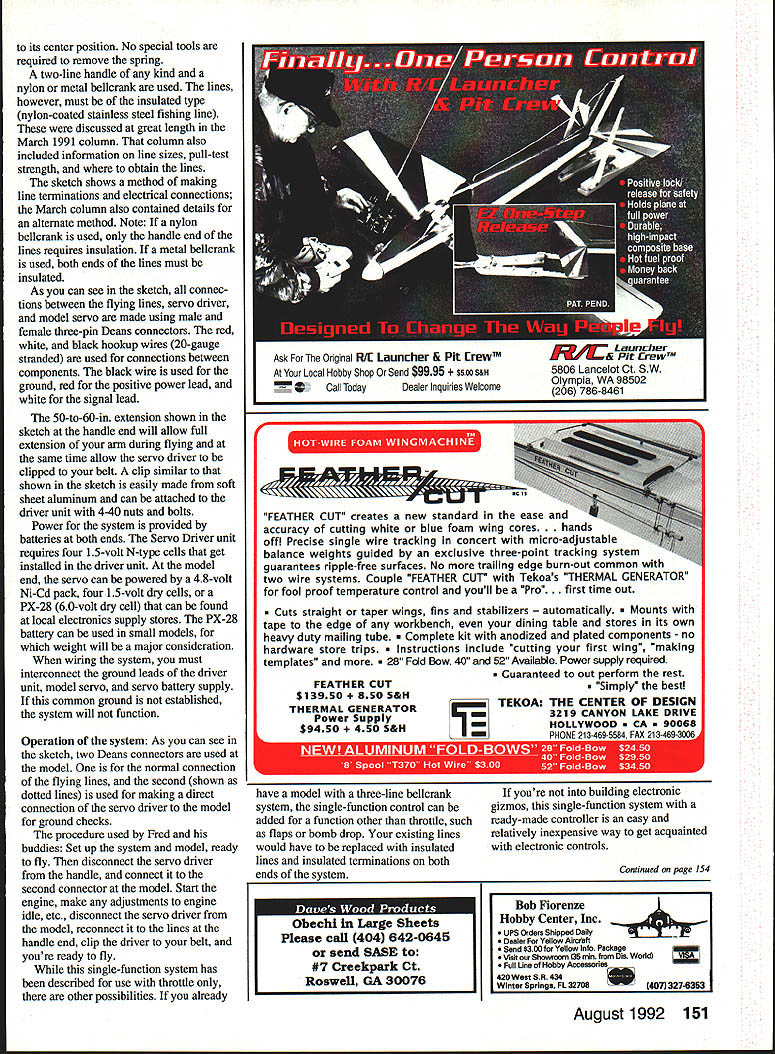
- The Servo Driver operates a servo (or electronic speed control) without a radio system. It is made by Custom Electronics, P.O. Box 1332, Alta Loma, CA 91701.
- Two types are available: the Servo Driver (non-centering rotary knob) and the Servo Driver JS (self-centering spring‑loaded joystick).
- Ace R/C (116 W. 19th St., P.O. Box 511, Higginsville, MO 64037) can also supply all the items, including the Servo Driver units.
Fred noted both types work equally well; he prefers the joystick type after a simple modification. He chose the joystick over the rotary knob because the rotary’s on/off switch can be accidentally turned off at the end of the knob’s rotation, and the joystick handle is larger and easier to manipulate.
Joystick modification
- The joystick must be made non-centering to provide continuous travel for proper throttle control.
- Modify by opening the driver case and removing the spring at the bottom of the joystick mechanism. Removal of the spring allows the stick full travel without returning to center.
- No special tools are required.
Lines and terminations
- Use insulated flying lines (nylon-coated stainless steel fishing line). These lines, sizes, pull-test strengths, and sources were discussed in the March 1991 column.
- The sketch (original article) shows a method for making line terminations and electrical connections; the March column included details for an alternate method.
- Note: If a nylon bellcrank is used, only the handle end of the lines requires insulation. If a metal bellcrank is used, both ends of the lines must be insulated.
Wiring and connectors
- All connections between the flying lines, servo driver, and model servo are made using 3-pin Deans connectors.
- Use red (positive), black (ground), and white (signal) hookup wires (20‑gauge stranded) for component connections.
- When wiring, interconnect the ground leads of the driver unit, model servo, and servo battery supply. If this common ground is not established, the system will not function.
Handle extension and belt clip
- A 50- to 60-inch extension at the handle end allows full arm extension during flying and lets the servo driver be clipped to your belt.
- A clip can be made from soft sheet aluminum and attached to the driver unit with 4-40 nuts and bolts.
Power
- The Servo Driver requires four 1.5‑volt N-type cells installed in the driver unit.
- At the model end, the servo can be powered by a 4.8‑volt Ni‑Cad pack, four 1.5‑volt dry cells, or a PX-28 (6.0‑volt dry cell) available from local electronics suppliers.
- The PX-28 is useful for very small models where weight is critical.
Operation and preflight procedure
- The sketch shows two driver connector positions to control the model servo: one for the normal connection to the flying lines, and a second (dotted) connection for directly connecting the servo driver to the model for ground checks.
- Fred’s usual procedure:
- Set up the system and model ready to fly.
- Disconnect the servo driver from the handle and connect it to the second connector at the model.
- Start the engine and make any idle adjustments.
- Disconnect the driver from the model and reconnect it to the lines at the handle end.
- Clip the driver to your belt — you’re ready to fly.
Other uses
- While described for throttle only, the single-function control can be applied to other functions such as flaps or bomb drop.
- If adding to a model that already has a three-line bellcrank, replace existing lines with insulated lines and add insulated terminations at both ends.
If you’re not into building electronic gizmos, this single-function system with a ready-made controller is an easy and relatively inexpensive way to get acquainted with electronic controls.
Contest activity
Fred also passed along the following information about upcoming West Coast contests:
- Knight’s Joust (AAA meet) — August 22–23, 1992
CD: Ken Smith, 521 Jansen Ave., San Dimas, CA 91773; telephone (714) 592-2100.
- Seeber-Hayes Memorial (AAA meet) — October 10–11, 1992
CD to be announced.
Both contests will feature Navy Carrier, Racing, and Stunt events and will include Sport and Profile Scale events. Both meets will be held at the Whittier Narrows flying site near Los Angeles, CA. Watch the AMA Contest Calendar for full details.
Book review
If you’re into Mustangs, Thunderbolts, Lightnings, or Spitfires and enjoy fighter-pilot exploits of WWII, Fighter Command by Jeffery L. Ethell and Robert T. Sand is recommended.
- The book is loaded with color photos taken during the war years showing planes in original color schemes and includes many close-ups of nose art — useful for choosing a color scheme for your model.
- Hardcover from Zenith Books, 729 Prospect Ave., Osceola, WI 54020. Cost: $29.95.
Workshop hint
Stan Novak of the Chesapeake Bay Radio Control Club (Maryland) suggests paying attention to everyday items. He discovered that one clean plastic bacon liner makes an excellent template maker or epoxy-mixer pad. (Wash the grease off first.)
Please send ideas, notices of upcoming CL Scale events, contest reports, and especially photos of CL Scale activity to me at the address at the very top of this column.
Transcribed from original scans by AI. Minor OCR errors may remain.

