
CONTROL LINE: Scale
Bill Boss 77-06 269th St. New Hyde Park, NY 11040
Sport Scale scoring question
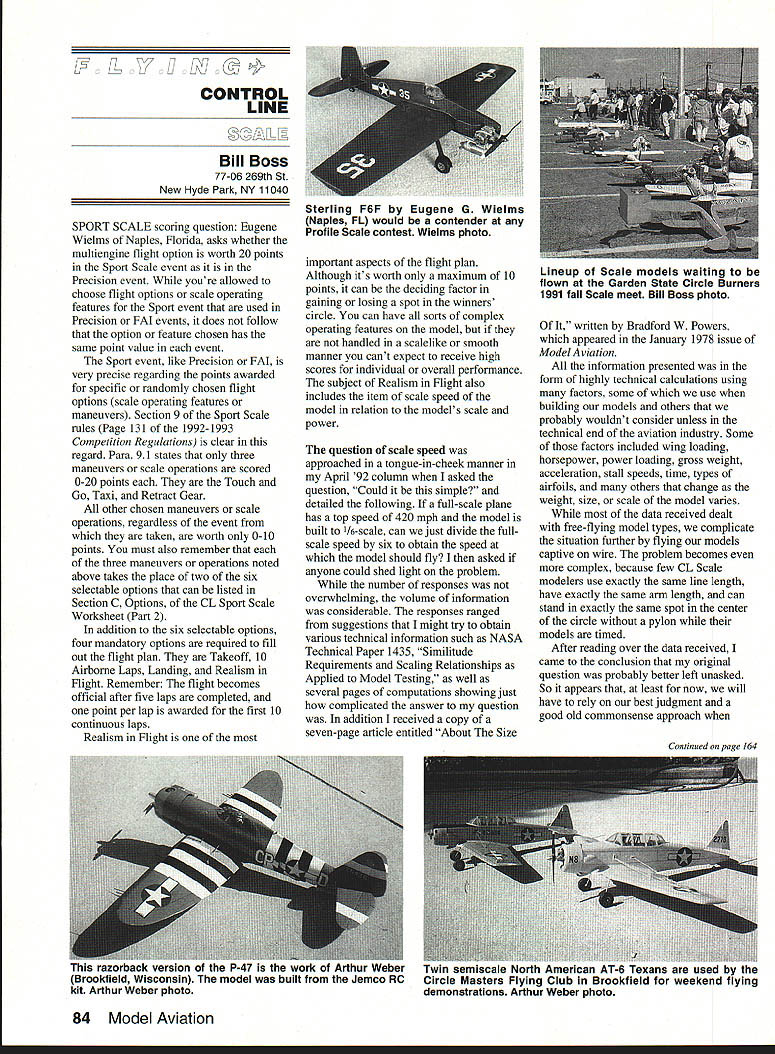
Eugene Wielms of Naples, Florida, asks whether the multiengine flight option is worth 20 points in the Sport Scale event as it is in the Precision event. While you're allowed to choose flight options or scale operating features for the Sport event that are used in Precision or FAI events, it does not follow that the option or feature chosen has the same point value in each event.
The Sport event, like Precision or FAI, is very precise regarding the points awarded for specific or randomly chosen flight options (scale operating features or maneuvers). Section 9 of the Sport Scale rules (Page 131 of the 1992–1993 Competition Regulations) is clear in this regard. Para. 9.1 states that only three maneuvers or scale operations are scored 0–20 points each. They are:
- Touch and Go
- Taxi
- Retract Gear
All other chosen maneuvers or scale operations, regardless of the event from which they are taken, are worth only 0–10 points. You must also remember that each of the three maneuvers or operations noted above takes the place of two of the six selectable options that can be listed in Section C, Options, of the CL Sport Scale Worksheet (Part 2).
In addition to the six selectable options, four mandatory options are required to fill out the flight plan. They are:
- Takeoff
- 10 Airborne Laps
- Landing
- Realism in Flight
Remember: The flight becomes official after five laps are completed, and one point per lap is awarded for the first 10 continuous laps.
Realism in Flight is one of the most important aspects of the flight plan. Although it's worth only a maximum of 10 points, it can be the deciding factor in gaining or losing a spot in the winners' circle. You can have all sorts of complex operating features on the model, but if they are not handled in a scalelike or smooth manner you can't expect to receive high scores for individual or overall performance. The subject of Realism in Flight also includes the item of scale speed of the model in relation to the model's scale and power.
The question of scale speed was approached in a single-check manner in my April 1992 column when I asked, "Could it be this simple?" and detailed the following. If a full-scale plane has a top speed of 420 mph and the model is built to 1/6 scale, can we just divide the full-scale speed by six to obtain the speed at which the model should fly? I then asked if anyone could shed light on the problem.
While the number of responses was not overwhelming, the volume of information was considerable. The responses ranged from suggestions that I might try to obtain various technical information such as NASA Technical Paper 1435, "Similitude Requirements and Scaling Relationships as Applied to Model Testing," as well as several pages of computations showing just how complicated the answer to my question was. In addition I received a copy of a seven-page article entitled "About The Size of It," written by Bradford W. Powers, which appeared in the January 1978 issue of Model Aviation.
All the information presented was in the form of highly technical calculations using many factors, some of which we use when building our models and others that we probably wouldn't consider unless in the technical end of the aviation industry. Some of those factors included wing loading, horsepower, power loading, gross weight, acceleration, stall speeds, time, types of airfoils, and many others that change as the weight, size, or scale of the model varies.
While most of the data received dealt with free-flying models, we complicate the situation further by flying our models captive on wire. The problem becomes even more complex, because few CL Scale modelers use exactly the same line length, have exactly the same arm length, or can stand in exactly the same spot in the center of the circle without a pylon while their models are timed.
After reading over the data received, I came to the conclusion that my original question was probably better left unasked. So it appears that, at least for now, we will have to rely on our best judgment and a good old commonsense approach when judging the speed of CL Scale models in flight.
Thanks to Fred Cronenwett of Canoga Park, California; Joe Sullivan of Dallas, Texas; and John W. McKee of Boynton, Texas, for their efforts and data. Anyone interested in copies of that data? Send a large (8 x 10) envelope and $1 to cover postage and copying costs to the address at the top of this column.
"Oops" photo correction
A note from Joseph P. Magar of Plantersville, Texas, pointed out that the June column contained a picture of a B-25 that I labeled a B-24. Joe, a flight engineer with 50 combat missions to his credit, flew on B-24s in the 450th Bomb Group, 720th Bomb Squadron, "The Cottonballs." He is certainly right in bringing this to our attention.
It seems that a slip of the finger on the keyboard of the computer can be a dangerous thing. The "4" and "5" keys are just too close to each other for fat fingers. Thanks, Joe, for the correction.
New British magazine
A new British model magazine called Flying Model Designer and Constructor (Vol. 1, No. 1, dated October 1991) was introduced in Britain in the fall of 1991.
The editorial policy of the magazine is to "devote its pages to all forms of model flying and not to be a specialized magazine." The intention is to provide articles, plans, photographs, technical discussions, design and construction techniques, model kit reviews, and occasional contest reports all dealing with the very wide aspects of model building and flying. The first issue contains articles on airfoils, an RC cross-country piece, an RC glider kit review, something on Old-Time Rubber, a CL construction article, and several other items, including a full-size plan of the Bob Copeland Northern Star and a historical piece on human flight. All in all it appears to be a well-diversified magazine.
The publishers state that, upon good reception of the first issue, they plan to publish the magazine quarterly beginning with a second issue in early 1992. For information about currently available issues and costs, write to J. Dalieda, 4314 West 238th Street, Torrance, CA 90505. This item came from Wing Tips, the newsletter of the Mid-Hudson Modelmasters.
Contest Activity
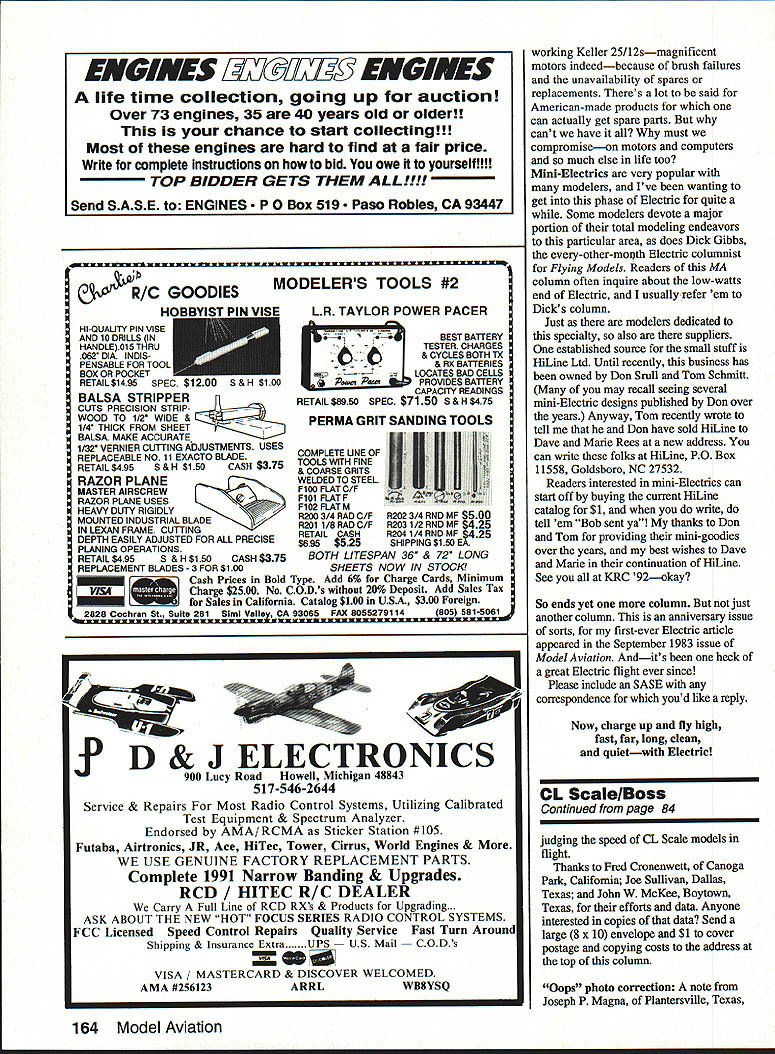
The Garden State Circle Burners will be holding its annual "all" Scale meet Sunday, September 20, 1992. The site will be the Bendix Corporation parking lot, adjacent to the west side of Teterboro Airport. As usual, Precision, Sport, and Profile Scale will be offered.
A big change this year: the GSCB will be using the new AMA Profile event rules (same as Sport Scale, see new 1992–1993 Competition Regulations) instead of the GSCB rules that were the driving force in getting Profile Scale established as an event. This meet, under the direction of George Gaydos, is one of the best attended and best run CL scale meets on the East Coast. Give it a try in '92.
Please send ideas, notice of upcoming CL Scale events, contest reports, and especially photos of CL Scale activity to me at the address at the very top of this column.
Transcribed from original scans by AI. Minor OCR errors may remain.

