
CONTROL LINE: SCALE
Bill Boss 77-06 269th St. New Hyde Park, NY 11040
PROFILE Scale event interest appears to be growing and has been generating questions since becoming a supplemental event in our Competition Regulations. In the June column I included some words on documentation and a couple of building tips for this new event. This month I'll comment on a question sent in by John Brownlee of Yuba City, California. John's question concerned the reduced thickness of the profile fuselage in relation to the model's wingspan and scale configuration.
The question: If the fuselage is reduced in thickness from four inches (width of a full-size fuselage) to the one-inch thickness allowed in the new Profile event rules, should the wingspan be reduced by the same amount?
My answer to John was that while the fuselage may be reduced in thickness, all other dimensions, outlines, etc., should conform to the planform or three-view drawing used for the model's documentation. If for some reason the wingspan were to be reduced, you would have to reduce all other surface dimensions (tail surfaces and fuselage length included) accordingly to maintain the proper scale appearance of the model and its relationship to the scale plans.
I also noted that the object of all Scale events is to duplicate the prototype in model form and that the only difference between Precision, Sport, and now the new Profile event is the degree to which we examine the model for fidelity to scale scoring. In Precision we look very closely at the model and all its details. In Sport and the new Profile event, we are looking at the model from a distance of 15 feet, which makes some of the model's finer details less visible.
However, the overall objective is still the same for all Scale events: to determine how close the scale model's outline and dimensions are to those of the prototype, based on the three-view drawings presented for judging.
Profile cockpit and canopy
While on the subject of the profile fuselage, the one-inch allowable thickness does leave us with the ability to be a little innovative. Eugene Wielms, of Naples, Florida, suggests that we can dress up the cockpit area of the profile model by adding a plastic canopy rather than just painting in the windscreen outline as most of us have done in the past. He also notes that we can further enhance the looks of the cockpit by adding a pilot figure.
The canopy can easily be formed if you happen to have a vacu-form-type machine, or you might find a suitable canopy form in the ready-made plastic packaging used for the display and sale of nuts, bolts, screws, and the myriad small household items found in your local hardware department.
The pilot figure can be made in several ways:
- Cut the basic bust profile out of a piece of thin plywood, draw in the face, helmet, etc., and glue it in place.
- Put yourself in the cockpit: have pictures taken of both sides of your own profile, have them enlarged or reduced to the size needed, cut out profiles, mount on a thin piece of plywood or foam plastic, and glue in place.
I have made a point of mentioning the use of a visible pilot figure in the profile model because of our use of the Sport Scale rules for the Profile event. Paragraph 3 of Sport rule 3.0, Model Requirements, states, "If the pilot is visible in flight in the prototype aircraft then a man-shaped dummy pilot of scale size and width must be visible in the model during flight."
While the pilot figure is not scored in any way during static judging, it is required according to the rules—even in profiles—during flight. Is there a realistic rule for the Profile event? Should it be mandatory to have a pilot figure in view during flight in a profile model? This might be one aspect of this new event that deserves some discussion and possible change. What do you think?
Idea update
Lorenzo Cordova, of Glenview, Illinois, notes that while the profile landing gear mounting shown in the June column provides a neat appearance, the fixed or hand landings can easily spread the legs, causing damage where the landing gear exits the fuselage. Lorenzo indicated that tying the legs together at a point close to the fuselage helps prevent this.
The gear can be improved by shaping a piece of piano wire (the same thickness as the gear) to fit inside the legs about one-half inch below the fuselage. Wrap the legs and new crossmember with soft copper wire, and solder in place. This addition should help prevent damage to the landing gear, especially when flying off grass areas.
Bob Holman Plans has put together a new Best In Scale catalog that contains listings of dozens of models, kits, and plans, including those for the famous Brian Taylor models. Many of the model kits and plans have spans of 60 in. to 72 in., are suitable for .60 engine power, and are excellent subjects for CL Scale. The catalog also lists the availability of spinners, cowls, canopies, retract units, and many other accessories for the various plans. The catalog is offered for $4 plus $2 postage. To obtain a copy write to Bob Holman Plans, P.O. Box 741, San Bernardino, CA 92402.
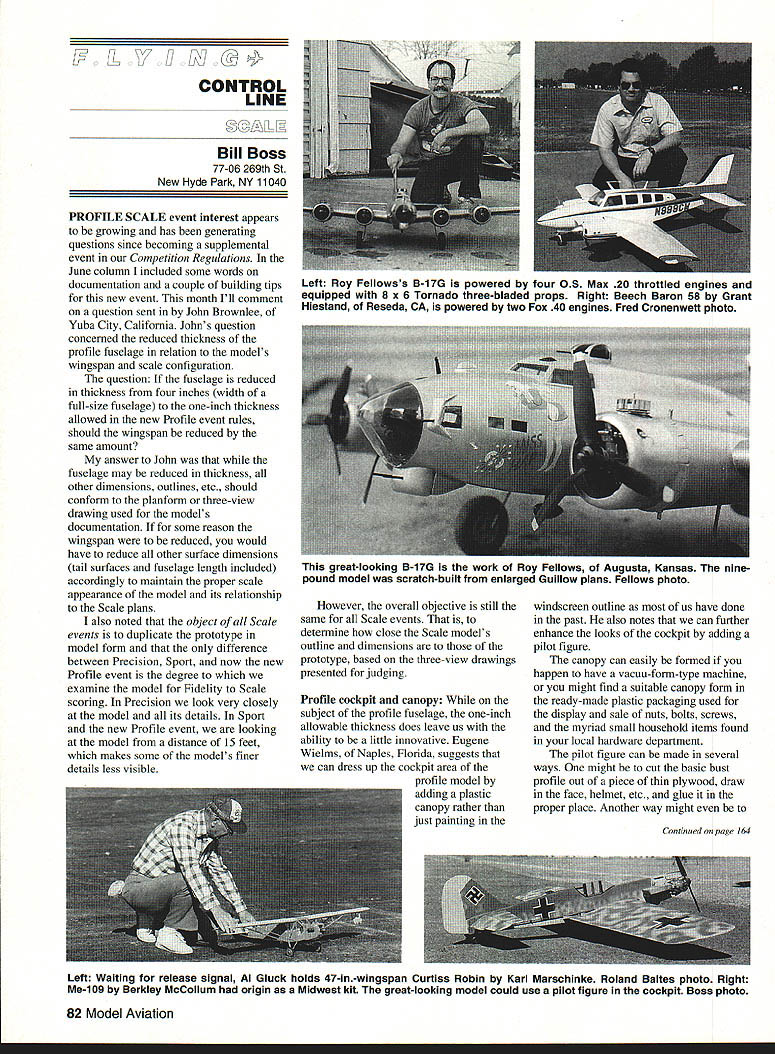
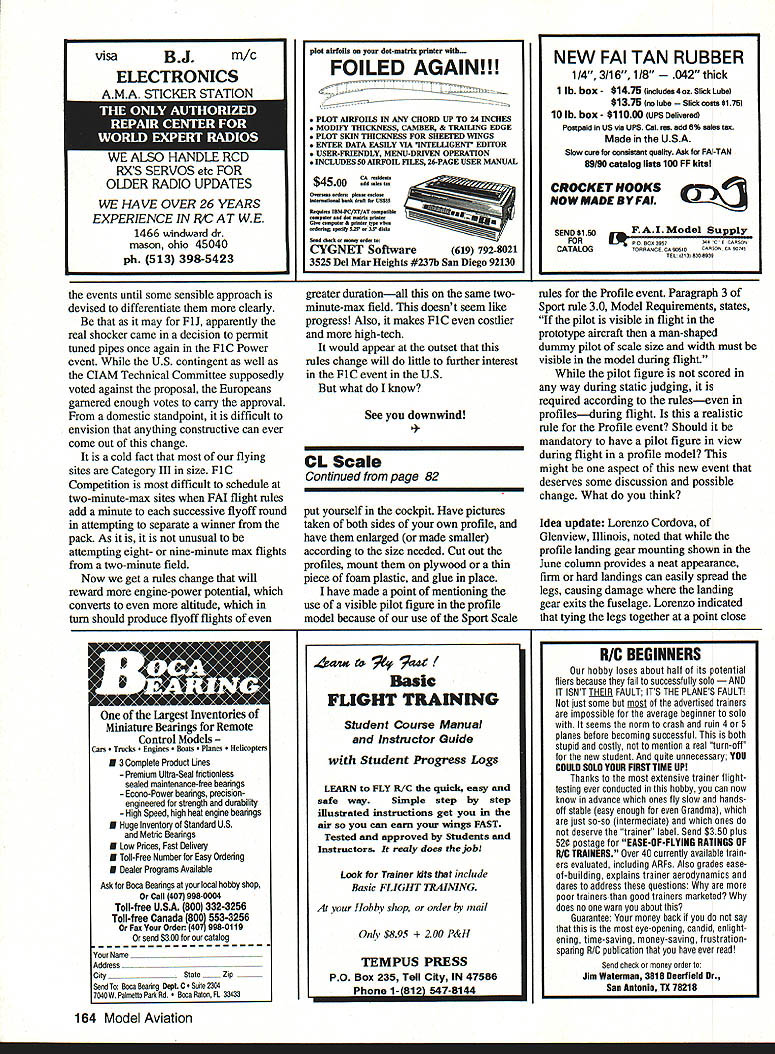
The B-17G photo in this month's column is the work of Roy Fellows, of Augusta, Kansas. The model is scratch-built from enlarged Guillow model plans, is powered by four O.S. Max .20 engines, and weighs about nine pounds. The model is finished with fiberglass cloth and epoxy resin. Hobbyboy paints were used.
Roy indicated that the color scheme (natural aluminum) and markings are for a B-17 of the 379th Bomb Group that his father flew in during WWII. The plane, called Miss Hap, had the great misfortune of flying only one mission. It embarked on its main mission in good form, but returned to base on only two engines and so badly shot up that it was scrapped.
While Roy's research on the plane verified most of the color and markings, he admits to taking artistic license with the nose art because of the lack of a photo. If anyone involved with B-17s can shed light on the nose art used on this particular plane, I would be glad to hear from you. Please write to me at the address at the top of this column; I'll see that any information is forwarded to Roy.
Please send ideas, notice of upcoming CL Scale events, contest reports, and especially photos of CL Scale activity to me at the address at the very top of this column.
Transcribed from original scans by AI. Minor OCR errors may remain.

