
Control Line: Scale
Bill Boss, 77-06 269th St., New Hyde Park, NY 11040
Contest report
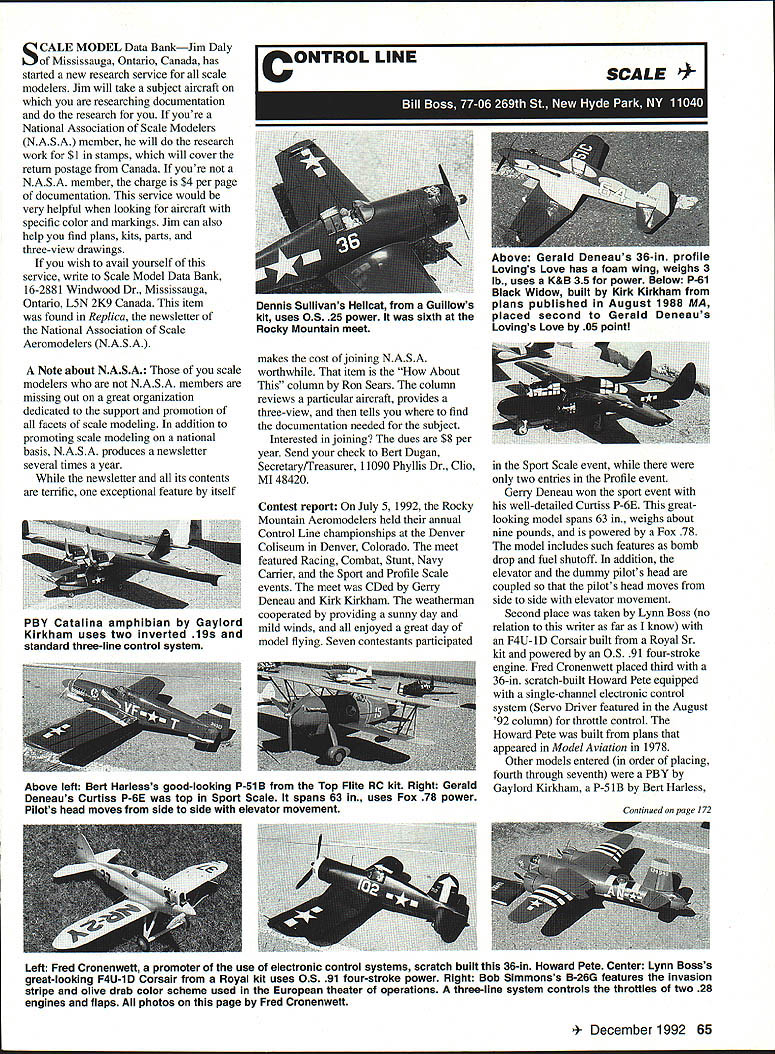
On July 5, 1992, the Rocky Mountain Aeromodelers held their annual Control Line championships at the Denver Coliseum in Denver, Colorado. The meet featured Racing, Combat, Stunt, Navy Carrier, and the Sport and Profile Scale events. The meet was CD'ed by Gerry Deneau and Kirk Kirkham. The weatherman cooperated by providing a sunny day and mild winds, and all enjoyed a great day of model flying. Seven contestants participated in the Sport Scale event, while there were only two entries in the Profile event.
Gerry Deneau won the Sport Scale event with his well-detailed Curtiss P-6E. This great-looking model spans 63 in., weighs about nine pounds, and is powered by a Fox .78. The model includes features such as a bomb drop and fuel shutoff. In addition, the elevator and the dummy pilot's head are coupled so that the pilot's head moves from side to side with elevator movement.
Second place was taken by Lynn Boss (no relation to this writer as far as I know) with an F4U-1D Corsair built from a Royal Sr. kit and powered by an O.S. .91 four-stroke engine. Fred Cronenwett placed third with a 36-in. scratch-built Howard Pete equipped with a single-channel electronic control system (the Servo Driver featured in the August '92 column) for throttle control. The Howard Pete was built from plans that appeared in Model Aviation in 1978.
Other models entered (fourth through seventh) included:
- PBY by Gaylord Kirkham.
- P-51B by Bert Harless.
- Dennis Sullivan's Hellcat from a Guillows kit using O.S. .25 power.
- Bob Simmons's B-26G, which features the invasion stripe and olive-drab color scheme used in European theater operations; a three-line system controls the throttles of two .28 engines and flaps.
Electronic control video
Fred Cronenwett has been a constant promoter of the use of electronic controls for scale and carrier models. As you probably remember, this column has featured Fred's work on the subject several times. In an effort to further promote the use of electronics, Fred and a couple of his West Coast cohorts, Merle Mohring and Grant Hiestand, have put together a video presentation on the use of electronic control systems.
The video provides good how-to detail for the use, installation, and operation of single-channel and multi-channel systems. It also includes step-by-step detail on flying-line makeup and sources for insulated wire, as well as information on the use of various types of batteries for the systems' operation. The tape, which runs about an hour and a half, includes some model flying by the three demonstrators using different electronic systems. Also included with the tape are several pages of written material, including names and addresses for obtaining system parts, insulated line data, radio conversions, etc.
A copy of the tape and other information can be obtained by sending $15 to: Fred Cronenwett 7352 Independence #201 Canoga Park, CA 91303
If you have been on the fence about using electronics for your latest control line project, this tape might help you decide.
Hints from the workshop
While this item was meant more for the sport flier—or perhaps the stunt flier—I thought it could also be applied to our scale models. Bob Furr, who has been a great source of model-building tips and ideas for this column, tells of a unique method he came across for adding an adjustable wing-tip weight to models.
Many times, after finishing a model and putting it through its first flight, we find that we didn't put in sufficient outboard wing weight. The problem then is that the model's finish must be marred in order to add the needed weight.
Bob suggests epoxying a 1/4-in. blind nut to the last outboard wing rib or recessing it into the wing tip. The blind nut will allow the use of various lengths of 1/4-in. screws until the appropriate outboard weight is found. When the proper-weight screw is found, add a little glue to the threads to hold it in place. The screw can be painted to match the wing.
For a scale model, rather than put the blind nut in the last outboard rib, consider recessing it in the wing tip. When the proper weight is found the screw gets glued in place, and the recess is filled and finished. If the weight has to be changed later, only the small wing-tip area will be involved. This item was found in the newsletter of the Orbiting Eagles Control Line Club.
Book review
America's Top Guns, by Gallery Books of New York City, is a survey of some of the most important aircraft in service with the U.S. armed forces. Included among the more than 60 aircraft featured are the F-4 Phantom, F-14 Tomcat, F-15 Eagle, A-10 Thunderbolt, AC-130 Hercules gunship, B-52, and A-4 Skyhawk II. Several helicopters are also included, such as the UH-1 Iroquois, AH-1 Huey Cobra, and the AH-64.
America's Top Guns (ISBN #0-8317-0359-8) contains details of specifications, performance, weaponry, and firepower. Each plane is illustrated with photographs and artwork showing details of markings, countries of service, three-views, and cutaways of some of the more important aircraft. It's a great book for those into modeling of jet and special-duty aircraft. I found my copy at my local Barnes & Noble Bookstore for $15.
Please send ideas, notices of upcoming CL scale events, contest reports, and especially photos of CL scale activity to me at the address at the very top of this column.
CL Navy Carrier/Perry
(Continued from page 64)
Bob Banka offers a phenomenal collection of three-views and other products listed in his catalog, which costs $4.
Bob can also help with photos documenting color schemes and scale details for those who want to model a particular full-scale carrier aircraft or for those scale competitors who happen to be reading the "CL Navy Carrier" column. You scale modelers don't have to admit to reading my column; just tell Bob you saw his ad in Model Aviation.
Nationals analysis
With the 1992 National Championships within an easy day's drive of my Virginia home, I had hoped to attend, but the pressures of my job, combined with looking for my next job, kept me away. I'm sorry to have missed seeing and flying with the East Coast carrier modelers whom I hadn't seen at the 1991 Nationals. My thanks to Joe Just, president of the Navy Carrier Society, for providing me with copies of the score sheets and processing information so I could pass the information on to you in this column.
You've seen the results in last month's Model Aviation, but let me add my congratulations to the winners: Herb Patrick (Class I), Pete Mazur (Class II), and Brian Silversmith (Profile), and especially to Ryan Calkins (Junior Profile) and Chad Dinkerman (Senior Class I, Class II, and Profile).
Pete Mazur continued his winning ways, combining third place in Profile Carrier with a first in Class II to once again take home the Eugene Ely Award as the best Carrier competitor at the Nationals.
Pete changed airplanes in two classes this year, retiring his profile Superfish in favor of a new MO-1 and using a larger MO-1 with a built-up wing in Class I. His engines remain the same ones he has successfully used in previous Ely wins. His tuned O.S. achieved the best top speed in Profile at 20.25 seconds (88.9 mph), driving a Grish Tornado 9 x 7 prop. Pete had obviously been practicing with his new MO-1, because he managed the low best speed as well, at 259 seconds (6.9 mph). A missed landing cost him first place in the event.
The top speeds in Class I and Class II both went to Brian Silversmith. In Class I Brian used a Don Gerber-designed MO-1 to reach 107.8 mph (16.69 seconds). His engine was an O.S. .40 run on pressure, swinging a Top Flite 9 x 8 prop.
In Class II Brian flew a 36-in. span Guardian (Sterling kit configuration) powered by an OPS .65 with a Top Flite 11 x 8.25 prop. Although the prop is larger than the 10 x 8 that has become the accepted standard for the big engines, the top...
Transcribed from original scans by AI. Minor OCR errors may remain.

