
Control Line: Scale
PICTURE-TAKING notes
Stan Alexander, editor of Replica (the N.A.S.A. newsletter), offered these tips on taking model photos and submitting them for magazine or newsletter use.
Black-and-white photos are generally best, but good color photos are acceptable.
Some simple do's and don'ts:
- Don't shoot down on a model unless you want the photo to show specific details; in that case, close-up shots are preferable.
- Don't include many other items or people in the photo unless a grouping of planes or people is being shown.
- Try to fill—or nearly fill—the frame with the subject only. Filling only half the frame allows the background to take emphasis away from the subject.
- Take the subject against a contrasting background or color. A dark-colored model photographed against a very dark background will blend in, losing detail and making the photo unusable for publication.
- Low-angle shots (even with the camera on the ground), front-, side-, and some 3/4-rear-view photos usually show off models to best advantage.
Taking pictures of models in flight presents extra challenges. Good results usually require practice tracking and focusing on the plane. Standard 50mm lenses often force you to be almost on top of the subject; a telephoto lens of about 200mm is almost a necessity. Practice, practice, practice.
When sending photos for publication, provide as much detail as possible:
- Type of model
- Engine size
- Operating features (throttle, flaps, retracts, smoke, etc.)
- Color scheme and origin
- Weight and type of control system
- Whether scratch-built or kit
- Any other details of interest
Include your name and address so you can be credited if a photo is used. You can write information lightly on the back of the photo with a good ballpoint pen, but better yet, number the photos and provide the data typed on a separate sheet. Avoid felt-tip pens—the ink does not always dry well on photo paper and can transfer to other photos when stacked.
Thanks to Stan Alexander for providing the basis for these notes.
Contest activity
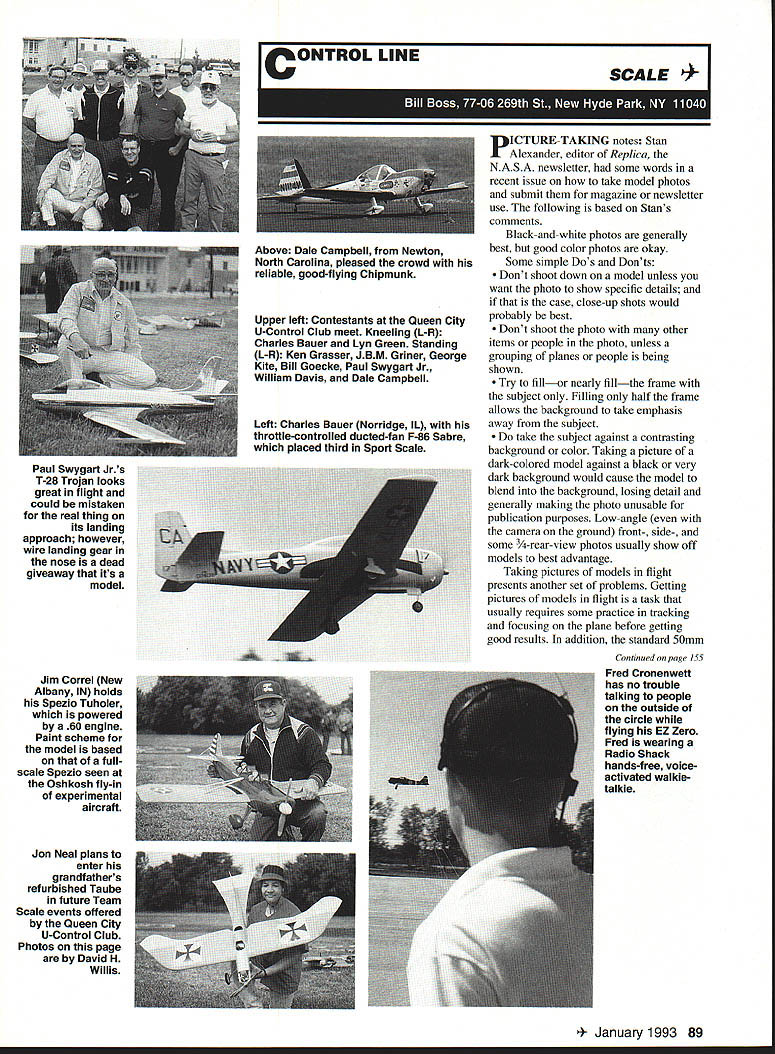
Clubs are now sending information on contest activity and photos; reports may appear some time after the event but it's valuable to let readers elsewhere know what's happening. This month we focus on the Queen City U-Control Club meet held in Cincinnati, Ohio, May 31, 1992. Dave Willis, club secretary, reported the weather was fine; the contest featured sport, profile, scale, and a new Team Scale event. This year's scale events drew nine contestants, three more than last year, showing scale is alive and growing in that area.
Three contestants used electronic control systems for independent operation of throttle, flaps, retracts, and smoke. The reliable operation of these functions made flights more interesting to watch than the typical three-line flight with touch-and-go, taxi, and throttle as options.
#### Sport
- 1st: Dale Campbell — Chipmunk (with flaps, throttle, and smoke generation)
- 2nd: George Kite — throttle-controlled Antoinette
- 3rd: Charlie Bauer — ducted-fan F-86 Sabre
#### Profile scale
- 1st: Charlie Bauer — TA-154 (featuring brakes and throttle)
- 2nd: Lyn Green — P-61 Black Widow (with bomb drop and brakes)
- 3rd: Bill Goecke — P-38
#### Team Scale Team Scale was a trial event this year, limited mostly to club members. William Davis, flying a throttle-controlled Ryan STA, won the event.
The event pairs good model builders who can no longer fly their models (for medical or other reasons) with good fliers, allowing the builder a chance to see the model back in competition. The club will not allow bought aircraft or ARFs; generally the builder must have a legitimate reason for not flying the model (medical, inexperience, or deceased).
A good example is 14-year-old Jon Neal and his grandfather's Taube. After his grandfather's passing the Taube had become a family relic. With Team Scale, Jon stripped, recovered, and refinished the model. He now has his first three-line model and an opportunity for competition experience without having to prove that he built the model.
Thanks to the Queen City Club for the Team Scale idea, which can bring out the old-timers and provide an avenue for good fliers inexperienced at scale to try scale competition. The club plans to open this event to all comers at future meets.
Circle communications
While flying your model, you may wish to talk to someone outside the circle (without shouting) to check gear position, get instructions, or verify maneuvers. Fred Cronenwett suggests using the hands-free headset-type walkie-talkies offered by Radio Shack. The units:
- Are powered by 9V batteries
- Are voice- or manually-activated (VOX)
- Have volume and VOX sensitivity controls
- Have about a 1/4-mile range
- Are useful at the flying field and for keeping track of family at outings, amusement parks, etc.
The units are designated Realistic TRC-500 (Catalog #21-403) and cost about $70 per pair.
Monthly notes / Upcoming
- May: Comments on proposed 1992–93 CL scale rules changes
- June: Notes on profile scale documentation — Bob Furr; X-Acto keyhole saw extension; Tips on strengthening profile model landing gear and wing installation — Tom Hampshire
- July: WRAM Show report
- August: Single-channel electronic control — Fred Cronenwett; Paul Matt's Scale Airplane Drawings (Aviation Heritage Books); Workshop hint by Stan Novak
- September: Twin-engine scoring question for profile scale; Scale speed question answered; New British model magazine; Contest activity — GSCB fall meet rules changes
- October: Profile models — questions on fuselage width vs. wingspan and on the need for a visible pilot in the cockpit; Update on profile model landing gear installation; Notes on new Bob Holman catalog; B-17G comments by Roy Fellows
- November: 1992 Nats coverage
- December: Scale model data bank — Jim Daly; Rocky Mountain Aeromodelers 1992 CL Championships contest report; Electronic control video — Fred Cronenwett; Workshop hint by Bob Furr — adjustable wing tip weight; Book review: America's Top Guns
Editor's note
Model Aviation prefers black-and-white photos to assure the best quality of reproduction. Enlargements of 5 x 7 (or larger) are preferred; however, if enlargements are not readily available, smaller prints and the negatives (uncut strips, please) can be submitted. Recommended films:
- Black-and-white: Kodak TMAX 400
- Color prints: Kodak Ektar 100
- Transparencies: Kodachrome 64
Transcribed from original scans by AI. Minor OCR errors may remain.

