
Control Line: Scale
Circle Masters contest
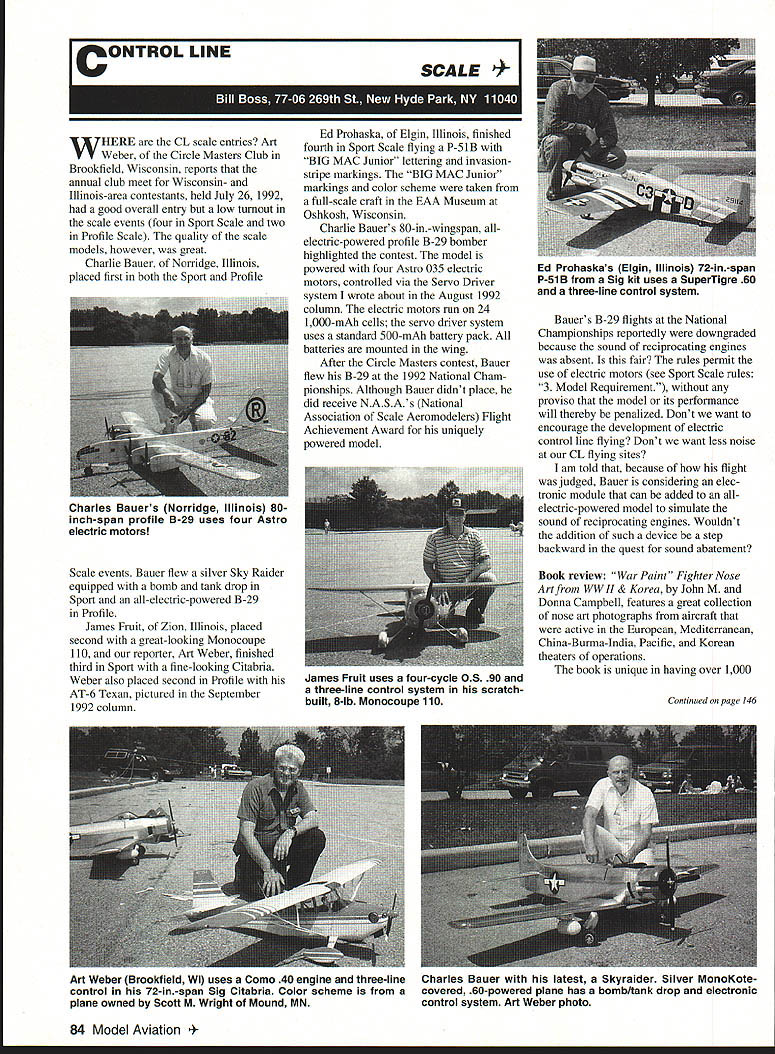
Where are the CL scale entries? Art Weber, of the Circle Masters Club in Brookfield, Wisconsin, reports that the annual club meet for Wisconsin- and Illinois-area contestants, held July 26, 1992, had a good overall entry but a low turnout in the scale events (four in Sport Scale and two in Profile Scale). The quality of the scale models, however, was great.
Results and highlights:
- Charlie Bauer, Norridge, Illinois — 1st in Sport Scale and 1st in Profile Scale. Bauer flew a silver Sky Raider equipped with a bomb and tank drop in Sport Scale and an all-electric-powered B-29 in Profile Scale.
- James Fruit, Zion, Illinois — 2nd in Sport Scale with a great-looking Monocoupe 110.
- Art Weber — 3rd in Sport Scale flying a fine-looking Citabria; also 2nd in Profile Scale with his AT-6 Texan (pictured in the September 1992 column).
- Ed Prohaska, Elgin, Illinois — 4th in Sport Scale flying a P-51B with "BIG MAC Junior" lettering and invasion-stripe markings. The markings and color scheme were taken from a full-scale craft in the EAA Museum at Oshkosh, Wisconsin.
Charlie Bauer's 80-inch-wingspan, all-electric profile B-29 bomber highlighted the contest. The model is powered with four Astro 035 electric motors, controlled via the Servo Driver system the columnist wrote about in the August 1992 column. The electric motors run on 24 1,000-mAh cells; the servo driver system uses a standard 500-mAh battery pack. All batteries are mounted in the wing.
After the Circle Masters contest, Bauer flew his B-29 at the 1992 National Championships. Although he didn't place, he received N.A.S.A.'s (National Association of Scale Aeromodelers) Flight Achievement Award for his uniquely powered model.
Bauer's B-29 flights at the National Championships reportedly were downgraded because the sound of reciprocating engines was absent. Is this fair? The rules permit the use of electric motors (see Sport Scale rules: "3. Model Requirement"), without any proviso that a model or its performance will thereby be penalized. Don't we want to encourage the development of electric control line flying? Don't we want less noise at our CL flying sites?
I am told that, because of how his flight was judged, Bauer is considering an electronic module that can be added to an all-electric-powered model to simulate the sound of reciprocating engines. Wouldn't the addition of such a device be a step backward in the quest for sound abatement?
Book review
"War Paint: Fighter Nose Art from WWII & Korea," by John M. and Donna Campbell, features a great collection of nose art photographs from aircraft active in the European, Mediterranean, China-Burma-India, Pacific, and Korean theaters of operations. The book is unique in having over 1,000 black-and-white and color pictures of "fighter aircraft only," gleaned by the authors from major photo archives around the country.
A back-of-the-book alphabetical listing of the nose art permits quick identification and location of photographs of interest. Nearly all photographs are captioned with information about the plane, fighter group, squadron, etc. In many cases, the origins of the nose art are also provided.
The volume is available for $39.95 from Zenith Books, P.O. Box 1, Osceola, WI 54020. The catalog number is 114494AP. Zenith Books is a great source for almost any aviation book.
Electronic and electrical control systems; mini-guide
Electronic and electrical servo systems have been explored in this column and elsewhere over the past few years. In a recent issue of the Garden State Circle Burners newsletter, Prop Wash, club member Bill Reynolds Sr. published a six-page "Mini-Guide to Remote Control of Control Line Model Aircraft."
The mini-guide is a résumé of magazine articles (citing the relevant publications and issue dates) and other sources of information about electronic and electrical control systems in C/L scale model aircraft. Historical background on the development of these systems is included.
I have obtained Bill's permission to offer copies of the mini-guide. If you would like a copy, please send a self-addressed, stamped envelope to me at the address at the top of this column.
Notes from N.A.S.A.
A recent issue of Replica (the newsletter of the National Association of Aeromodellers) featured a couple of items that might be of interest to the scale builder.
- RC Kits aluminum covering material
RC Kits (221 Middleworth S.W., North Canton, OH 44720) is now offering a .005" aluminum covering material. The aluminum is provided in rolls 6 inches wide by 20 feet long, has an adhesive backing, and is ready to be cut and rolled on with a hardwood dowel. The material can be applied to almost any kind of well-finished surface. The cost is $15.95 per roll plus shipping and handling; call your vendor for shipping charges, which vary with destination. Write or telephone RC Kits for full details. Telephone: (216) 499-5323. This could be the covering for your next super-scale job.
- Military Aircraft Colors and Markings 1939–1945
M&M Model Products is offering a publication called Military Aircraft Colors and Markings 1939–1945. Included are color photographs of full-size aircraft and actual mixed paint chips (not reproductions) for a variety of air forces: U.S. Navy/Marine Corps, U.S. Army Air Forces, Imperial Japanese Army and Navy, British Royal Air Force, German Luftwaffe, Italian, Russian, Turkish, Romanian, and Hungarian. The U.S. colors are from the Federal Standard Color Guide; the Japanese colors are from the Chicago Scale Master Color Guide; the German colors are from the RLM color chart. The color guide costs $29.95 and can be obtained from the Hobby Super Store, 1387 N. Military Trail, West Palm Beach, FL 33409; telephone (407) 688-0569. The next time you're in the West Palm Beach area, treat yourself to a visit to the Hobby Super Store.
Please send ideas, notices of upcoming CL Scale events, contest reports, and especially photos of CL scale activity to me at the address at the very top of this column.
Transcribed from original scans by AI. Minor OCR errors may remain.

