
Control Line: Scale
Bill Boss 77-06 269th St., New Hyde Park, NY 11040
Control Systems
Art Weber, a consistent contributor of ideas, noted that many recent columns have contained considerable information about electronic control systems and servos for operating model functions. He wondered what happened to the good old bellcrank-and-pushrod systems.
The operation of any model function—throttle control, dropping bombs or fuel tanks, ejecting stores, opening and closing cooler doors, and even operating flaps—can be done with the same basic mechanism whether using a servo or a three-line bellcrank. The only difference is where the control rod for the operating mechanism is attached: a bellcrank or a servo.
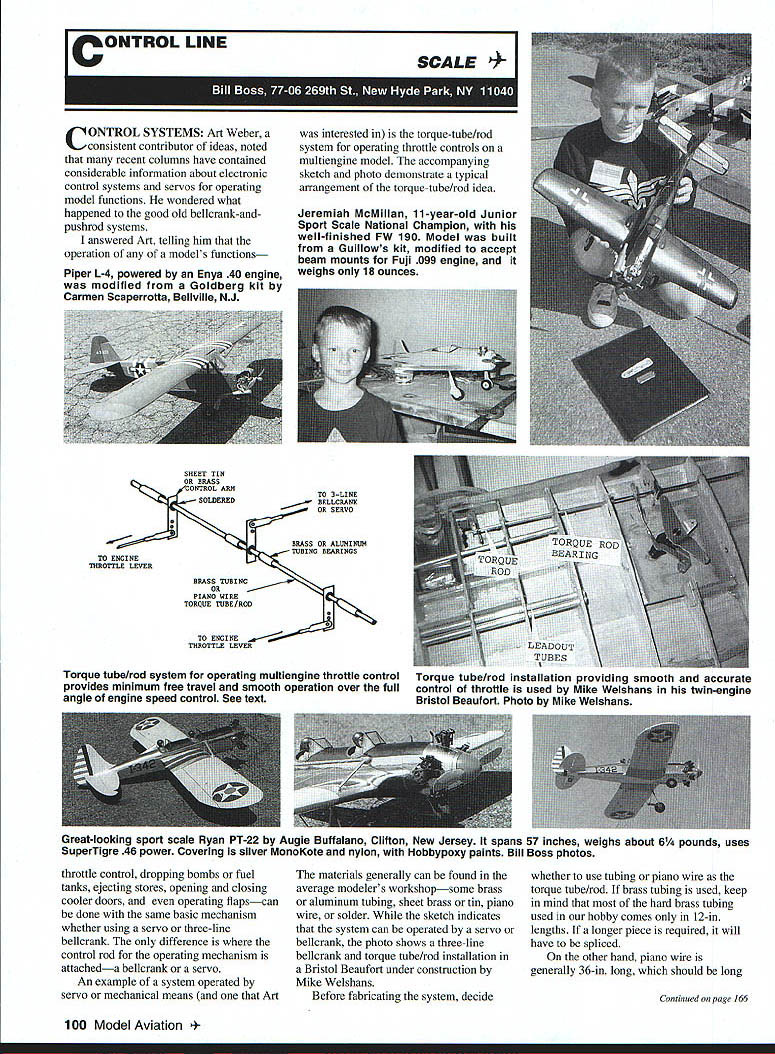
An example of a system that can be operated by either servo or mechanical means (and one that Art was interested in) is the torque-tube/rod system for operating throttle controls on a multiengine model. The accompanying sketch and photo demonstrate a typical arrangement of the torque-tube/rod idea.
Materials are generally available in the average modeler’s workshop—brass or aluminum tubing, sheet brass or tin, piano wire, and solder. While the sketch indicates the system can be operated by a servo or bellcrank, the photo shows the three-line bellcrank and torque-tube/rod installation in a Bristol Beaufort under construction by Mike Welshans.
Before fabricating the system, decide whether to use tubing or piano wire as the torque tube/rod. Note:
- Most hard brass tubing used in the hobby comes only in 12-inch lengths; longer pieces must be spliced.
- Piano wire is generally 36 inches long, usually long enough for most models, even those with four engines.
- Two wire/tubing combinations to consider are 3/32-in. wire with 1/8-in. O.D. tubing, and 5/64-in. wire with 3/32-in. O.D. tubing.
Fabrication and installation steps:
- Make a series of bearings from tubing sized to the chosen torque tube/rod and make control arms from sheet tin or brass stock.
- Drill clearance holes in the control arms for the torque-tube/rod and for the engine throttle snap-on connectors. Make the holes for the engine control snap-on connectors the correct size to keep free travel in the system to a minimum.
- Mount the tubing bearings and control rod assembly in the wing ribs or balsa blocks. Position the bellcrank and engine control arms on the torque rod but do not solder them yet. Cut small slots in the wing ribs, if necessary, to install the bearings.
- When the torque rod operates freely, epoxy-glue the bearings in place. After the glue has hardened, connect the control arms to the model’s engines and bellcrank or servo.
- Place the engine linkages and bellcrank or servo in the high- or low-speed position, and solder the control arms in place. Before proceeding with further model construction, verify the system is working freely.
While multiengine throttle control can be installed using a series of bellcranks in place of the torque tube, each bellcrank would add significant free travel to the system. The torque-tube method reduces free travel and provides smoother operation over the full range of an engine’s speed control.
Flying Lines
Dave Dahlke of Oshkosh, Wisconsin, sent a note citing a source of wire suitable for flying lines. Cabela’s Inc., 812 Thirteenth Avenue, Sidney, NE 69162, carries both solid and stranded wire in bulk quantities. Dave’s sample showed solid, top-grade, noncorrosive stainless steel wire in diameters ranging from .011 to .043 and in various lengths. Write to Cabela’s for a catalog and further details.
Workshop Hint / Safety Tip
M. McCloskey of the Cholla Choppers MAC, Tucson, Arizona, notes that frequent inspection of flying lines is good safety practice and provides some insurance against losing a model to a broken line. Suggestions:
- Inspect flight handles and lines before flying demonstrations and events.
- Lay out the lines and walk the entire length while feeling for kinks, tight loops, or broken strands. Be careful—broken strands can cause skin punctures and considerable pain.
- If kinks of about 45° or more are found, remove the line and re-splice or replace it.
- If broken or cracked strands are found, replace the line.
- If rust is found, wipe the lines with an oiled rag to see if it can be removed. If rust is not easily removed, it may have penetrated the lines and weakened strands—replace the line.
- Check all line terminations and the control handle (especially Roberts or G.S. types) for cracks or other damage. If there is any doubt about integrity or smooth operation, replace the handle or line.
It’s better to incur the expense of a new line or handle than to risk the destruction of a great model.
This idea appeared in Hangar Talk, the Cholla Choppers’ newsletter.
Scale Model Research Catalog
Scale Model Research, with Bob Banka at the helm, has published the 10th-anniversary issue of the Scale Aircraft Documentation and Resource Guide. The new guide is over 130 pages and includes:
- 4,000 color Foto Paaks
- 22,000 three-view drawings
- Detailed articles on: putting together a scale presentation, model markings, contest judging on scale outline, locating scale data, how to pick scale rivets, and how to shoot your own documentation photos
- Articles written by experienced scale modelers, judges, and industry people including Ron Sears, Cliff Tacie, Mike Anderson, Johnnie Rapillo, and Eloy Marez
- Many advertisers for various types of scale model equipment and kits
The catalog can be obtained for $5 from Scale Model Research, 2334 Ticonderoga Way, Costa Mesa, CA 92626. The “How To Do” articles alone are worth the price.
Contest Activity
The Circle Masters Flying Club will hold its annual Stunt-Scale meet on Sunday, June 20, 1993, at Dretzka Park, Milwaukee, Wisconsin. In addition to the traditional stunt events (including Old-Time Stunt, Profile, and Sport Scale events), scale events will be flown.
Art Weber, CD for the meet, urges all scale modelers in the area to come out, enjoy a great day of flying, and support the scale events. Full details can be obtained by writing to Art Weber, 17560 Windermere Rd., Brookfield, WI 53045.
Please send ideas, notice of upcoming CL scale events, contest reports, and especially photos of CL scale activity to the address at the top of this column.
Transcribed from original scans by AI. Minor OCR errors may remain.

