
CONTROL LINE: SCALE
By Bill Boss
77-06 269th St., New Hyde Park, NY 11040
Great is the only way to describe the response to the offer in my February '93 column of copies of Bill Reynolds's Mini-Guide to Remote Control of Control Line Scale Models. In less than two weeks after the column appeared I had more than two dozen requests for the guide. One surprising thing about these requests is that more than one-third came from RC modelers now interested in Control Line Scale.
Is Control Line Scale making a comeback? Could it be that electronic systems (converted radios or specially made encoder/decoder systems) will be the vehicle to boost interest in Control Line Scale activities? I certainly hope so.
It might also be that the use of electronics and servos makes it somewhat easier to accomplish the independent operation of such features as flaps, throttle, retracting landing gear, bomb bay doors, and so on, for the more complicated models.
I am sure there are those who will stay with the three-line system that has been our standard for many years. However, the use of servos for individual operations certainly solves the problem of designing a series of bellcrank-and-pushrod systems necessary for operating features when only the three-line bellcrank is employed.
Both systems have advantages and disadvantages. As noted above, the electronic system permits the independent operation of many features but can be subject to failure because of servo or battery problems. The three-line mechanical system has its limitations with regard to the number of independent feature operations but seldom fails to perform its basic functions.
Perhaps the use of the two systems in the same model would satisfy those wanting to try the electronic system without abandoning the mechanical completely. For example, you might try using the standard three-line system for throttle and a two- to six-channel electronic system and servos for all other operating features of the model. This combination would certainly provide maximum flexibility and range of control for the most complicated control line models.
I also feel this combination builds in a great measure of safety. Putting the model's throttle control (which is most important in any Control Line Scale model) on the mechanical system would minimize the possibility of throttle control failure. While you can't eliminate throttle failure entirely, the chance of failure in the electronic system would be greater because of the number of components involved. In the end, only you can determine what type of system or combination of systems you would be comfortable with. I can't help but feel that the outlook for CL Scale is good and that the use of electronic controls will be a factor contributing to its future growth.
Anyone who may have missed the February '93 offer of the mini-guide can still get a copy by sending a self-addressed, stamped envelope to me at the address shown at the top of this column.
Book Review: Scale Aircraft Drawings, Volumes I and II
Scale Aircraft Drawings, Volumes I and II, would be excellent additions to any modeler's aviation library. Each volume provides information and data on 37 aircraft, including a great assortment of three-view drawings by Wylam, Nye, Larson, Nieto, Karlstrom, and others, plus additional information about many popular scale modeling subjects.
Both books are in an 8 1/2 x 11-inch format and are softbound. The cost of each volume is advertised as $12.95; however, you can have both volumes for $18.95, plus approximately $4 shipping and handling. Write to Air Age Mail Order Services, 251 Danbury Rd., Wilton, CT 06897.
Volume I is devoted to aircraft of World War I. In addition to the three-view drawings, there is general information and history about each subject and a section devoted to engines, guns, and bombs used on planes of that era.
Volume II covers the World War II era and includes drawings of many fighters and bombers flown by the U.S., Great Britain, Japan, and Germany. In addition to historical notes and general information, this volume includes a section on the colors and markings used on these aircraft.
If you're looking for a three-view drawing, photos, and general information for your next scale project, you might find it all in one of these Scale Aircraft Drawing books.
Workshop hint
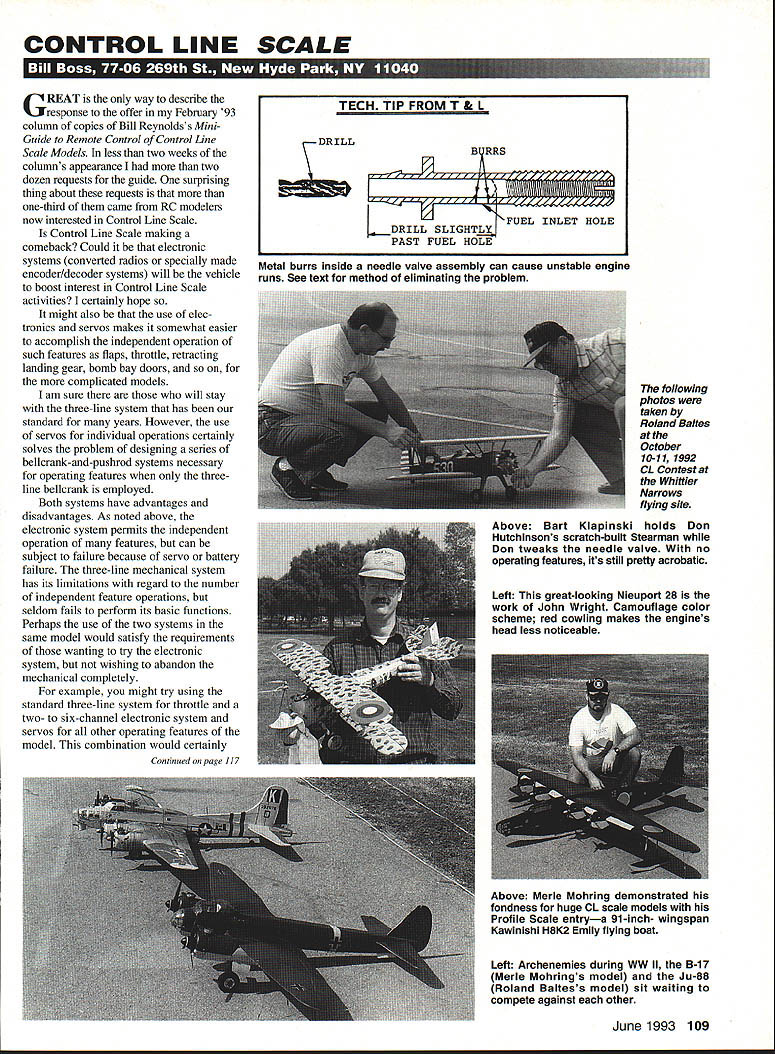
Are you having trouble getting constant needle valve settings? Tom Lay of T & L Specialties (Box 6052, Torrance, CA 90504) says the trouble might be inside your engine's spray bar. Burrs left in the fuel inlet hole after drilling or manufacture can cause unstable needle valve settings.
In just a few minutes you can remove any burrs and save yourself hours of aggravation on the field. Steps:
- Remove the spray bar assembly from the engine. While removing the assembly, note the position of the fuel inlet hole so it can be returned to the same position on reassembly.
- Find a drill bit that will just fit into the needle valve assembly.
- Enter the drill bit into the assembly and, turning the drill bit by hand, remove any burrs. Take care not to put the drill bit past the fuel inlet hole so as not to disturb the needle valve threads on the other end.
- When finished, flush or blow out any metal particles.
Contest activity
The Circle Masters CL Club of Wisconsin will hold the Wisconsin-Midwest CL Championships on Sunday, June 20, 1993, at Dretzka Park (Bradley Road and Highway 145), Milwaukee, Wisconsin. In addition to other CL events, Sport and Profile Scale will be offered. Scale will be flown on a paved circle.
For further details contact:
- Art Weber (CD), 17560 Windermere Rd., Brookfield, WI 53045. Tel.: (414) 783-4079.
- Jim Krueger. Tel.: (414) 786-9463.
While speaking of contest activity, I would like to thank Roland Baltes on the West Coast for some pictures in this month's column. They were taken at a contest held at the Whittier Narrows flying site on October 10–11, 1992. While Roland didn't provide much information on contestant turnout and scoring, he did indicate it was a fun day for all.
Please send ideas, notices of upcoming CL Scale events, contest reports, and especially photos of CL Scale activity to me at the address at the very top of this column.
Transcribed from original scans by AI. Minor OCR errors may remain.

