
CONTROL LINE SCALE
Bill Boss, 77-06 269th St., New Hyde Park, NY 11040
Lozenge pattern reproduction made easier
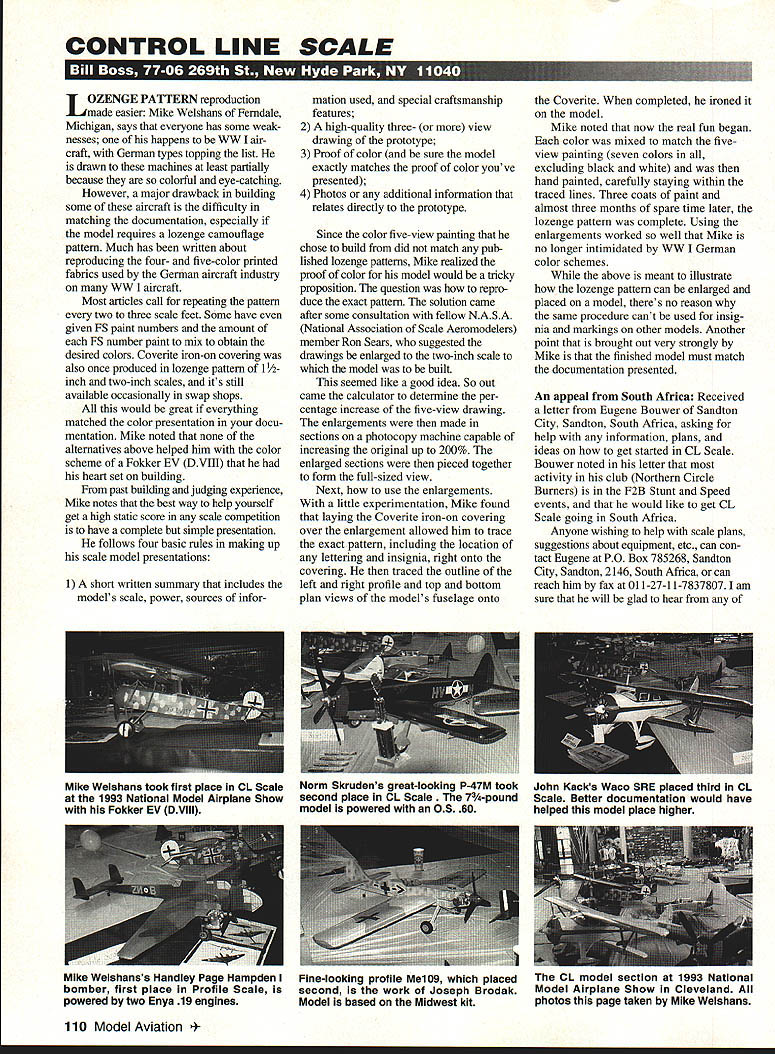
Mike Welshans of Ferndale, Michigan, says everyone has some weaknesses; one of his happens to be WW I aircraft, with German types topping the list. He is drawn to these machines at least partially because they're so colorful and eye-catching.
A major drawback in building some of these aircraft is the difficulty in matching the documentation, especially if the model requires a lozenge camouflage pattern. Much has been written about reproducing the four- and five-color printed fabrics used by the German aircraft industry on many WW I aircraft. Most articles call for repeating the pattern every two to three scale feet. Some have even given FS paint numbers and the amount of each FS paint to mix to obtain the desired colors. Coverite iron-on covering was once produced in lozenge pattern in 1-1/2-inch and two-inch scales, and it is still found occasionally in swap shops.
All this would be fine if everything matched the color presentation in your documentation. Mike noted that none of these alternatives helped him with the color scheme of a Fokker D.VIII that he was set on building.
From past building and judging experience, Mike notes that the best way to get a high static score in any scale competition is to have a complete but simple presentation. He follows four basic rules when preparing his scale model presentations:
- A short written summary that includes the model's scale, power, sources of information used, and special craftsmanship features.
- A high-quality three-view (or more) drawing of the prototype.
- Proof of color (and be sure the model exactly matches the proof of color you have presented).
- Photos or any additional information that relates directly to the prototype.
Since the five-view painting he chose to build from did not match any published lozenge patterns, Mike realized the proof of color for his model would be a tricky proposition. The question was how to reproduce the exact pattern. The solution came after consultation with fellow N.A.S.A. (National Association of Scale Aeromodelers) member Ron Sears, who suggested enlarging the drawings to the two-inch scale to which the model was to be built.
Out came the calculator to determine the percentage increase of the five-view drawing. The enlargements were made in sections on a photocopy machine capable of increasing the original up to 200%. The enlarged sections were then pieced together to form the full-sized view.
Next, how to use the enlargements. With a little experimentation, Mike found that laying Coverite iron-on covering over the enlargement allowed him to trace the exact pattern, including the location of any lettering and insignia, right onto the covering. He traced the outline of the left and right profiles and the top and bottom plan views of the model's fuselage onto the Coverite. When completed, he ironed it onto the model.
Now the real work began. Each color was mixed to match the five-view painting (seven colors in all, excluding black and white) and was then hand painted, carefully staying within the traced lines. After three coats of paint and almost three months of spare time, the lozenge pattern was complete. Using the enlargements worked so well that Mike is no longer intimidated by WW I German color schemes.
While this illustrates how the lozenge pattern can be enlarged and placed on a model, the same procedure can be used for insignia and markings on other models. Another point Mike strongly emphasizes is that the finished model must match the documentation presented.
An appeal from South Africa
I received a letter from Eugene Bouwer of Sandton City, Sandton, South Africa, asking for help with information, plans, and ideas on how to get started in CL Scale. Bouwer noted that most activity in his club (Northern Circle Burners) is in the F2B Stunt and Speed events, and he would like to get CL Scale going in South Africa.
Anyone wishing to help with scale plans, suggestions about equipment, etc., can contact Eugene at: P.O. Box 785268, Sandton City, Sandton 2146, South Africa Fax: 011-27-11-7837807
I am sure he will be glad to hear from U.S. scale modelers and will appreciate any help offered.
Scale Team Racing and three-view drawings
Scale Team Racing, a unique event by the Queen City club of Cincinnati, Ohio, was discussed in last month's column. The event is for full-bodied models of racing planes from the Golden Age of racers.
While going through recent newsletters, I found an ad for a source of three-view drawings of famous American racing planes. The American Air Racing Association offers three-views of racing planes spanning 1929 to 1938 and includes such planes as the Brown B-2 Miss Los Angeles, various Keith Rider models, the Laird Super Solution, Gee Bee R-1, Chester Jeep, and many others. Most drawings offered are 3/4-inch scale.
If interested, write to: Rudy Proffat, 4060 W. 158th St., Cleveland, OH 44135 This item was found in Wing Tips, the newsletter of the Mid-Hudson Modelmasters.
Workshop hints
Bob Furr of the Orbiting Eagles of Omaha offers a great workshop tip. One tool every modeler needs is a very good yardstick for the workshop—not the free wooden one from a hardware store, but a metal one. Most wooden rulers are not straight, and if you use one as a guide when cutting balsa, you're likely to cut into the ruler as well as the wood below it.
A steel or aluminum ruler is best. However, metal rulers are slick and can move when making cuts. A simple solution: using a little rubber or contact cement (3M 77 spray works well), attach several one-inch squares of medium-grit sandpaper to the back of the ruler. Now when you lay it on the wood to be cut, it will stay in place. This tip was found in the Orbiting Eagles' newsletter.
Please send ideas, notices of upcoming CL Scale events, contest reports, and especially photos of CL Scale activity to me at the address at the very top of this column.
Safe flying is no accident.
Transcribed from original scans by AI. Minor OCR errors may remain.

