
CONTROL LINE SCALE
Bill Boss 77-06 269th Street New Hyde Park, NY 11040
SCALE RULES CHANGES I believe the low number of rules changes (only four this past rules cycle) affecting control line Scale must be some sort of record. It has been many years since we had so few changes to be aware of going into a new competition season.
Two of the proposals that passed were really not changes but clarifications of a rule that already exists in the General Section of the Competition Regulations. That rule states that only one model can be entered in an event unless specified otherwise in particular event rules; it was covered in Paragraph 10, Number of Models, in the "General Information, All Categories" section of the rule book.
The passing of SC-94-2 and SC-94-3 will provide wording in the Scale General section (Item 2, General, Page 117) stating that a contestant may appear only once on a list of winners in each event and may only receive one award in each event. While all of this may have been understood from the General section of the Competition Regulations, it will now be stated specifically in the General Section of the Scale rules.
The other proposals that passed final vote were SC-94-24 and SC-94-37, and they deal with the new Supplemental Profile Scale event. SC-94-24 eliminates the requirement for a contestant to provide the Rule 4.6 declaration of parts not made by him that were used in building a profile scale model. I believe this change is a good one because the event is intended to encourage non-scale modelers and beginners to try the scale events.
SC-94-37 exempts the Profile event from the dummy pilot requirement; therefore a model should not be downgraded in scoring for not having a pilot visible in the cockpit area. While the passage of this proposal was intended to make the event less complicated and easier for the newcomer, shouldn't a contestant who makes the effort to install a plastic canopy and pilot figure in his profile model be given some scoring reward for that effort in Craftsmanship or Fidelity to Scale?
A Question Answered
In the August 1993 column I presented a chart showing the compatibility of various finishing materials we use on our models. While I took the information from The Newsletter of the Rocky Mountain Aeromodelers, I also noted that the source of the chart was unknown.
Several of you sent notes indicating the chart came from Harry Higley's book There Are No Secrets, and that I should have credited Harry and his books as the source. I might also note that a similar chart appears in Higley's Master Modeling book. Note that I said similar, as the chart in Master Modeling does not contain the reference to the compatibility of nitrate dope that was published in my August column. Because of this slight difference I am not really sure of the original source.
However, those of you who wrote in are right about the Higley books. They do make great additions to the modeling library and contain valuable information on model building for both the beginner and the expert. For information on the Higley books and other modeling products, write to Harry B. Higley & Sons, Inc., P.O. Box 532, Glenwood, IL 60425.
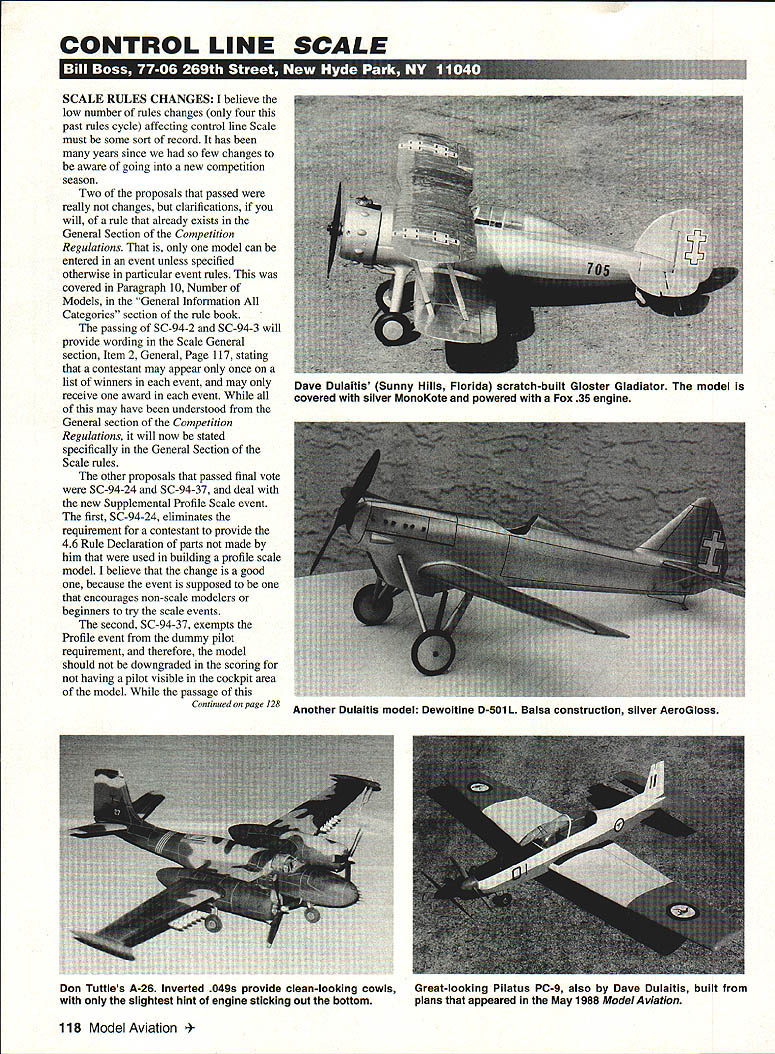
Dave Dulaitis of Sunny Hills, Florida, specializes in Lithuanian Air Force planes, their color, and markings, in his pursuit of Scale modeling for fun. In December 1988 we featured three models by Dave: the Anbo VIII, Fiat CR-20, and Anbo IV. This month we add two more Lithuanian-marked models to Dave's fleet of Just-for-Fun Scale models, bringing his total to nine planes.
This month we are adding the Gloster Gladiator and Dewoitine D.501L. Both models are scratch-built to one-inch-to-the-foot scale and are powered by Fox .35 engines. The Gloster Gladiator is covered with silver-colored MonoKote, while the Dewoitine is finished in silver AeroGloss dope. Dave said one of the big advantages of using MonoKote was that he could cover the model on the dining-room table while watching Wings without complaints from his wife.
Another model by Dave is a Pilatus PC-9, done up in Australian markings and also powered with a Fox .35. The Pilatus was built using Dave Haught's plans, published in the May 1988 issue of Model Aviation. However, instead of building it with the profile fuselage, Dave built up the fuselage to hide the fuel tank and added a great-looking canopy. Dave uses this model for practice flying and aerobatic training. His ultimate goal is to build a Scale model capable of full-scale aerobatics.
HINT FOR THE WORKSHOP Bob Furr noted in a recent Orbiting Eagles of Omaha newsletter that many times when building models you use tools and techniques that are not used by everyone, only to learn that they are not so uncommon. Bob says that looking at a friend's scratch-built profile model, he noticed the leadout holes cut in the ribs were roughly done with a modeling knife. It made him think about other ways the holes can be cut out cleanly.
- One approach is to drill the holes before assembling the model. This assumes you are organized enough to remember this step. A regular drill bit tends to split and splinter balsa ribs, so many modelers make special drills from hard brass tubing, with the ends cut so they have little teeth like a saw blade.
- Another solution, if the wing is assembled without the holes, is to use a good hand punch like those used to make holes in paper. If the ribs are made of 1/8" balsa or thinner wood, this type of punch works well. A good punch also works well on thin plywood. The punches usually have a throat of about one-inch depth and can be used as a nibbling tool to remove wood from ribs and formers. Be careful not to nibble too much in your quest for lightness.
CL Scale/Boss
1993 Directory of CL Scale Items in Model Aviation
- January
- Picture-taking notes from NASA
- Contest Activity: Queen City CL Club, Cincinnati, OH
- Radio Shack hands-free walkie-talkie
- 1992 Directory of CL Scale Items in Model Aviation
- February
- Contest Report: Circle Masters Club, Brookfield, WI
- Book Review: Warpaint by John M. and Donna Campbell
- Notes from NASA: Aluminum covering material, and Military Aircraft Color Guide 1939–1945
- Offer of Mini-Guide to CL Electronics
- March
- Scale Rules Proposals discussion
- Contest Report: GSCB Annual Scale meet
- April
- Torque Tube System for throttle control in multiengine models
- Flying line source and safety tips
- SMR, Scale Aircraft Documentation and Resource Guide
- Contest Activity: Circle Masters Club, Milwaukee, WI
- May
- Improved profile model appearance using one-inch-thick fuselage
- Contest Activity: Rocky Mountain Aeromodelers
- RSM Distribution: CL Supplies
- Workshop Hint: Fix scratched canopies
- June
- Discussion: Electronics vs. Mechanical operating systems
- July/August
- Book Review: Scale Aircraft Drawings Vol. I & II
- Workshop Hint: Remove burrs from needle valve assembly
- 1993 WRAM Show Report
- Compatibility of finishing materials
- F.Y.I. — Model Flight Model aircraft/hobby data book
- Contest Report: Metrolina CL Society's 1992 Carolina Criterium Contest
- Queen City CL Club — Golden Age Racers
- Workshop Hint: Soldering leadout wires
- September
- Lozenge pattern reproduction made easy
- Appeal from South African modeler
- Golden Age Racers: Source of 3-views
- Workshop Hint: Workshop ruler
- Electronics vs. 3-Line Bellcrank System, further discussion
- CL Aerial Photography
- Jim Pepino's Scale Plans and Photo Service
- October
- Scale Flying for Fun
- November
- Notes on NASA Membership
- Control Line Supplies: John Brodak
- Hints for the Workshop
- Flexible leadout termination sleeves and hair clips as clamps
- 1993 National Championships coverage
- December
Please send ideas, notices of upcoming CL Scale events, contest reports, and especially photos of CL Scale activity to me at the address at the very top of this column.
Transcribed from original scans by AI. Minor OCR errors may remain.

