
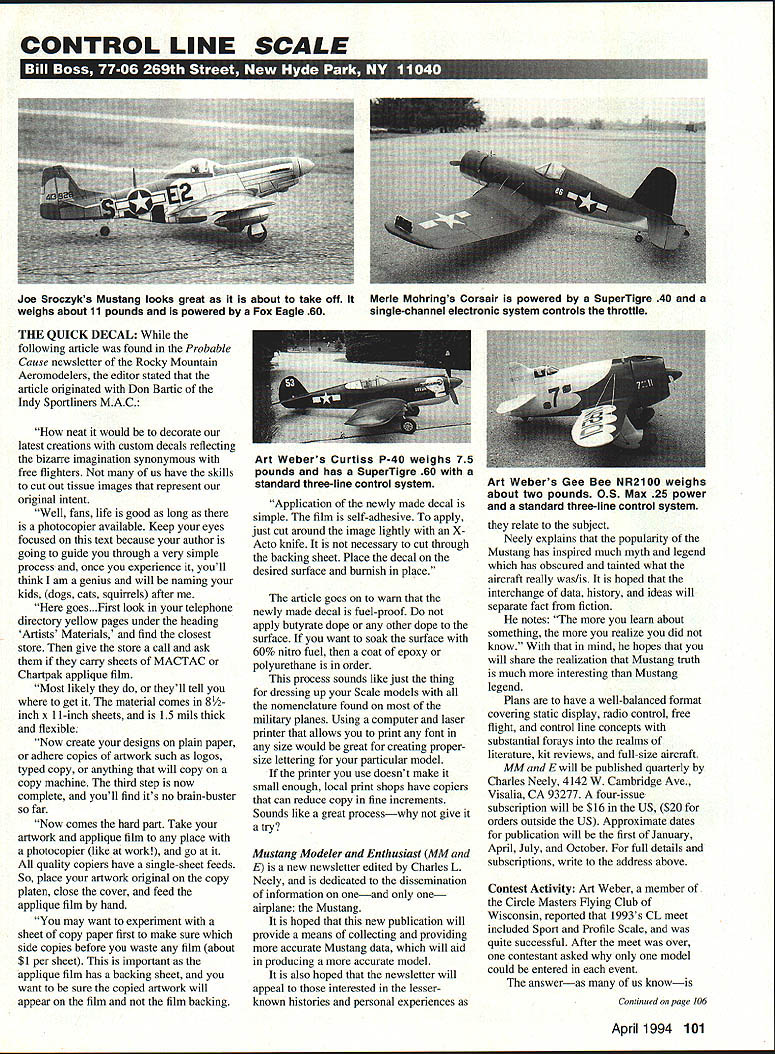
CONTROL LINE SCALE
Bill Boss 77-06 269th Street, New Hyde Park, NY 11040
THE QUICK DECAL
While the following article was found in the Probable Cause newsletter of the Rocky Mountain Aeromodelers, the editor stated that the article originated with Don Bartic of the Indy Sportliners M.A.C.
"How neat it would be to decorate our latest creations with custom decals reflecting the bizarre imagination synonymous with free fighters. Not many of us have the skills to cut out tissue images that represent our original intent. Well, fans, life is as good as long as there is a photocopier available. Keep your eyes focused on this text because your author is going to guide you through a very simple process and, once you experience it, you'll think I am a genius and will be naming your kids, dogs, cats, squirrels after me.
Here goes...
- Look in your telephone directory yellow pages under the heading 'Artists' Materials' and find the closest store. Call and ask if they carry sheets of MACTAC or Chartpak applique film. Most likely they do, or they'll tell you where to get it. The material comes in 8-1/2" x 11" sheets and is about 1.5 mil thick and flexible.
- Create your designs on plain paper, or adhere copies of artwork such as logos, typed copy, or anything that will copy on a copy machine.
- Take your artwork and the applique film to any place with a photocopier (like at work!) and make the copy. All quality copiers have a single-sheet feed. Place your artwork original on the copy platen, close the cover, and feed the applique film by hand.
- You may want to experiment with a sheet of copy paper first to make sure which side copies before you waste any film (about $1 per sheet). This is important because the applique film has a backing sheet, and you want to be sure the copied artwork will appear on the film and not the film backing.
- Apply the decal. The film is self-adhesive. Cut around the image lightly with an X-Acto knife — it is not necessary to cut through the backing sheet. Place the decal on the desired surface and burnish in place.
- Warning: the newly made decal is NOT fuel-proof. Do not apply butyrate dope or any other dope to the surface. If you want to expose the surface to 60% nitro fuel, apply a coat of epoxy or polyurethane first.
This process is ideal for dressing up scale models with the nomenclature found on most military planes. Using a computer and a laser printer allows you to print any font in any size and is great for creating proper-size lettering for your particular model. If your printer doesn't make type small enough, local print shops have copiers that can reduce copies in fine increments. Sounds like a great process—why not give it a try?
Mustang Modeler and Enthusiast (MM and E)
Mustang Modeler and Enthusiast (MM and E) is a new newsletter edited by Charles L. Neely and is dedicated to the dissemination of information on one—and only one—airplane: the Mustang.
- Purpose: To collect and provide more accurate Mustang data to aid in producing more accurate models.
- Audience: Those interested in lesser-known histories and personal experiences related to the Mustang.
- Editorial note: Neely explains that the Mustang's popularity has inspired myth and legend that obscure the aircraft's true history. He hopes the interchange of data, history, and ideas will separate fact from fiction.
- Quote: "The more you learn about something, the more you realize you did not know." Neely hopes you will share the realization that Mustang truth is much more interesting than Mustang legend.
Plans include a well-balanced format covering static display, radio control, free flight, and control line concepts with substantial forays into literature, kit reviews, and full-size aircraft.
Publication details:
- Publisher/editor: Charles Neely
- Address: 4142 W. Cambridge Ave., Visalia, CA 93277
- Subscription: Four-issue subscription $16 in the U.S.; $20 outside the U.S.
- Approximate publication dates: January 1, April 1, July 1, October 1 (quarterly)
- For full details and subscriptions, write to the address above.
Contest Activity
Art Weber, a member of the Circle Masters Flying Club of Wisconsin, reported that the 1993 CL meet included Sport and Profile Scale and was quite successful. After the meet, one contestant asked why only one model could be entered in each event.
- The answer: Entries are restricted to one model per contestant in any Scale event, in accordance with AMA Competition Regulations.
- Local rules exception: Charlie Bauer noted that more than one entry in an event is permissible if the event is flown using local rules and properly advertised in advance of the contest.
As a result, the Circle Masters' June 1994 contest will include Stand-Off and Profile Scale events by "special local rules."
- There will be two classes in each event: Military and Non-Military.
- Two models will be allowed in each class per contestant.
- However, a contestant can win only one award per event.
Reasoning behind the local rules:
- To get more models out for the public to see.
- To give modelers who don't have a chance to fly their scale models from a good flying surface an opportunity to participate.
This should be an interesting experiment; results will be reported in a future column.
- Contact for contest details or comments: Art Weber, 17560 Windemere Rd., Brookfield, WI 53045.
Please send ideas, notices of upcoming CL Scale events, contest reports, and especially photos of CL Scale activity to the address at the top of this column (Bill Boss, 77-06 269th Street, New Hyde Park, NY 11040).
Transcribed from original scans by AI. Minor OCR errors may remain.

