
Control Line: Scale
Bill Boss 77-06 269th Street New Hyde Park, NY 11040
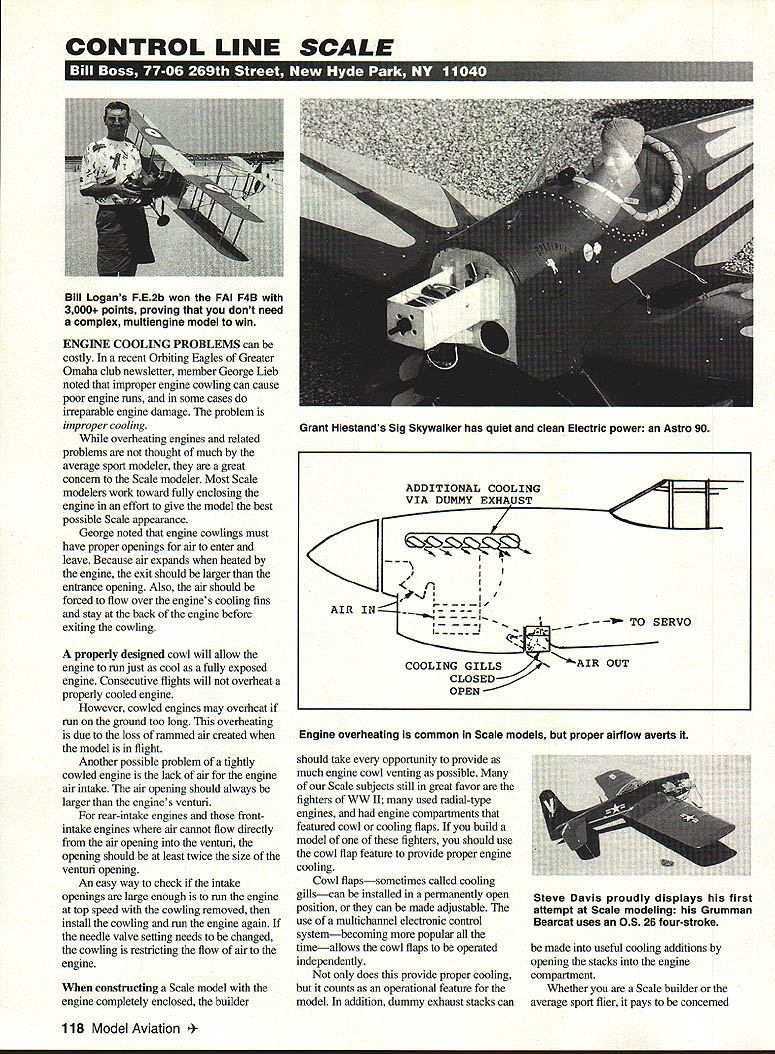
ENGINE COOLING PROBLEMS can be costly. In a recent Orbiting Eagles of Greater Omaha club newsletter, member George Lieb noted that improper engine cowling can cause poor engine runs and, in some cases, irreparable engine damage. The problem is improper cooling.
While overheating engines and related problems are not thought of much by the average sport modeler, they are a great concern to the scale modeler. Most scale modelers work toward fully enclosing the engine in an effort to give the model the best possible scale appearance.
George noted that engine cowlings must have proper openings for air to enter and leave. Because air expands when heated by the engine, the exit should be larger than the entrance opening. Also, the air should be forced to flow over the engine's cooling fins and stay at the back of the engine before exiting the cowling.
A properly designed cowl will allow the engine to run just as cool as a fully exposed engine. Consecutive flights will not overheat a properly cooled engine.
However, cowled engines may overheat if run on the ground too long. This overheating is due to the loss of ram air created when the model is in flight.
Another possible problem of a tightly cowled engine is a lack of air for the engine air intake. The air opening should always be larger than the engine's venturi.
For rear-intake engines and for those front-intake engines where air cannot flow directly from the air opening into the venturi, the opening should be at least twice the size of the venturi opening.
An easy way to check if the intake openings are large enough is to:
- Run the engine at top speed with the cowling removed.
- Install the cowling and run the engine again.
- If the needle valve setting needs to be changed, the cowling is restricting the flow of air to the engine.
When constructing a scale model with the engine completely enclosed, the builder should take every opportunity to provide as much engine cowl venting as possible. Many popular scale subjects are WWII fighters; many used radial-type engines and had engine compartments that featured cowl or cooling flaps. If you build a model of one of these fighters, you should use the cowl flap feature to provide proper engine cooling.
Cowl flaps—sometimes called cooling gills—can be installed in a permanently open position, or they can be made adjustable. The use of a multichannel electronic control system—becoming more popular all the time—allows the cowl flaps to be operated independently.
Not only does this provide proper cooling, but it counts as an operational feature for the model. In addition, dummy exhaust stacks can be made into useful cooling additions by opening the stacks into the engine compartment.
Whether you are a scale builder or the average sport flier, it pays to be concerned about engine overheating. A couple hours on the workbench ensuring the engine will have adequate cooling can save hours of aggravation at the flying field — you might also save the engine.
Book Review: Ironworks by Terry Treadwell
Ironworks by Terry Treadwell is the story of the Grumman Aircraft Corporation and the amazingly strong and dependable planes that it produced. The book covers the Grumman company from its inception in 1930 to present-day activities in our country's space programs.
The author begins with the FF-1 and F2F-1 biplanes, which were the first of a long series of planes used by the U.S. Navy. Among the more famous Grumman planes featured are the F4F Wildcat, F6F Hellcat, TBF/TBM Avenger, F2F-2 Guardian, F9F Panther/Cougar, S-2 Tracker, the Ag-Cat (a specially designed biplane for crop dusting), and jets such as the A-6 Intruder, the F-14 Tomcat, and the Grumman X-29 FSW (Forward Swept Wing), an experimental single-seat fighter.
The book has excellent photos, history, technical data, and includes cutaway drawings of most of the planes. While the book does not feature three-views, the information presented is good reading and might even convince you to build a model of one of Grumman's great aircraft.
Ironworks is available at many local bookstores, such as Barnes & Noble, and is also available through Zenith Books: P.O. Box 1, Osceola, WI 54020. Cat. #115630AE. The hardbound, 176-page book is designated as ISBN 0-87938-488-3, measures 8½ inches x 12 inches, and has approximately 200 illustrations. The cost is less than $15.
New club
A note from Royce Fine of Tampa, Florida, informed me of a new control-line club there: the Tampa Line Flyers. Fifteen interested and enthusiastic members had their first meeting in November 1993; several founding members are interested in both CL Scale and carrier events.
The club has applied for AMA charter club status; it will be putting out a newsletter and is in the process of looking for flying fields and appropriate flying sites. Anyone in Tampa or the surrounding area interested in participating in this new CL club's activities should contact the Tampa Line Flyers at:
Tampa Line Flyers 4319 Tyson Ave. Tampa, FL 33611
Good luck in your new endeavor. We hope to hear about your club's scale activities in the future.
National competition photos
As most of you probably know, Stan Alexander, NASA newsletter editor, covered the CL Scale events at the 1993 NATS, and his write-up of the events appeared in the December 1993 issue of Model Aviation.
Stan recently sent a large batch of photographs covering many of the models not in the December issue. I would like to thank Stan, and I will try to use them in various columns throughout the year.
It will give me an opportunity to show readers more of what was flown at the national competition, as well as the competitors who stand behind the handle. I won't be writing much about the models, since Stan did an excellent job of that.
I have started this month with Californian Grant Hiestand's electric-powered J-Scale Skywalker that placed first in the precision event. The other model is the RAF FE2b by Bill Logan of London, Ontario, Canada, that placed first in the F4B event (FAI Scale).
Please send ideas, notices of upcoming CL Scale events, contest reports, and especially photos of CL Scale activity to me at the address at the very top of this column.
Transcribed from original scans by AI. Minor OCR errors may remain.

