
CONTROL LINE SCALE
Bill Boss, 77-06 269th St., New Hyde Park, NY 11040
Three-view drawings and Frank Beatty's (Granite City, IL) latest Scale model are the main themes of this month's column.
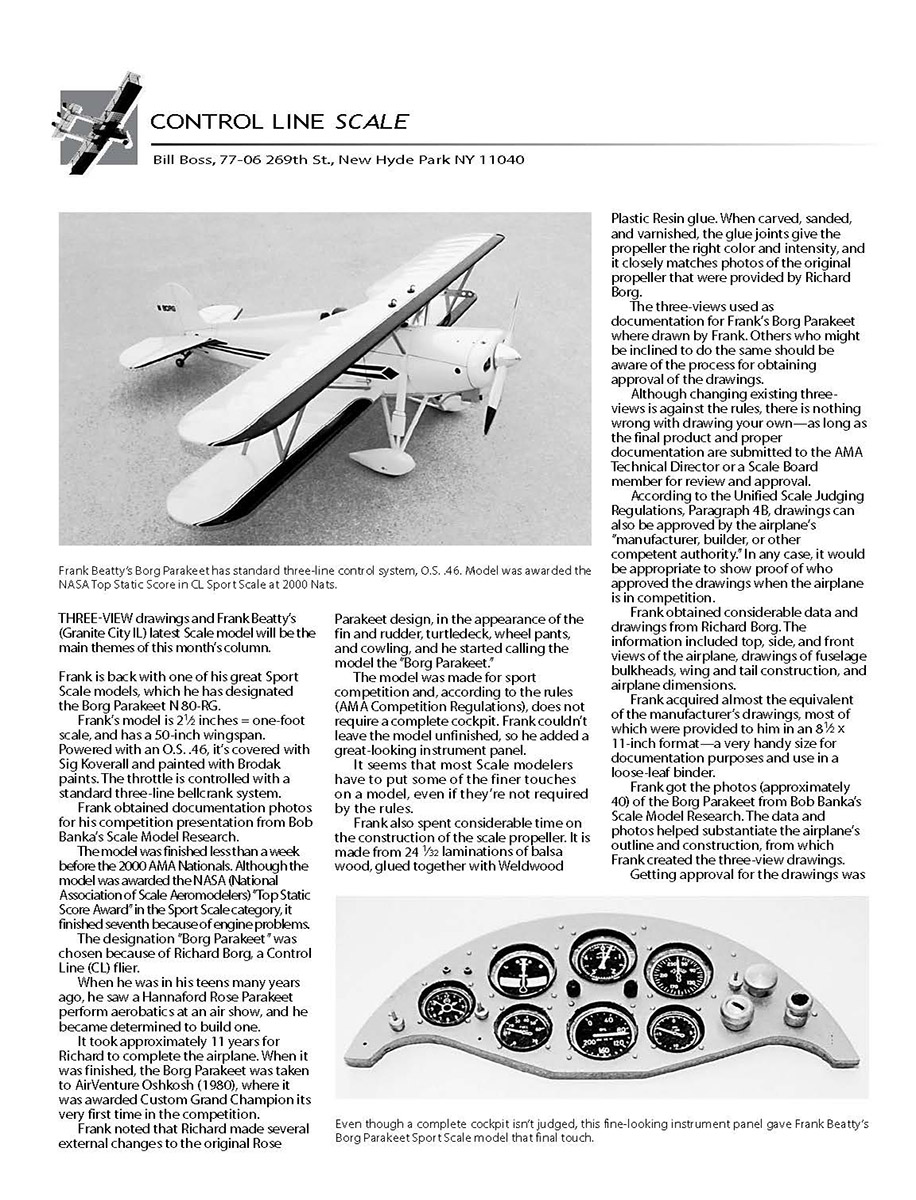
Frank Beatty's Borg Parakeet N-80-RG
Frank is back with one of his great Sport Scale models, which he has designated the Borg Parakeet N-80-RG. Frank's model is 2½ inches = one-foot scale and has a 50-inch wingspan. Powered with an O.S. .46, it's covered with Sig Koverall and painted with Brodak paints. The throttle is controlled with a standard three-line bellcrank system.
Frank obtained documentation photos for his competition presentation from Bob Banka's Scale Model Research. The model was finished less than a week before the 2000 AMA Nationals. Although the model was awarded the NASA (National Association of Scale Aeromodelers) "Top Static Score Award" in the Sport Scale category, it finished seventh because of engine problems.
The designation "Borg Parakeet" was chosen because of Richard Borg, a Control Line (CL) flier. When he was in his teens many years ago, he saw a Hannaford Rose Parakeet perform aerobatics at an air show, and he became determined to build one. It took approximately 11 years for Richard to complete the airplane. When it was finished, the Borg Parakeet was taken to AirVenture Oshkosh (1980), where it was awarded Custom Grand Champion its very first time in the competition.
Frank noted that Richard made several external changes to the original Rose Parakeet design and started calling the model the "Borg Parakeet." Changes included:
- fin and rudder appearance
- turtledeck
- wheel pants
- cowling
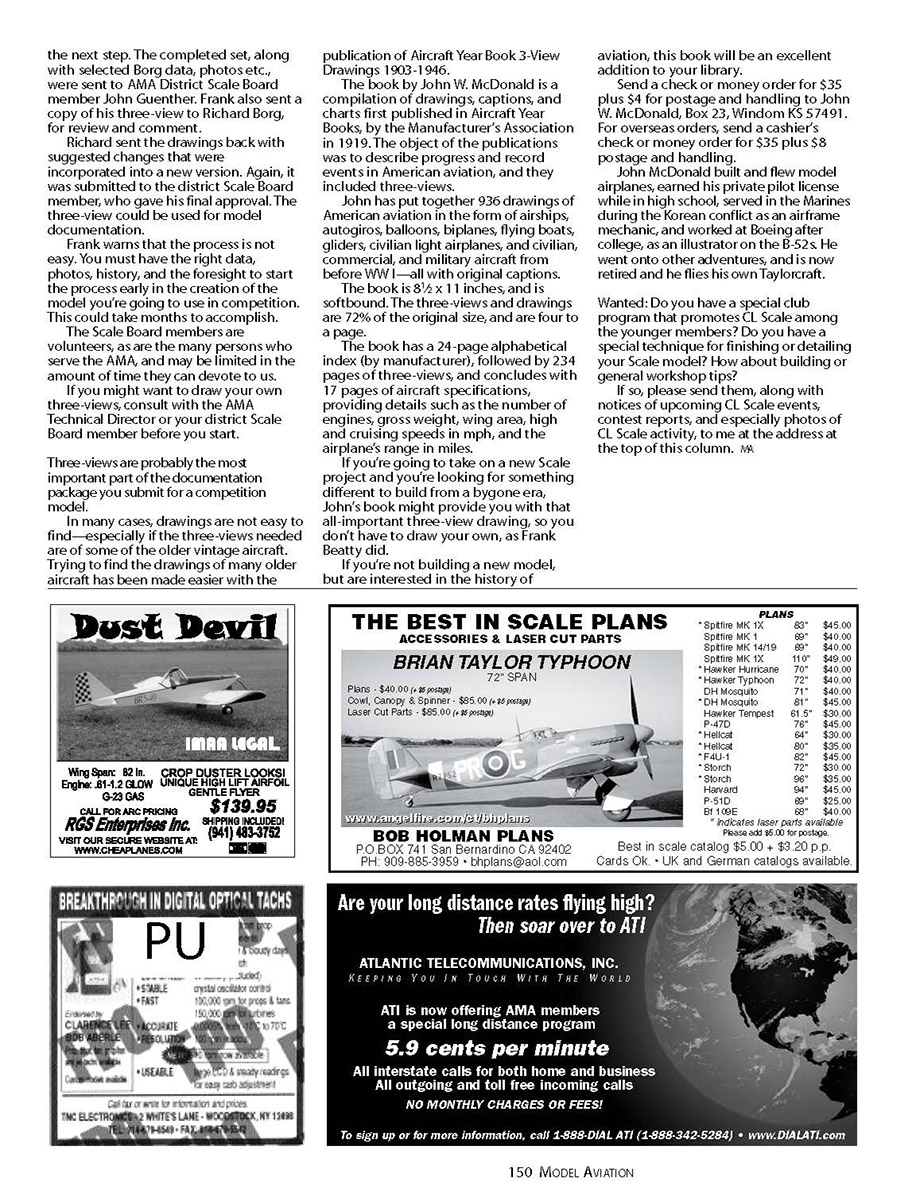
The model was made for sport competition and, according to the rules (AMA Competition Regulations), does not require a complete cockpit. Frank couldn't leave the model unfinished, so he added a great-looking instrument panel. It seems that most Scale modelers have to put some of the finer touches on a model, even if they're not required by the rules.
Frank also spent considerable time on the construction of the scale propeller. It is made from 24 laminations of 1/32" balsa wood, glued together with Weldwood Plastic Resin glue. When carved, sanded, and varnished, the glue joints give the propeller the right color and intensity, and it closely matches photos of the original propeller that were provided by Richard Borg.
Three-view drawings and documentation
The three-views used as documentation for Frank's Borg Parakeet were drawn by Frank. Others who might be inclined to do the same should be aware of the process for obtaining approval of the drawings.
Although changing existing three-views is against the rules, there is nothing wrong with drawing your own — as long as the final product and proper documentation are submitted to the AMA Technical Director or a Scale Board member for review and approval. According to the Unified Scale Judging Regulations, Paragraph 4B, drawings can also be approved by the airplane's "manufacturer, builder, or other competent authority." In any case, it would be appropriate to show proof of who approved the drawings when the airplane is in competition.
Frank obtained considerable data and drawings from Richard Borg. The information included:
- top, side, and front views of the airplane
- drawings of fuselage bulkheads
- wing and tail construction
- airplane dimensions
Frank acquired almost the equivalent of the manufacturer's drawings, most of which were provided to him in an 8½ x 11-inch format — a very handy size for documentation purposes and use in a loose-leaf binder. Frank got the photos (approximately 40) of the Borg Parakeet from Bob Banka's Scale Model Research. The data and photos helped substantiate the airplane's outline and construction, from which Frank created the three-view drawings.
Getting approval for the drawings was the next step. The completed set, along with selected Borg data, photos, and so on, were sent to AMA District Scale Board member John Guenther. Frank also sent a copy of his three-view to Richard Borg for review and comments. Richard sent the drawings back with suggested changes that were incorporated into a new version. Again, it was submitted to the district Scale Board member, who gave his final approval. The three-view could then be used for model documentation.
Frank warns that the process is not easy. You must have the right data, photos, history, and the foresight to start the process early in the creation of the model you're going to use in competition. This could take months to accomplish. The Scale Board members are volunteers, as are the many persons who serve the AMA, and may be limited in the amount of time they can devote to us. If you might want to draw your own three-views, consult with the AMA Technical Director or your district Scale Board member before you start.
Three-views are probably the most important part of the documentation package you submit for a competition model. In many cases, drawings are not easy to find—especially for older vintage aircraft.
Aircraft Year Book 3-View Drawings 1903-1946 (John W. McDonald)
Trying to find the drawings of many older aircraft has been made easier with the publication of Aircraft Year Book 3-View Drawings 1903-1946. The book by John W. McDonald is a compilation of drawings, captions, and charts first published in Aircraft Year Books by the Manufacturer's Association beginning in 1919. The object of the publications was to describe progress and record events in American aviation, and they included three-views.
John put together 936 drawings of American aviation in the form of airships, autogiros, balloons, biplanes, flying boats, gliders, civilian light airplanes, and civilian, commercial, and military aircraft from before WWI—all with original captions.
The book is 8½ x 11 inches and is softbound. The three-views and drawings are 72% of the original size and are four to a page. The book has a 24-page alphabetical index (by manufacturer), followed by 234 pages of three-views, and concludes with 17 pages of aircraft specifications, providing details such as engine names, gross weight, wing area, high and cruising speeds in mph, and the airplane's range in miles.
If you're going to take on a new Scale project and you're looking for something different to build from a bygone era, John's book might provide you with that all-important three-view drawing so you don't have to draw your own, as Frank Beatty did. If you're not building a new model but are interested in the history of aviation, this book will be an excellent addition to your library.
Order information:
- Send a check or money order for $35 plus $4 postage and handling to:
John W. McDonald, Box 23, Windom KS 57491
- For overseas orders, send a cashier's check or money order for $35 plus $8 postage and handling.
John McDonald built and flew model airplanes, earned his private pilot license while in high school, served in the Marines during the Korean conflict as an airframe mechanic, and worked at Boeing after college as an illustrator on the B-52s. He went on to other adventures, and is now retired; he flies his own Taylorcraft.
Wanted
Do you have a special club program that promotes CL Scale among younger members? Do you have a special technique for finishing or detailing your Scale model? How about building or general workshop tips?
If so, please send them, along with notices of upcoming CL Scale events, contest reports, and especially photos of CL Scale activity, to me at the address at the top of this column.
MM
Transcribed from original scans by AI. Minor OCR errors may remain.

