
CONTROL LINE SCALE
Bill Boss, 77-06 269th St., New Hyde Park, NY 11040
Documentation — or the lack of it — for models entered in competition was the main subject in the February 2001 column. I explored the importance of obtaining an up-to-date copy of the AMA Competition Regulations and making yourself aware of what is required for any Control Line (CL) Scale event you enter.
I wrote about using the CL Sport Scale Worksheet (Part 1) as a guide for presentation requirements, which would help you obtain a good static score. I also noted that I would explore what information and type of layout might be provided within the eight-page maximum allowed for model documentation in the Sport and Profile Scale events.
It's important that the documentation presented contains data that would satisfy all rule requirements and allow judges to fairly and easily static-score a model. The following is not only a review for the experienced scale modeler, but, more importantly, is for the modeler considering CL Scale for the first time.
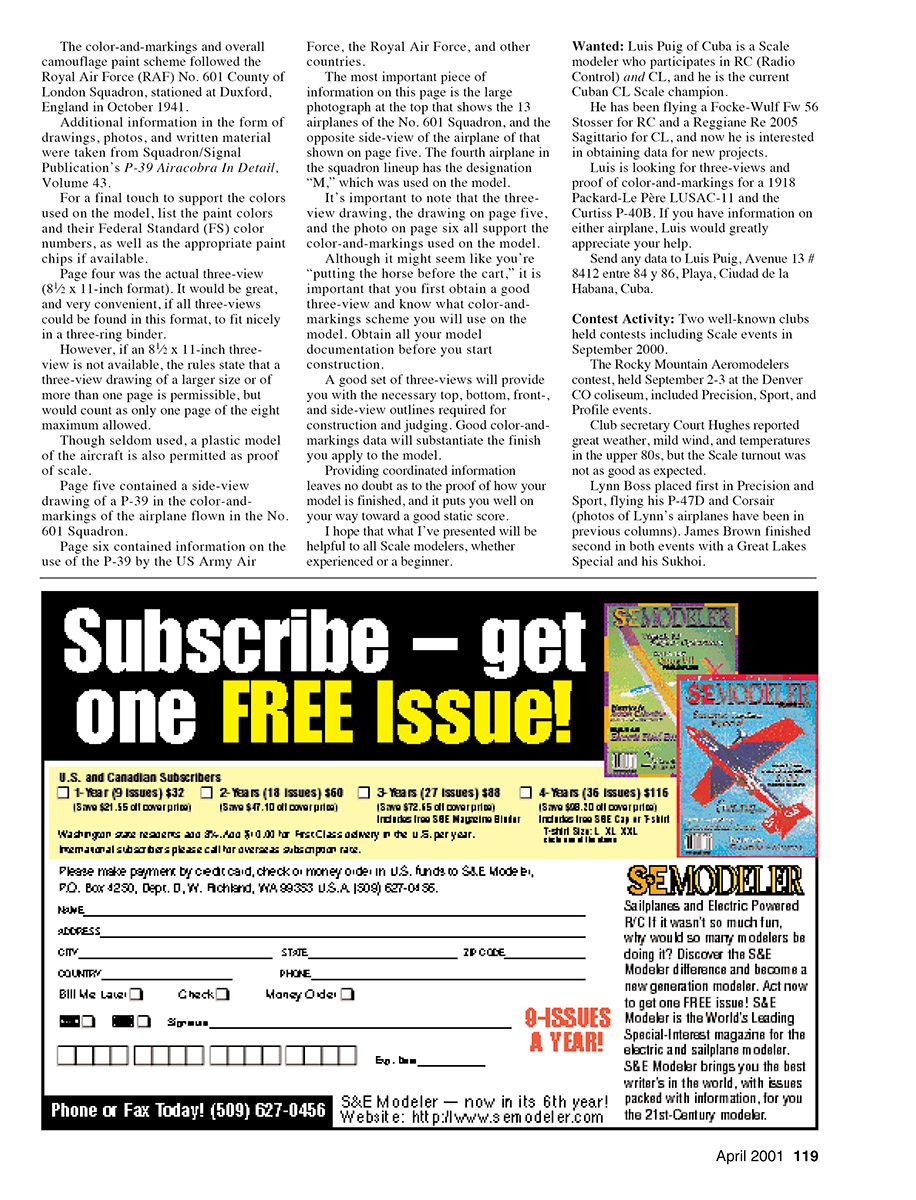
A documentation presentation can be made in six 8½ x 11-inch pages (put in a three-ring binder). As an example of what a presentation might include, I will discuss the documentation I used for the P-39 Airacobra.
Example documentation layout: P-39 Airacobra
- Page one contained:
- The name and model of the airplane
- My name, address, and AMA number
- Information relating to the scale of the model
- The name and size of the engine
- The model's weight (important to judges for pull-test purposes)
- Page two detailed the model's operational features:
- Retractable landing gear, split flaps, engine cutoff, and throttle
- How the operational features are controlled:
- Landing-gear retraction, engine cutoff, and split flaps were operated using a three-channel electronic system.
- Throttle control was operated by a standard three-line bellcrank system.
- Using the two systems met the rule requirement that flap operation be independent of throttle control.
- Note: All the operational features could be operated through a four-channel electronic system. The choice of system is yours.
- Page three included information about the three-views and the color-and-markings used on the model:
- The three-views were taken from the June/July 1963 issue of Air Progress magazine.
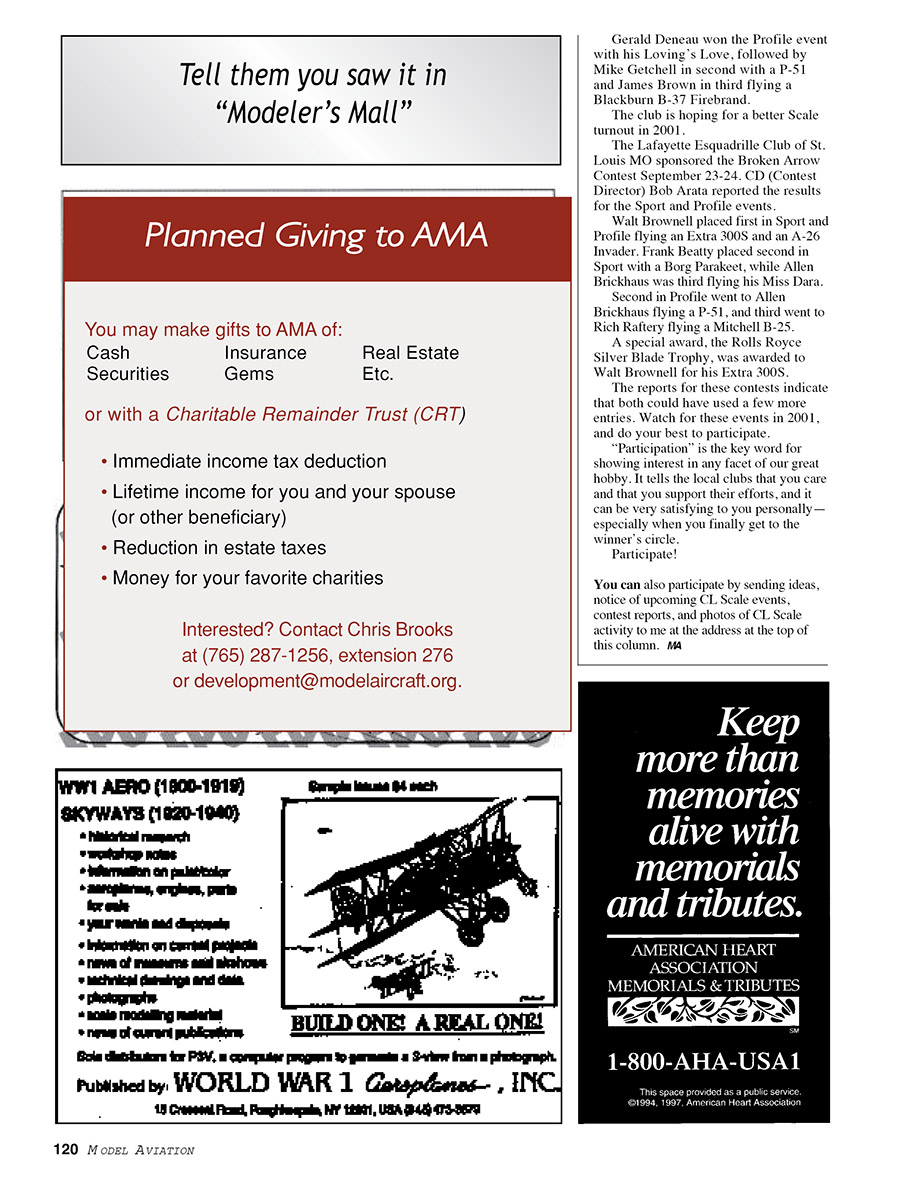
- The color-and-markings and overall camouflage paint scheme followed Royal Air Force (RAF) No. 601 County of London Squadron, stationed at Duxford, England in October 1941.
- Additional drawings, photos, and written material were taken from Squadron/Signal Publication's P-39 Airacobra In Detail, Volume 43.
- For final support of the colors used on the model, list the paint colors and their Federal Standard (FS) numbers, and include paint chips if available.
- Page four was the actual three-view (8½ x 11-inch format):
- It is convenient if all three-views can be found in 8½ x 11 format to fit in a binder.
- If an 8½ x 11 three-view is not available, the rules allow a larger three-view or one on more than one page; it will still count as only one of the eight maximum pages.
- A plastic model of the aircraft is also permitted as proof of scale (though seldom used).
- Page five contained a side-view drawing of the P-39 in the color-and-markings of the airplane flown in No. 601 Squadron.
- Page six contained information on the use of the P-39 by the US Army Air Force, the Royal Air Force, and other countries:
- The most important item on this page was a large photograph at the top showing the 13 airplanes of No. 601 Squadron, and the opposite side-view of the airplane shown on page five.
- The fourth airplane in the squadron lineup has the designation "M," which was used on the model.
It's important to note that the three-view drawing, the drawing on page five, and the photo on page six all support the color-and-markings used on the model.
Although it might seem like you're "putting the horse before the cart," it is important that you first obtain a good three-view and know what color-and-markings scheme you will use on the model. Obtain all your model documentation before you start construction.
A good set of three-views will provide the necessary top, bottom, front, and side outlines required for construction and judging. Good color-and-markings data will substantiate the finish you apply to the model. Providing coordinated information leaves no doubt as to the proof of how your model is finished, and it puts you well on your way toward a good static score.
I hope that what I've presented will be helpful to all scale modelers, whether experienced or a beginner.
Recent contest results
- Gerald Deneau won the Profile event with his Loving's Love.
- Mike Getchell placed second in Profile with a P-51.
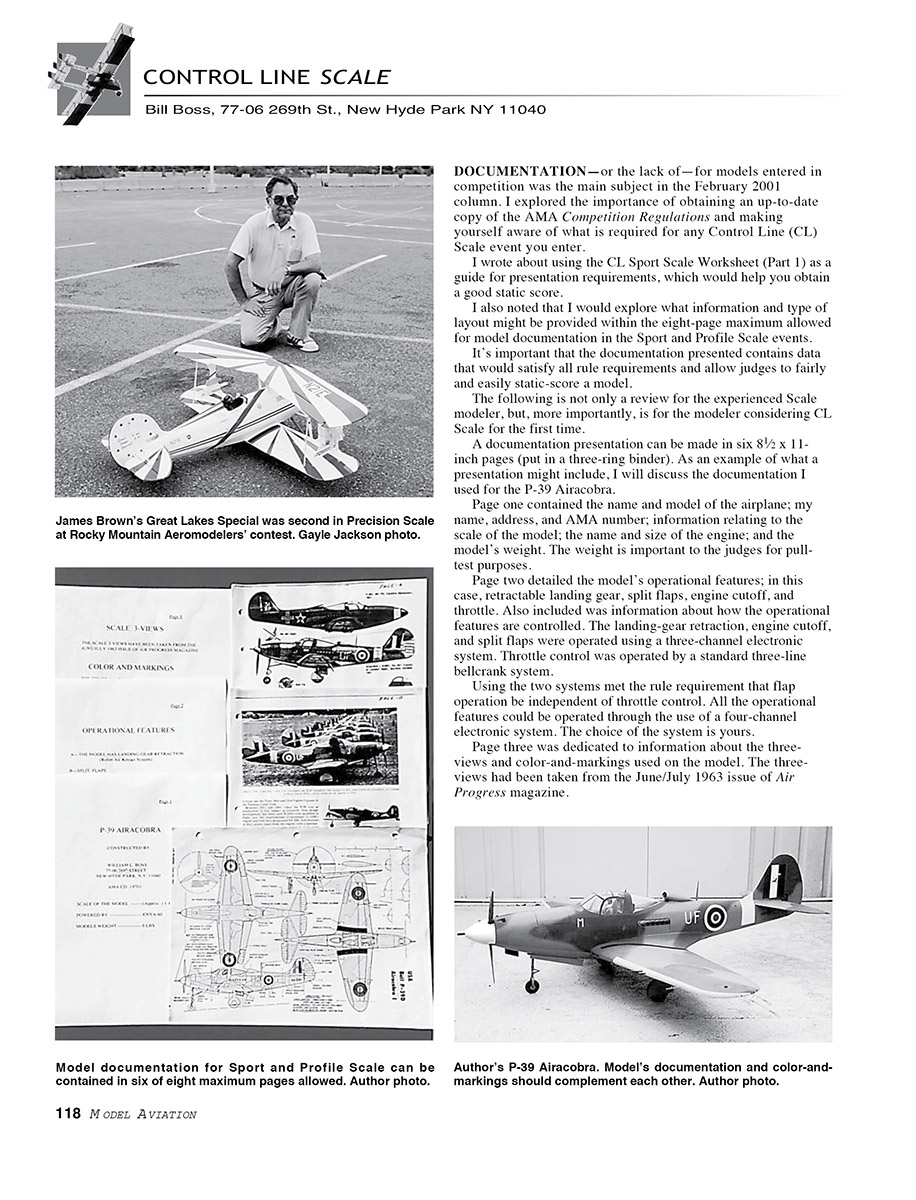
- James Brown placed third in Profile flying a Blackburn B-37 Firebrand.
The club is hoping for a better Scale turnout in 2001.
The Lafayette Esquadrille Club of St. Louis, MO sponsored the Broken Arrow Contest September 23–24. CD (Contest Director) Bob Arata reported the results for the Sport and Profile events:
- Walt Brownell placed first in Sport and Profile, flying an Extra 300S and an A-26 Invader.
- Frank Beatty placed second in Sport with a Borg Parakeet.
- Allen Brickhaus placed third in Sport flying his Miss Dara.
- In Profile, Allen Brickhaus placed second flying a P-51.
- Rich Raftery placed third in Profile flying a Mitchell B-25.
- A special award, the Rolls Royce Silver Blade Trophy, was awarded to Walt Brownell for his Extra 300S.
The reports for these contests indicate that both could have used a few more entries. Watch for these events in 2001, and do your best to participate.
"Participation" is the key word for showing interest in any facet of our great hobby. It tells the local clubs that you care and that you support their efforts, and it can be very satisfying to you personally—especially when you finally get to the winner's circle.
Participate!
You can also participate by sending ideas, notice of upcoming CL Scale events, contest reports, and photos of CL Scale activity to me at the address at the top of this column.
MA
Transcribed from original scans by AI. Minor OCR errors may remain.

