
CONTROL LINE SCALE
Bill Boss, 77-06 269th St., New Hyde Park, NY 11040
CONTROL LINE (CL) Team Scale has been run at some local CL club meets for several years. The Garden State Circle Burners (GSCB) club in NJ has successfully promoted the event at its annual all-scale meet, using its own set of rules.
The event is offered to CL Scale builders who would like to participate in the sanctioned Scale competition but are unable to complete the flying portion. The inability to fly the model is often caused by a physical disability that precludes spinning in a circle or enduring the model’s pull.
Based on the experience and success of local clubs, it was thought there might also be CL Scale builders who would like to compete at the national level but are unable to fly their models.
Mike Welshans, vice president of the National Association of Scale Aeromodelers (NASA), and Chuck Meyers of the Queen City U-Control Club (OH) informed me that Team Scale will be offered at the 2001 Scale Nationals, to be held July 6–8 at the national flying site in Muncie, IN. The event will be sponsored by the Queen City U-Control Club.
These dates were posted in the November/December 2000 issue of Replica, NASA’s newsletter, and are a correction to the dates published in the CL Scale Nationals results in the December 2000 Model Aviation.
Rules that will be used at the national competition are as follows.
Static and flight judging will be done in accordance with the rules governing the CL Sport Scale event (509), except as noted:
- Eligibility: The team will consist of the builder of the model and the pilot/flier.
- The model’s construction can also be a team effort; i.e., the pilot/flier can be involved in the building.
- The builder of the model must be listed as part of the team and must be present at the competition.
The object of promoting this event for the national competition—as well as for use at the local contest level—is not only to promote more participation in CL Scale modeling, but to give those who may have retired from Scale events another chance to put their work on display and in the air. The event also provides a great opportunity for modeling friends to get together on a team project.
AEROMODELING: HOBBY OR SPORT?
This topic was explored in Frank McMillan’s CL Aerobatics column (February 2001 Model Aviation) and in the column by Aeromodeling Editor Bob Hunt. Their discussions were based on an item by John Brodak in the November/December 2000 issue of Replica. I spoke with Bob by telephone about the article, and at the conclusion of our conversation I decided I would provide some of my thoughts on the subject.
Modeling activity has evolved from what was called a “hobby of building and flying model airplanes” to a highly sophisticated sport of aeromodeling. Today’s aeromodeling can be broken into two categories: recreational and competitive—removing the hobby connotation.
The recreational side of the sport can be considered as belonging to those modelers who participate in building and flying their models for the great joy of seeing something they have put together get into the air and return to earth undamaged. This modeler would most likely be building or using Almost Ready to Fly (ARF) and Ready to Fly (RTF) type models, whether CL, Radio Control (RC), or Free Flight (FF). At any model aircraft trade show you will see many manufacturers promoting almost-completed models that have the shape, color, and markings that make them look very much like the real thing and interesting for any spectator who may be watching. This type of modeler is primarily interested in enjoying a day of recreational model flying and doesn't want the hassle of rules and competition.
The other side of the sport is for the more serious modeler who is dedicated to the world of competition, whether it be local, national, or international.
I depart from a statement in Bob Hunt's column. He noted that the flying of our models would indeed be a sport, but that the building portion of our activity might still be considered a hobby.
I believe that for the competitor, building and flying must be considered as the whole sport.
Does the driver of a dragster consider the building of his/her car a hobby, and running down the strip a sport? Does the builder of an experimental airplane consider the building as his/her hobby, and flying as the sport? All the technical stuff that went into building the car or airplane is certainly a great part of the sport.
One of the things you must not forget is that the competitor in our sport is governed by rules and regulations and is compelled to build and fly his/her own creation. All the technical things that we employ in or build into our models, and the time spent before the finished product gets to the flying field, must be considered in the competitive side of our sport.
We are no longer in the years when our models were limited to doing a few simple things. We have come a long way in the sophistication and operation of our models.
RC aircraft are so sophisticated in control and power plants that they are capable of performing any kind of maneuver done by the prototype. This applies to the earliest biplanes as well as the most technically advanced turbine-powered jet models.
CL modeling has also seen some great advances. How about Speed events, where advances in engine technology have given speeds in the 200 mph range? Is building or modifying the engines to accomplish this considered a hobby and flying considered the sport? It is the engine development that makes the event.
Use of encoders and decoders (electronic systems), sending digital signals over a pair of wires, has allowed the CL modeler (especially in Scale) to add many independent operations to the model in a reliable manner, such as flaps, landing gear, bomb and tank drop, opening and closing a canopy, operating bomb bay doors, throttle control, engine cutoff, and more.
I don't think you can separate the building from the flying, and you must consider everything you do as part of the sport. Promoting the "sport of aeromodeling" is a task for all of us.
Every time you have the opportunity to bring the activity before the public, you must talk in terms of the "sport." Clubs and manufacturers who put on shows in local malls or civic centers might refer to their shows as the sport of aeromodeling, rather than as hobby shows.
When dealing with city or town officials, you must promote the idea that the sport you are engaged in is not only the flying of models but includes many hours, weeks, or months achieving what is seen at the flying field. The educational and learning experience, as well as the development of manual dexterity, should be stressed.
John Brodak said it best in his letter when he noted that it is time to end the "playing with toy airplanes" mind-set and that model aviation should be recognized as a respected sport.
The sport of aeromodeling is in your hands to promote.
Contest Activity:
The Indy Sportliners will hold the Al Pitts Memorial Contest Sunday, June 3, 2001, at the AMA International Aeromodeling Center, Muncie, IN. Beginner, Intermediate, Advanced, and Expert Precision Aerobatics will be flown.
AMA Sport and Profile and a Fun Scale event using the flight scoring of the Sport event will be offered in the Scale category.
John Davis, (317) 861-9990, will be directing the Stunt events and George Kite will be directing the Scale events. Call or write to George Kite, 109 N. Denny St., Indianapolis, IN 46201; Tel: (317) 356-4777 for a flyer.
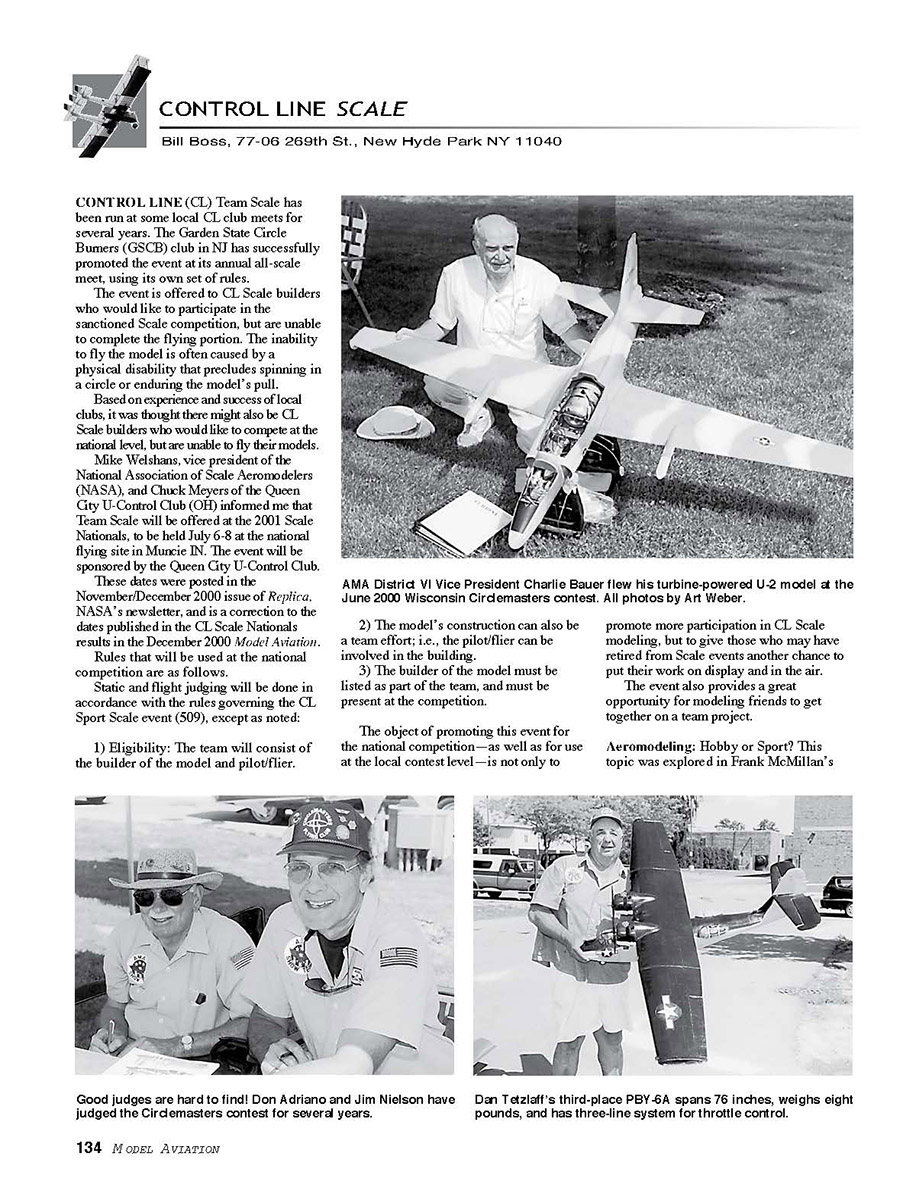
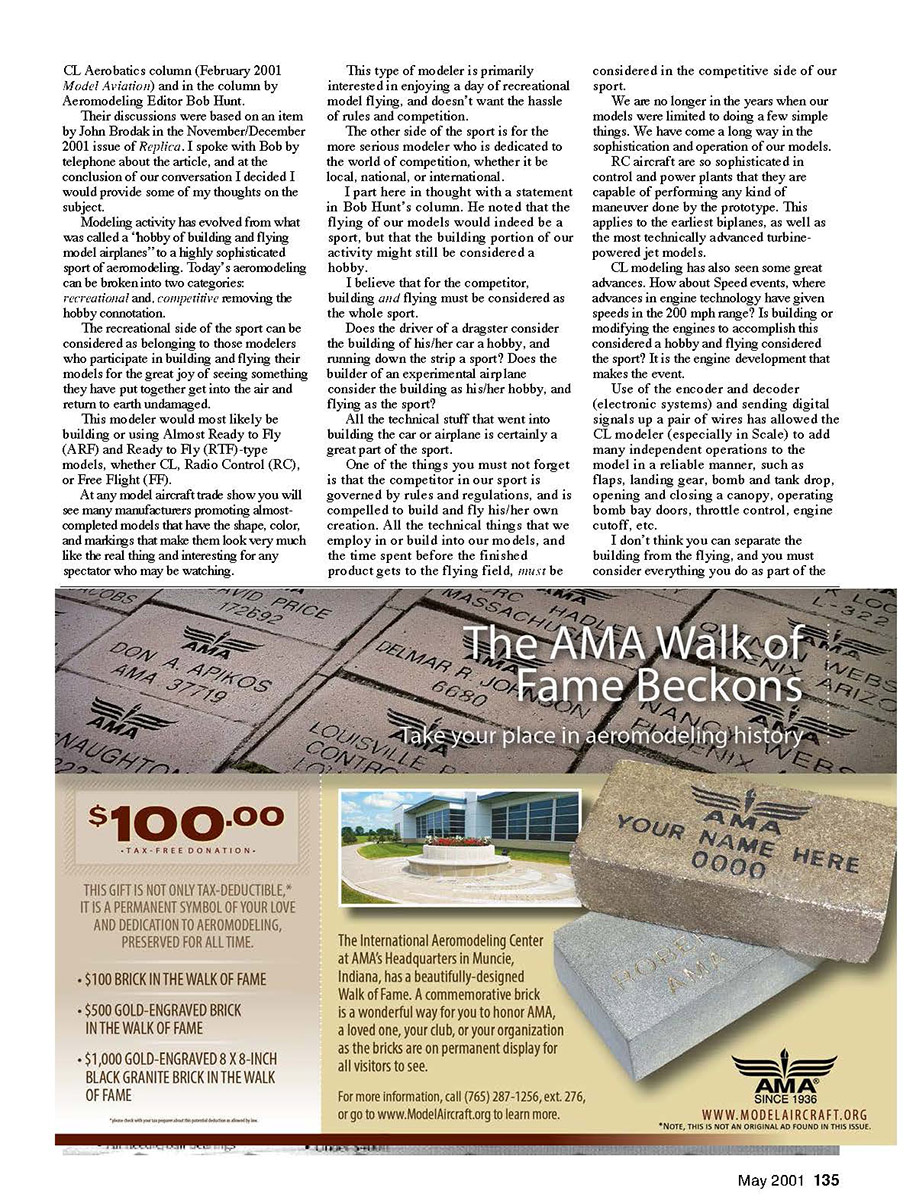
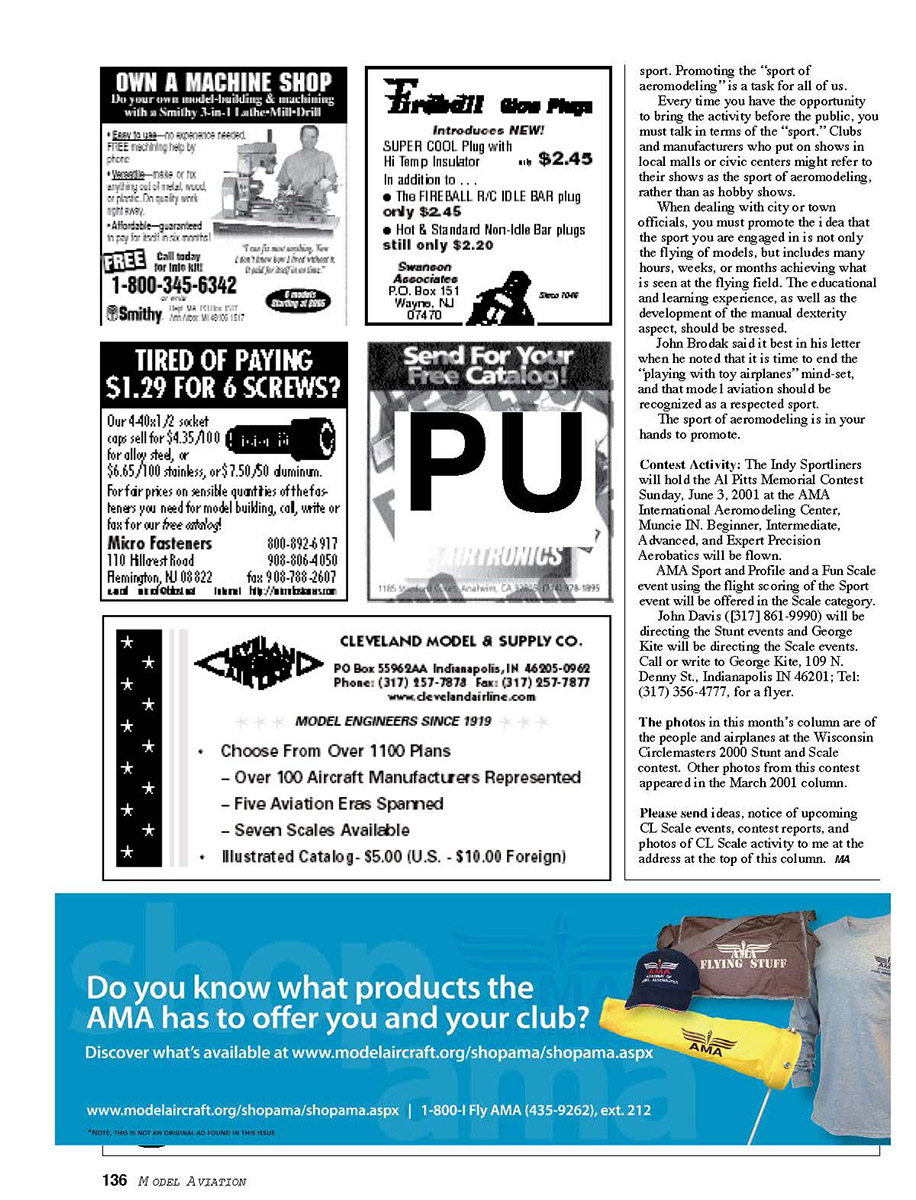
The photos in this month's column are of the people and airplanes at the Wisconsin Circlemasters 2000 Stunt and Scale contest. Other photos from this contest appeared in the March 2001 column.
Please send ideas, notices of upcoming CL Scale events, contest reports, and photos of CL Scale activity to me at the address at the top of this column. MA
Transcribed from original scans by AI. Minor OCR errors may remain.

