
CONTROL LINE SCALE
Bill Boss 77-06 269th St., New Hyde Park, NY 11040
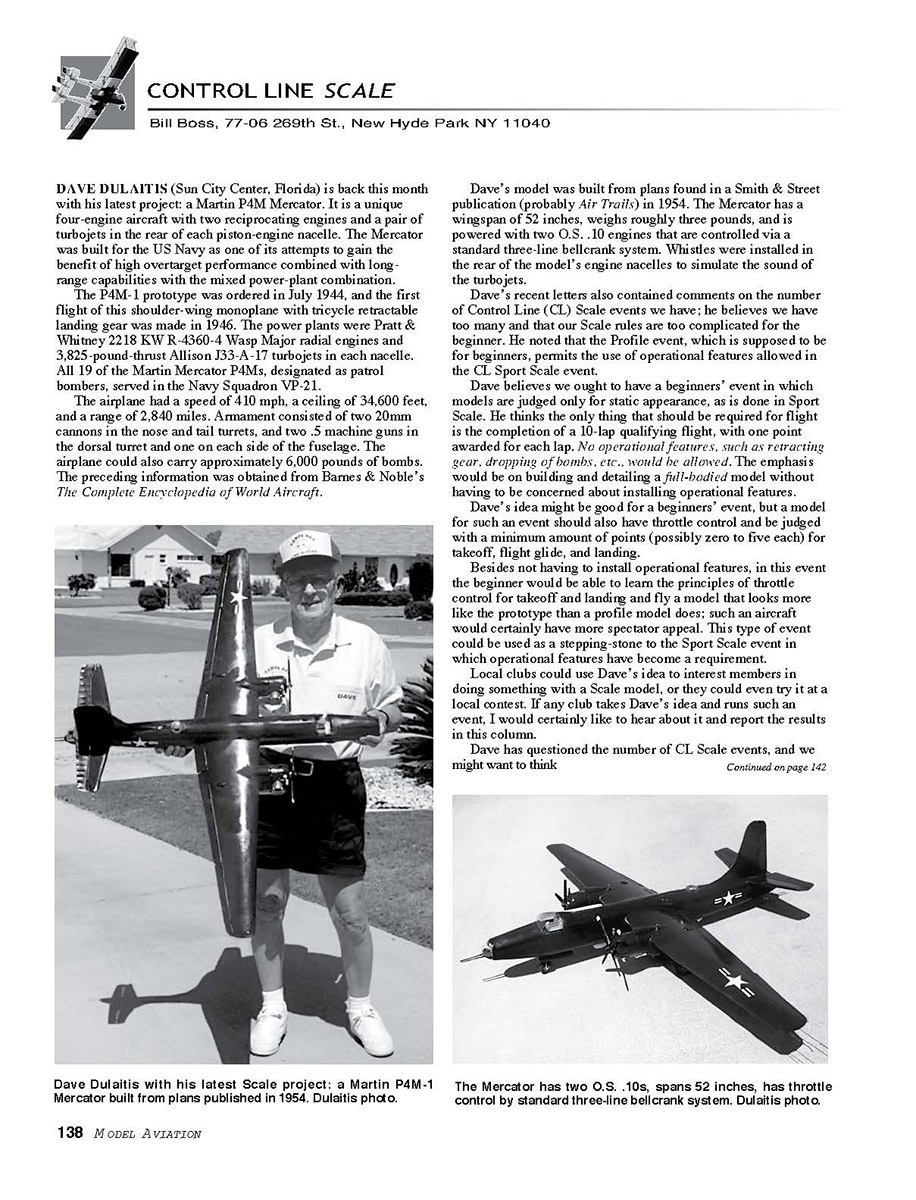
Martin P4M Mercator — Dave Dulaitis's Model
DAVE DULAITIS (Sun City Center, Florida) is back this month with his latest project: a Martin P4M Mercator. It is a unique four-engine aircraft with two reciprocating engines and a pair of turbojets in the rear of each piston-engine nacelle. The Mercator was built for the U.S. Navy as one of its attempts to gain the benefit of high over‑target performance combined with long-range capabilities using the mixed power-plant combination.
The P4M-1 prototype was ordered in July 1944, and the first flight of this shoulder-wing monoplane with tricycle retractable landing gear was made in 1946. The power plants were Pratt & Whitney R-4360-4 Wasp Major radial engines and 3,825 lb‑thrust Allison J33-A-17 turbojets in each nacelle. All 19 Martin Mercator P4Ms, designated as patrol bombers, served in Navy Squadron VP-21.
Aircraft specifications (as reported in The Complete Encyclopedia of World Aircraft):
- Speed: 410 mph
- Service ceiling: 34,600 ft
- Range: 2,840 miles
- Armament: two 20 mm cannons in nose and tail turrets; two .50-cal machine guns in the dorsal turret and one on each side of the fuselage
- Bomb load: approximately 6,000 lb
The preceding information was obtained from Barnes & Noble's The Complete Encyclopedia of World Aircraft.
Dave's model was built from plans found in a Smith & Street publication (probably Air Trails) in 1954. The Mercator model has a wingspan of 52 inches, weighs roughly three pounds, and is powered with two O.S. .10 engines controlled via a standard three-line bellcrank system. Whistles were installed in the rear of the model's engine nacelles to simulate the sound of the turbojets.
Discussion: CL Scale Events and a Beginner Proposal
Dave's recent letters also contained comments on the number of Control Line (CL) Scale events we have; he believes we have too many and that our Scale rules are too complicated for the beginner. He noted that the Profile event, which is supposed to be for beginners, permits the use of operational features allowed in the CL Sport Scale event. Dave believes we ought to have a beginners' event in which models are judged only for static appearance, as is done in Sport Scale.
His proposal for a beginners' event:
- Models judged primarily on static appearance (similar to Sport Scale)
- Flight requirement: completion of a 10-lap qualifying flight, with one point awarded per lap
- No operational features allowed (no retracting gear, bomb drops, etc.)
- Emphasis on building and detailing a full-bodied model without installing operational features
My view is that Dave's idea might be good for a beginners' event, but a model for such an event should also have throttle control and be judged with a minimal allocation of points (possibly 0–5 each) for takeoff, flight/glide, and landing. Besides not having to install operational features, this event would allow beginners to learn throttle control principles for takeoff and landing and fly a model that looks more like the prototype than a profile model does. Such aircraft would have greater spectator appeal.
This type of event could be used as a stepping-stone to the Sport Scale event where operational features are required. Local clubs could use Dave's idea to interest members in building a scale model, or even try it at a local contest. If any club runs such an event, please let me know so I can report the results in this column.
Dave has questioned the number of CL Scale events, and we might want to consider reducing them. One idea is to combine the Designer and Precision events to create a single ultimate CL Scale event judged by Precision rules but requiring models to be designed and built under Designer rules.
This would reduce CL Scale events to three:
- The ultimate event (Designer/Precision) for the expert modeler
- The Sport event for the intermediate modeler
- The Profile or the beginner event such as Dave has suggested
What are your thoughts?
Cradle of Aviation Museum (Mitchell Field, Garden City, NY)
The Cradle of Aviation Museum at Mitchell Field in Garden City, New York, reopened to visitors on May 13, 2002, on the 75th anniversary of Charles Lindbergh's New York-to-Paris trans‑Atlantic flight.
The revitalized museum has about 130,000 sq ft of space, the Reckson Center, a 300‑seat IMAX dome theater, an excellent aviation bookstore (useful for documentation), educational toys and gifts, a café, and more than 70 aircraft and space items on display. The aircraft include Lindbergh's Jenny and the Brunner Winkle Bird reportedly purchased to teach his wife Ann Morrow how to fly.
The museum is located on Charles Lindbergh Boulevard in Garden City and is open daily from 10 a.m. to 5 p.m. It's a great place to take the family or school classes to learn about Long Island's aviation and space heritage.
Directions: Take Meadowbrook State Parkway to Exit M4, follow signs to the Nassau Coliseum on Charles Lindbergh Boulevard. Go to the second traffic light and turn right into the museum parking lot.
For more information, visit: www.cradleofaviation.org
Wind Canyon Books
Wind Canyon Books, Inc. offers three books about the Golden Age of Aviation. The books provide details of the families, people, and manufacturing operations of many companies from the early 1900s through the Golden Age and World War II. Each book is softbound, 96–124 pages, filled with history, photos, and three‑view drawings in an 8.5 × 11‑inch format.
Wind Canyon also has all Paul Mattis scale airplane drawings in sheet form, two books, and a CD-ROM. SuperScale drawings are available in 24 × 36‑inch format for such airplanes as the P-47D Thunderbolt, Lockheed P-38, Spitfire Mk. I, and others. The drawings include complete structure, markings, and detail.
For cost and a complete listing of books and drawings, write to: Wind Canyon Books, Inc. Box 511, Brawley, CA 92227 or visit: www.windcanyonbooks.com
Workshop Tips
Bob Furr of the Orbiting Eagles club of Omaha, Nebraska, offers these tips:
- Rubbed joints: A close-fitting joint will often bond satisfactorily under atmospheric pressure without clamping. Wet both surfaces with glue, then rub them together to squeeze glue and air out of the joining components. This is called a "rubbed joint." Do not use this method if you need the parts clamped to ensure a precise fit.
- Gluing large balsa sheets: A bead of glue along a long edge can be hard to control. Fasten the sheets to the work surface with double-sided tape, then slice them back apart, leaving the tape on the two pieces. Glue the exposed side as usual; any excess glue beads will form on the tape, not the wood. When the glue is dry, pull the tape off—the excess glue comes with it—leaving the sheets nearly free of surface glue and minimizing sanding.
Please send news, notices of upcoming CL Scale events, contest reports, and especially photos of CL Scale activity to me at the address at the top of this column.
Transcribed from original scans by AI. Minor OCR errors may remain.

