
CONTROL LINE SCALE
Bill Boss, 77-06 269th St., New Hyde Park NY 11040
Rearwin Airplanes — brief history
Rearwin Airplanes was started in mid-1928 by Rae Rearwin, who engaged Fred Landgraf as a designer/engineer for the production of the first Rearwin aircraft. The venture was started because of the growing enthusiasm for sport aviation after Charles Lindbergh's successful flight across the Atlantic.
The first aircraft produced was the Rearwin Ken-Royce 2000C, named after Rae's sons Ken and Royce. The 2000C was a conventional unequal-span biplane seating three in tandem open cockpits and was powered by a 170-horsepower Curtiss Challenger engine. In spite of the aircraft's considerable success and good performance, only three were built.
Following the 2000C, Rearwin produced a string of aircraft that included the Junior models, the Sportsters, the Speedsters, the Cloudsters, and the Skyrangers. The Speedster is the focus of this column; two versions were built: the 6000 and the 6000-M.
Mike Welshans’ Rearwin Speedster (6000-M)
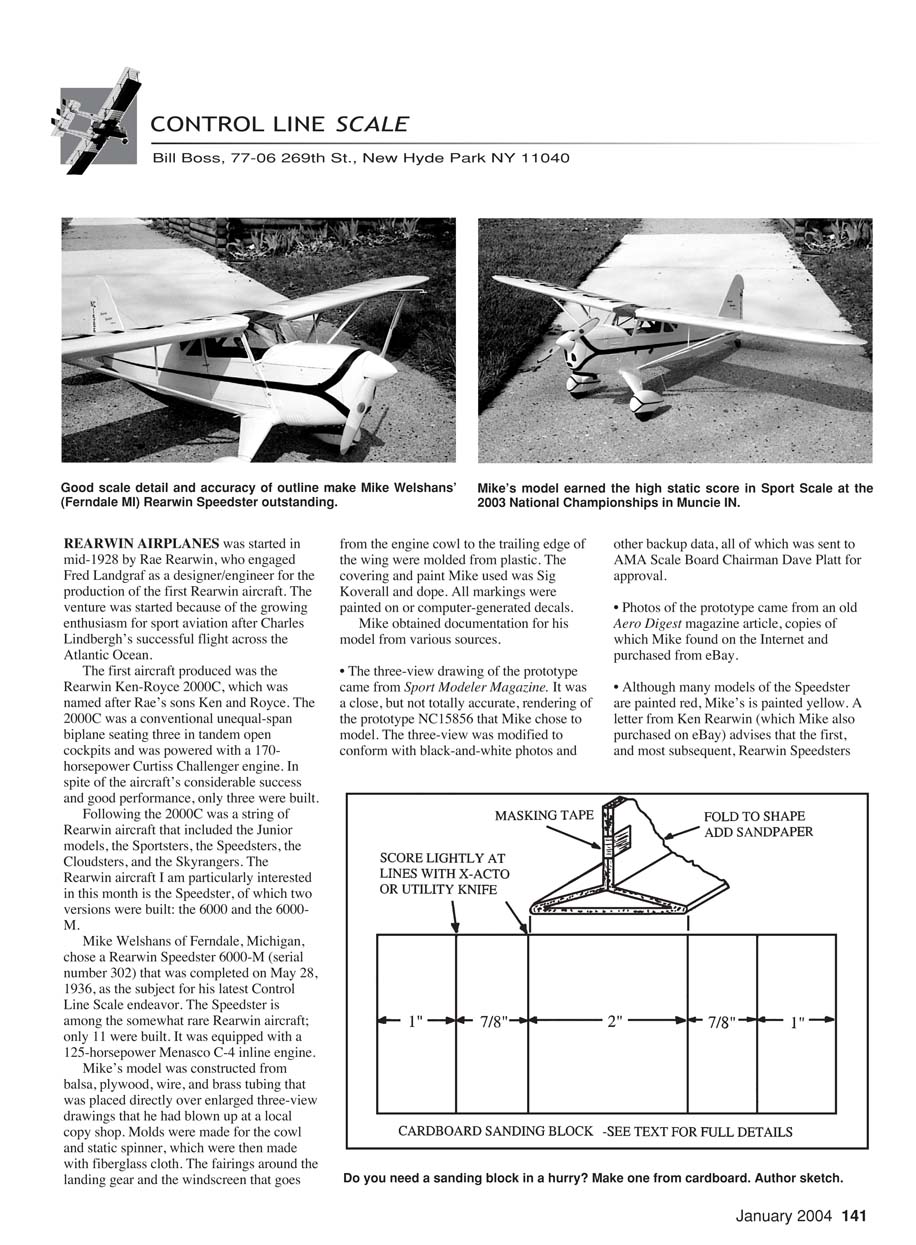
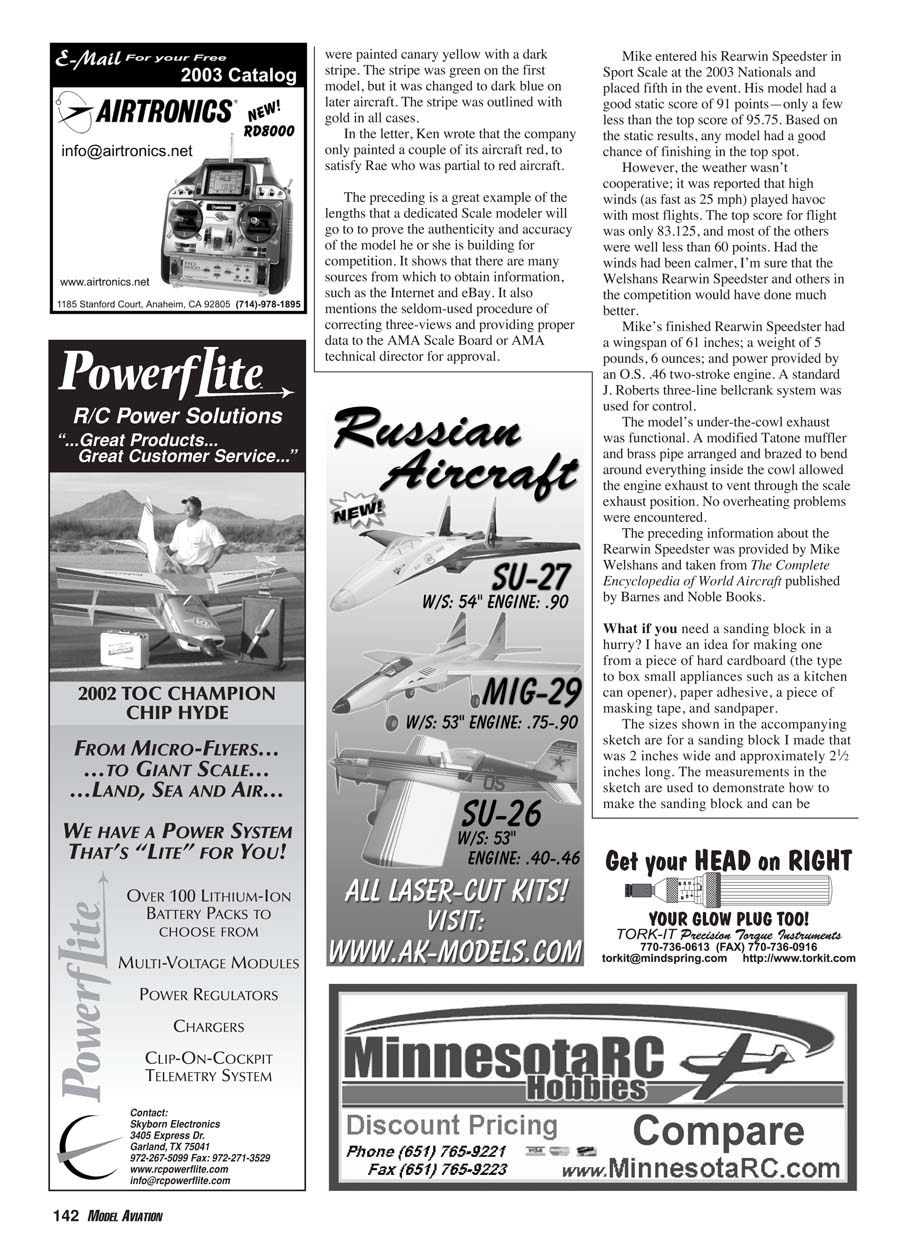
Mike Welshans of Ferndale, Michigan, chose a Rearwin Speedster 6000-M (serial number 302), completed on May 28, 1936, as the subject for his latest Control Line Scale endeavor. The Speedster is among the somewhat rare Rearwin aircraft; only 11 were built. It was equipped with a 125-horsepower Menasco C-4 inline engine.
Mike constructed his model from balsa, plywood, wire, and brass tubing placed directly over enlarged three-view drawings that he had blown up at a local copy shop. Molds were made for the cowl and static spinner, which were then formed with fiberglass cloth. The fairings around the landing gear and the windscreen (which runs from the engine cowl to the trailing edge of the wing) were molded from plastic. The covering and paint used was Sig Koverall and dope. All markings were either painted on or applied as computer-generated decals.
The model's under-the-cowl exhaust was functional. A modified Tatone muffler and brass pipe were arranged and brazed to bend around the cowl internals so that the engine exhaust vented through the scale exhaust position. No overheating problems were encountered.
Documentation and research
Mike obtained documentation for his model from several sources and took steps to ensure accuracy:
- Three-view drawing
- The three-view of the prototype came from Sport Modeler magazine. It was close but not completely accurate for prototype NC15856 (the aircraft Mike modeled).
- The three-view was modified to conform with black-and-white photos and other backup data. All corrections and supporting data were sent to AMA Scale Board Chairman Dave Platt for approval.
- Photographs
- Photos of the prototype were obtained from an old Aero Digest magazine article; Mike found copies on the Internet and purchased them via eBay.
- Color and markings
- Although many Speedsters are painted red, Mike's model is yellow. A letter from Ken Rearwin (also purchased on eBay) states that the first and most subsequent Rearwin Speedsters were painted canary yellow with a dark stripe. The stripe was green on the first model but changed to dark blue on later aircraft; the stripe was outlined in gold in all cases.
- Ken wrote that the company only painted a couple of aircraft red, to satisfy Rae, who was partial to red aircraft.
This is a good example of the lengths a dedicated scale modeler will go to prove authenticity and accuracy for competition. It shows that many sources (Internet, eBay, periodicals, primary letters) can be used and also highlights the procedure of correcting three-views and submitting proper data to the AMA Scale Board or AMA technical director for approval.
Competition: 2003 Nationals — Sport Scale
Mike entered his Rearwin Speedster in Sport Scale at the 2003 Nationals and placed fifth in the event. His model had a strong static score of 91 points — only a few points less than the top static score of 95.75. Based on the static results, any model had a good chance of finishing at the top.
However, weather was not cooperative. High winds (reported as fast as 25 mph) affected most flights. The top flight score was only 83.125, and most other flight scores were well under 60 points. Had the winds been calmer, the Welshans Rearwin Speedster and others likely would have performed much better.
Model specifications and control system
- Wingspan: 61 inches
- Weight: 5 lb 6 oz
- Powerplant: O.S. .46 two-stroke engine
- Control system: standard J. Roberts three-line bellcrank system
Sources
The historical and technical information about the Rearwin Speedster was provided by Mike Welshans and referenced from The Complete Encyclopedia of World Aircraft (Barnes & Noble Books).
Quick workshop tip — cardboard sanding block
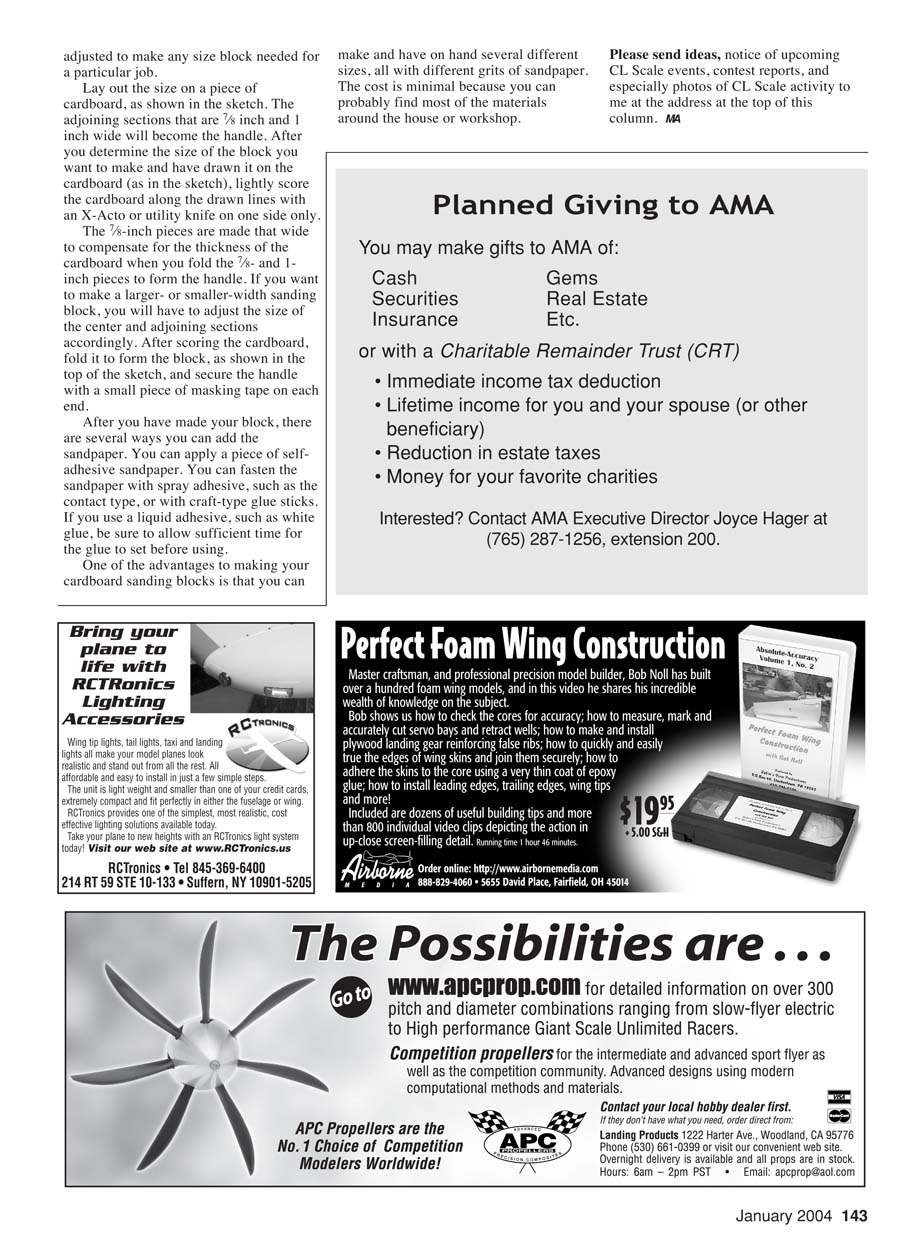
What if you need a sanding block in a hurry? Here is an easy method using common materials: a piece of hard cardboard (the kind used to box small appliances), paper adhesive, a piece of masking tape, and sandpaper.
- Materials
- Hard cardboard (sturdy box stock)
- Paper adhesive (spray contact adhesive or glue stick)
- Masking tape
- Sandpaper (various grits)
- Suggested size
- Example block: 2 inches wide by approximately 2½ inches long. Measurements can be scaled to any needed size.
- Construction and use
- Cut the cardboard to the desired dimensions and stack layers if additional thickness or rigidity is needed.
- Cover the block with a piece of sandpaper. You can:
- Use self-adhesive sandpaper; or
- Fasten the sandpaper with spray adhesive (contact type) or with a craft glue stick; or
- Use white glue — if you use a liquid adhesive, allow sufficient time for the glue to set before using.
- Make several blocks in different sizes and with different grits for convenience. The cost is minimal since most materials can be found around the house or workshop.
Please send ideas, notice of upcoming CL Scale events, contest reports, and especially photos of CL Scale activity to me at the address at the top of this column. MA
Transcribed from original scans by AI. Minor OCR errors may remain.

