
CONTROL LINE SCALE
Bill Boss
77-06 269th St., New Hyde Park NY 11040
It has been quite some time since I covered some of the basics associated with building our scale models. I know that what I will write about may be old news to many of our advanced CL modelers (scale or otherwise), but there is always a new group of modelers coming along, and some of what I write here may be beneficial to them.
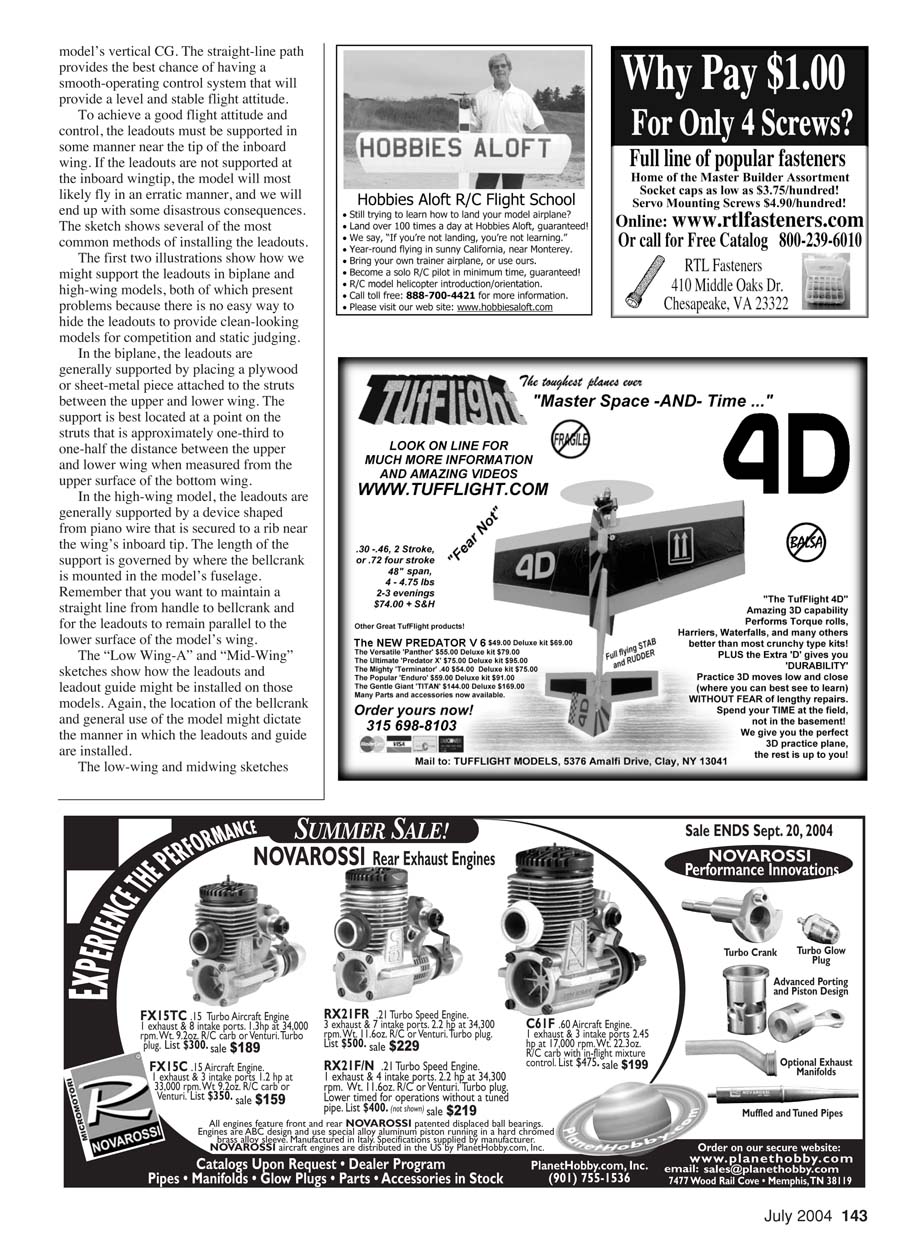
This month I'm going to review the many ways in which CL-model leadouts can be installed. The accompanying sketch (not included here) shows the various ways in which the leadouts may be mounted or anchored in/to our models.
You might ask why there is so much concern about how the leadouts are installed. Typical questions include:
- What is the purpose of the leadouts?
- Do they have to be installed in any particular manner to keep the model stable in flight?
- What types of supports are used to hold the leadouts in place?
- What effect does the leadout and bellcrank placement have on the scale interior of the model?
- What are the rules regarding the use of removable leadout guides on our scale models?
The leadouts provide the means by which we attach the flying lines to the model's bellcrank. The placement of the bellcrank and leadouts will depend on the type of airplane you are building: biplane, high-wing, low-wing, or mid-wing configuration.
When installing the leadouts and bellcrank, we make every effort to create a straight line from the control handle through the lines to the bellcrank. This depends on the bellcrank being mounted at, or near, the model's vertical CG. The straight-line path provides the best chance of having a smooth-operating control system that will provide a level and stable flight attitude.
To achieve a good flight attitude and control, the leadouts must be supported in some manner near the tip of the inboard wing. If the leadouts are not supported at the inboard wingtip, the model will most likely fly in an erratic manner and could result in disastrous consequences.
Leadout installation methods
- Biplane
The leadouts are generally supported by placing a plywood or sheet-metal piece attached to the interplane struts between the upper and lower wing. The support is best located at a point on the struts that is approximately one-third to one-half the distance between the upper and lower wing when measured from the upper surface of the bottom wing. Biplanes present a challenge because there is no easy way to hide the leadouts for a clean appearance.
- High-wing
Leadouts are generally supported by a device shaped from piano wire that is secured to a rib near the wing's inboard tip. The length of the support is governed by where the bellcrank is mounted in the fuselage. Maintain a straight line from handle to bellcrank and keep the leadouts parallel to the lower surface of the wing. High-wing models also present hiding/appearance issues.
- Low Wing-A
Shows a typical installation where the leadouts and a leadout guide are mounted on/under the wing. Location and detail depend on bellcrank position and intended use.
- Mid-wing
The bellcrank can be installed low in the fuselage so that only a small portion of the leadouts is visible under the wing — a good option for competition models because it yields a cleaner appearance.
- Removable leadout guide
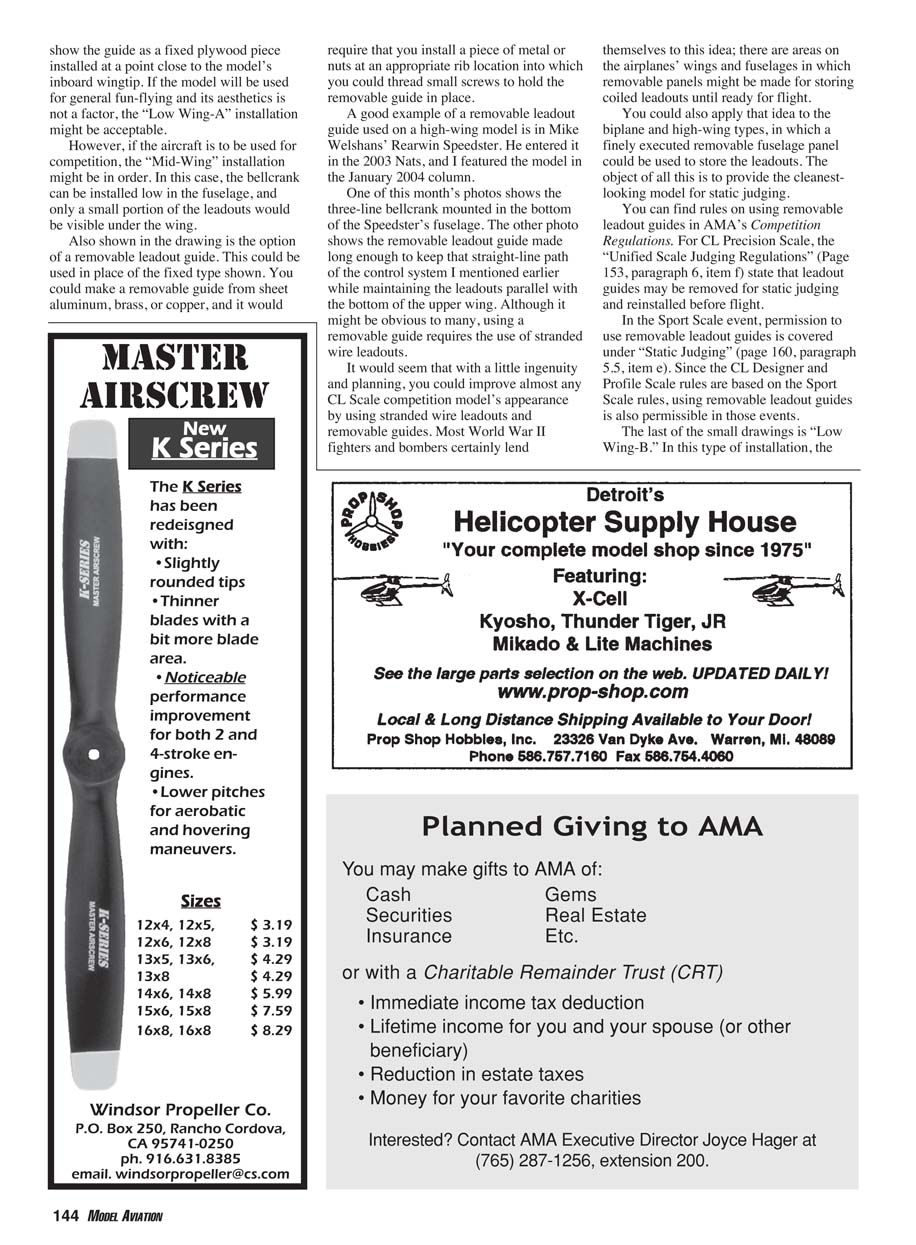
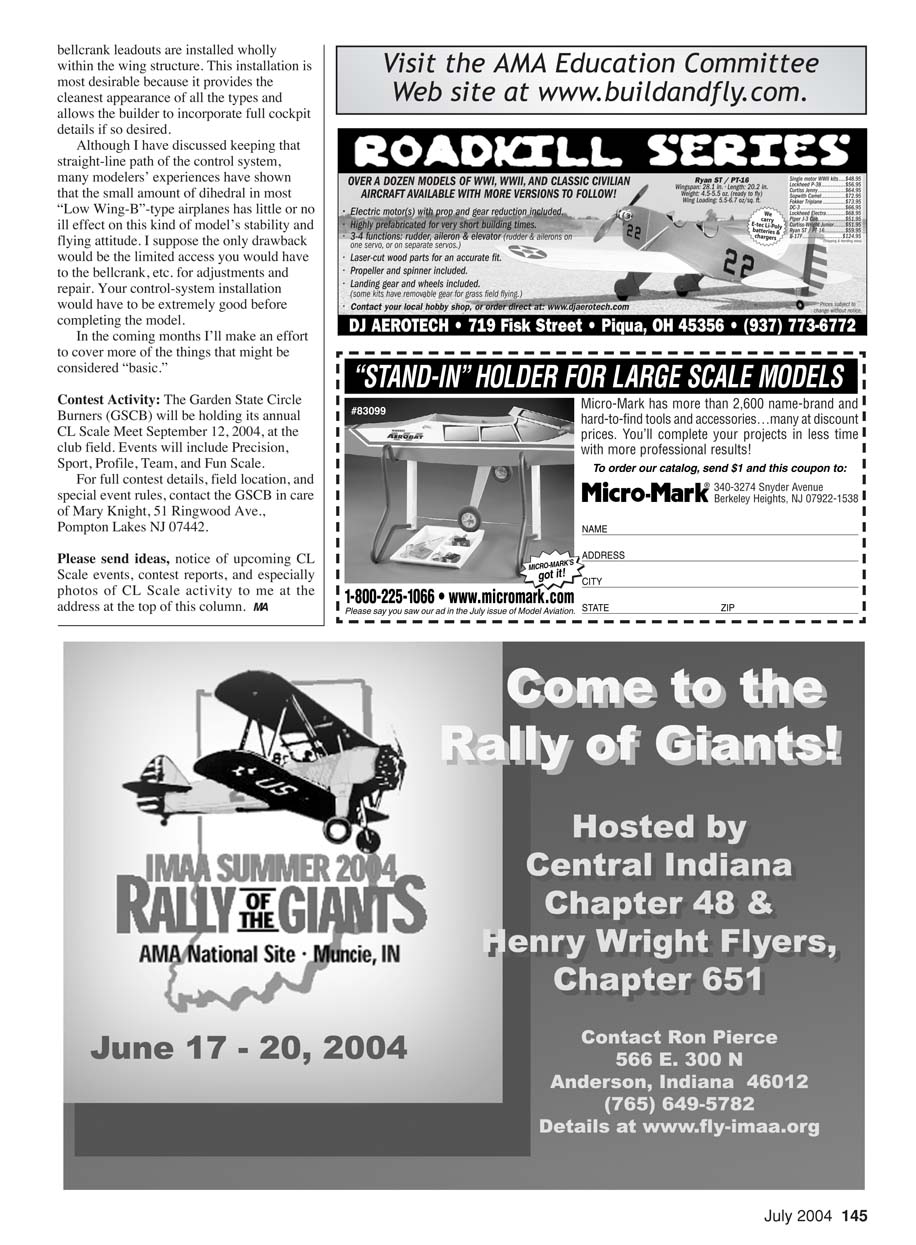
Instead of a fixed guide, you can make a removable guide from sheet aluminum, brass, or copper. Install a piece of metal or nuts at an appropriate rib location so small screws can hold the removable guide in place. Using a removable guide requires stranded wire leadouts. A good example is Mike Welshans' Rearwin Speedster (entered in the 2003 Nats), which uses a three-line bellcrank mounted in the bottom of the fuselage and a removable guide made long enough to maintain the straight-line control path while keeping the leadouts parallel with the bottom of the upper wing.
- Low Wing-B
In this installation the bellcrank leadouts are installed wholly within the wing structure. This is the most desirable for cleanliness of appearance and allows incorporation of full cockpit details. The small dihedral typical of many Low Wing-B designs usually has little or no ill effect on stability and flying attitude. The drawback is limited access to the bellcrank for adjustments and repairs, so the control-system installation must be excellent before completing the model.
With a little ingenuity and planning, you can improve almost any CL scale competition model's appearance by using stranded wire leadouts and removable guides. Most World War II fighters and bombers lend themselves to this idea; removable panels can be made on wings and fuselages to store coiled leadouts until ready for flight. The same idea can be applied to biplanes and high-wing types by using finely executed removable fuselage panels to store the leadouts. The objective is the cleanest-looking model for static judging.
Rules on removable leadout guides
You can find rules on using removable leadout guides in the AMA Competition Regulations:
- CL Precision Scale: Unified Scale Judging Regulations (page 153, paragraph 6, item f) — leadout guides may be removed for static judging and reinstalled before flight.
- Sport Scale: Static Judging (page 160, paragraph 5.5, item e) — permission to use removable leadout guides is covered here.
- CL Designer and Profile Scale rules are based on Sport Scale rules, so removable leadout guides are also permissible in those events.
In the coming months I'll make an effort to cover more of the things that might be considered "basic."
Contest Activity
The Garden State Circle Burners (GSCB) will be holding its annual CL Scale Meet on September 12, 2004, at the club field. Events will include Precision, Sport, Profile, Team, and Fun Scale.
For full contest details, field location, and special event rules, contact: Mary Knight 51 Ringwood Ave., Pompton Lakes NJ 07442
Please send ideas, notice of upcoming CL scale events, contest reports, and especially photos of CL scale activity to me at the address at the top of this column.
MA
Transcribed from original scans by AI. Minor OCR errors may remain.

