
CONTROL LINE SCALE
Bill Boss, 77-06 269th St., New Hyde Park, NY 11040
Introduction
In the July column I went back to basics with some words about installing leadout guides. This month I’ll step back again and review the use and makeup of the standard three-line bellcrank system that control-line (CL) fliers have used for many years. I’ll also cover some of the problems associated with making the system and choosing three-line bellcranks.
I’ll cover these subjects as they apply to Scale, but the three-line system is also used by many CL modelers for regular sport or fun-flying and Navy Carrier flying. The three-line control system is composed of a special three-line control handle, three lines of solid or stranded wire, and a special three-line bellcrank that is matched to the handle. It can be troublesome if care is not taken in making the three lines and selecting the right handle and bellcrank.
Three-line systems
Two types of three-line systems have been used through the years: the J. Roberts Sturdi-Built system and the LR (GS) Products Ltd. handle and bellcranks. Each type has the throw of the handle control lever and the travel of the bellcrank as a matched set, and problems arise when you try to mix the handles and bellcranks.
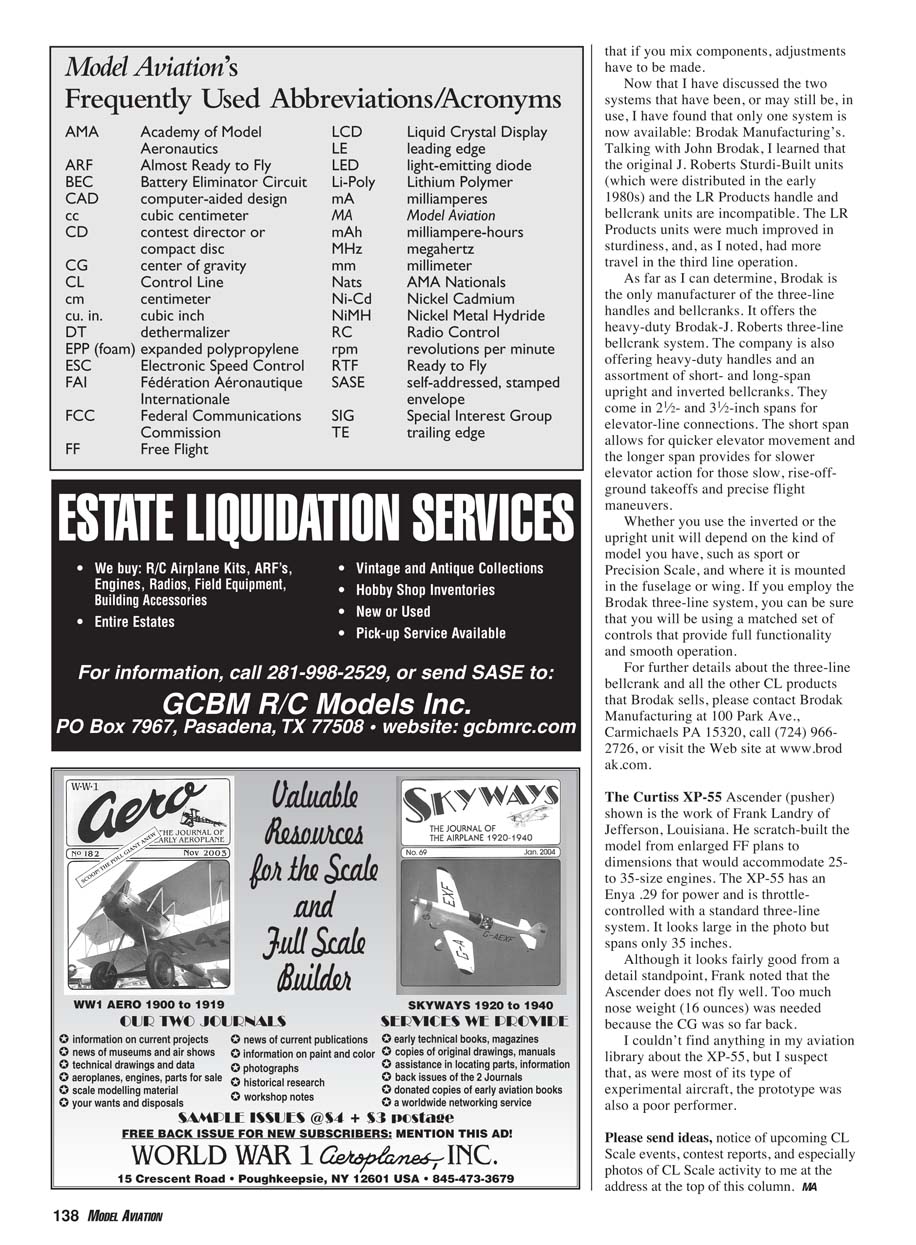
The key to a successful three-line operating system is balance. That means that when the handle control lever is moved through its operating range, the bellcrank will follow exactly, and there will be no slack in any of the three lines between the handle and the model. (The accompanying sketch in the original column shows the basic system structure, with an upper drawing for the high-speed position and a lower drawing for the low-speed position.)
The control handle has a built-in cam action that allows the elevator and engine speed-control lines to move in opposite directions when the control lever, or finger trigger, at the top of the handle is moved through its operating range.
Lines and wire sizes
The lines can be made from solid or stranded wire, of appropriate thickness for the size and weight of each model. Tables in the Academy of Model Aeronautics’ Competition Regulations booklet specify the size of wire to be used for the weight of any particular aircraft for Scale and Navy Carrier.
If you’re using a three-line system in a model built just for sport or fun-flying, I suggest that you adhere to the line sizes recommended in the table for Scale models. All of the line sizes for model weights in the tables have been set for safety purposes.
The systems I mentioned work equally well and are the same in principle as long as they are put together correctly using only matched parts supplied by the manufacturer. The systems provide a means to control an airplane’s engine throttle and other operating features such as dropping bombs and retracting landing gear.
Basic setup rules
To obtain a successfully operating setup, you must follow basic instructions when making the system:
- All three lines between the handle and the model's leadouts must be exactly the same length.
- The model's control (third line) leadout must be 2 1/8 inches longer than the elevator-control leadouts. The 2 1/8-inch measurement must be made when the elevator leadouts are pulled tight (which would be the system's high-speed position) and held even with each other.
If you build the system as specified above, you should have a balanced setup that maintains equal tension on the three lines through the entire range of operation.
Matching handles and bellcranks
The preceding explanation assumes the control handle and model unit are a matched set from the same manufacturer. Even though the two systems mentioned are the same in principle, there is a basic difference between them: the amount of travel of the third, or control, line.
- The J. Roberts Sturdi-Built units have approximately 1 1/8 inches of third-line travel.
- The LR Products (GS) units have approximately 1 3/8 inches of travel — a difference of 1/4 inch.
If you mix the components, you must consider the difference in travel and the possibility of improper operation. For example:
- Using a J. Roberts Sturdi-Built handle with an LR Products control unit will not allow you to obtain the maximum travel available in the LR unit; you must plan operational functions accordingly.
- Using an LR handle with a J. Roberts control unit could give the control lead more travel than the airplane's control unit. This combination could result in slack elevator control lines, in which case the full weight and pull of the flying model would be on the control line (third line), creating an unsafe condition.
The solution is to be sure of what you are doing, make sure all lines are of equal length, and be aware that if you mix components, adjustments must be made.
Current availability — Brodak Manufacturing
As far as I have found, only one system is now widely available: Brodak Manufacturing's. Talking with John Brodak, I learned that the original J. Roberts Sturdi-Built units (distributed in the early 1980s) and the LR Products handle and bellcrank units are incompatible. The LR Products units were much improved in sturdiness and had more third-line travel.
Brodak offers a heavy-duty Brodak-J. Roberts three-line bellcrank system. The company also offers heavy-duty handles and an assortment of short- and long-span upright and inverted bellcranks. They come in 2½- and 3½-inch spans for elevator-line connections. The short span allows for quicker elevator movement and the longer span provides slower elevator action for slow, rise-off-ground takeoffs and precise flight maneuvers.
Whether you use the inverted or the upright unit will depend on the kind of model you have, such as sport or Precision Scale, and where it is mounted in the fuselage or wing. If you employ the Brodak three-line system, you can be sure you are using a matched set of controls that provide full functionality and smooth operation.
Contact and submissions
For further details about the three-line bellcrank and other CL products that Brodak sells, contact Brodak Manufacturing at:
- Brodak Manufacturing, 100 Park Ave., Carmichaels, PA 15320
- Phone: (724) 966-2726
- Web: www.brodak.com
Please send ideas, notice of upcoming CL Scale events, contest reports, and especially photos of CL Scale activity to me at the address at the top of this column.
MA
Transcribed from original scans by AI. Minor OCR errors may remain.

