
CONTROL LINE SCALE
Bill Boss 77-06 269th Street, New Hyde Park, NY 11040
Detailing the Surface
Detailing the surface of our models is probably one of the most difficult and time-consuming aspects of scale model building. We sometimes go to great lengths to simulate panel lines, hatches, rivets, screws, and aircraft nomenclature. While there is nothing like seeing these details as real or working items, there is a handy solution for the modeler who doesn't want to spend months—or even years—detailing a scale model.
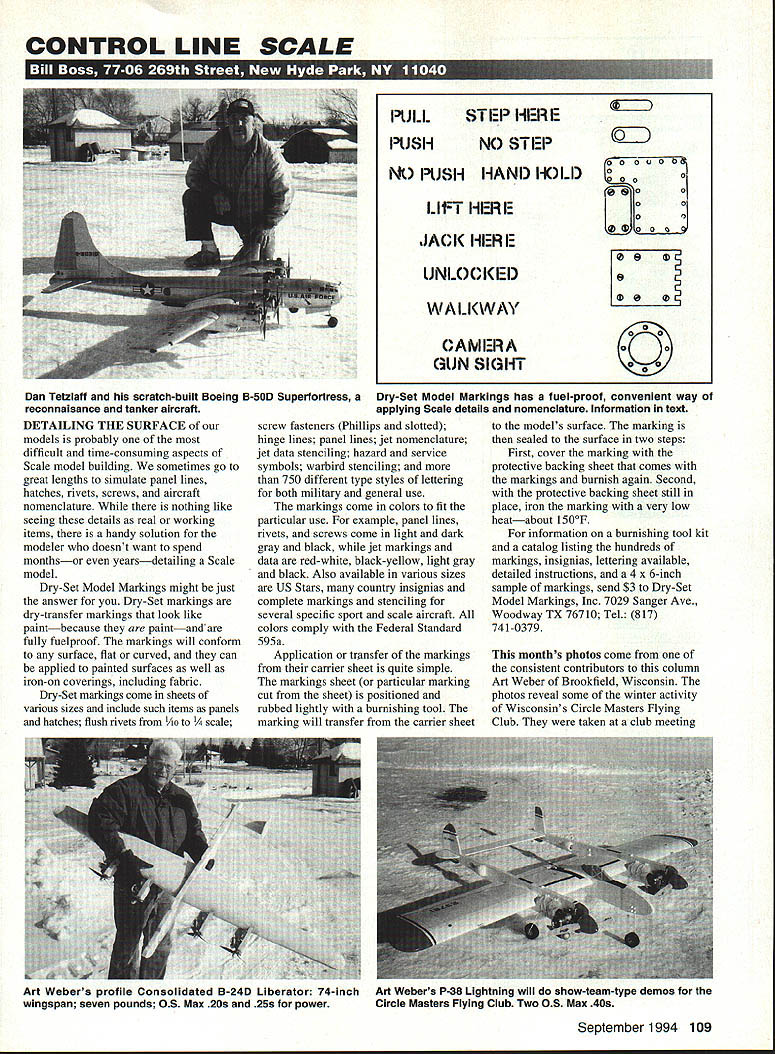
Dry-Set Model Markings might be just the answer for you. Dry-Set markings are dry-transfer markings that look like paint—because they are paint—and are fully fuelproof. The markings will conform to any surface, flat or curved, and they can be applied to painted surfaces as well as iron-on coverings, including fabric.
Dry-Set markings come in sheets of various sizes and include such items as panels and hatches; flush rivets from 1/16 to 1/4 scale; screw fasteners (Phillips and slotted); hinge lines; panel lines; jet nomenclature; jet data stenciling; hazard and service symbols; warbird stenciling; and more than 750 different type styles of lettering for both military and general use.
The markings come in colors to fit the particular use. For example, panel lines, rivets, and screws come in light and dark gray and black, while jet markings and data are red-white, black-yellow, light gray, and black. Also available in various sizes are U.S. stars, many country insignias, and complete markings and stenciling for several specific sport and scale aircraft. All colors comply with Federal Standard 595A.
Application (transfer) of the markings from their carrier sheet is quite simple. The markings sheet (or a particular marking cut from the sheet) is positioned and rubbed lightly with a burnishing tool. The marking will transfer from the carrier sheet to the model's surface. The marking is then sealed to the surface in two steps:
- Cover the marking with the protective backing sheet that comes with the markings and burnish again.
- With the protective backing sheet still in place, iron the marking with very low heat—about 150°F.
For information on a burnishing tool kit and a catalog listing the hundreds of markings, insignias, and lettering available, detailed instructions, and a 4 x 6-inch sample of markings, send $3 to Dry-Set Model Markings, Inc., 7029 Sanger Ave., Woodway, TX 76710; Tel: (817) 741-0379.
Club Photos and Winter Activity
This month's photos come from one of the consistent contributors to this column: Art Weber of Brookfield, Wisconsin. The photos reveal some of the winter activity of Wisconsin's Circle Masters Flying Club. They were taken at a club meeting on a sunny day in mid-February 1994 when the chill factor was −15°F. That's really braving the weather in the name of modeling. Winter construction activity among Circle Masters members has produced some great-looking control-line scale models for the 1994 flying season.
Highlights of models shown or reported:
- Art Weber: profile P-38 Lightning, 60-inch span, powered by .40-size engines, weighing about 4½ pounds.
- John Valasek: scratch-built F9F-2 Panther, 48-inch span, nine pounds, powered by a BVM 81 violet fan.
- Dan Tetzlaff: B-50D, 82-inch span, powered by two McCoy .29s and two McCoy .19s; weighs about 11 pounds.
- Pete Mick: another P-38 Lightning built for Circle Masters show-team purposes.
The models use a three-line control system with throttle and other control functions.
Art Weber is also designing and building a profile B-24D Liberator and expects to have detailed plans for the P-38 Lightning and B-24 Liberator profile models available in the near future. I'll keep you posted on availability. Glad to see strong CL scale activity—Circle Masters are taking advantage of the cold months up north.
Building Tip
George Lieb, Orbiting Eagles, Omaha, suggests that when mounting a high-performance .35–.40-size engine in a model, especially a profile model, consider using 6-32 Allen-head screws and blind nuts.
Reasons to use the larger bolts and nuts:
- Greater strength; less susceptible to thread stripping and head shearing.
- Less risk of loss of the engine.
- Better tightened with an Allen wrench.
- Larger blind mounting nuts provide a better base for spreading the engine mounting load over a wider area of wooden engine mounts, which helps prolong the life of the mounts.
(The above item was based on an article by George Lieb and appeared in a recent issue of the Orbiting Eagles' newsletter.)
West Coast Contest Activity
The 101st Screaming Eagles will hold the Eleventh Annual Sebree Hayes Memorial AAA Control Line contest October 8–9, 1994 at Whittier Narrows, South El Monte, California. The site is located at Interstate 60 and Rosemead Boulevard.
The contest will offer Speed, Racing, Stunt, Combat, Carrier, and—of interest to readers of this column—Sport and Profile Scale events. Hot food and soda will be available at the site.
For event details, write or call CD Virgil Wilbur at 9984 Cedardale Dr., Santa Fe Springs, CA 90670; Tel: (310) 864-0790.
East Coast Contest Activity
The Garden State Circle Burners will hold their annual Teterboro Airport Scale Contest on Sunday, September 25, 1994. The event has been re-named the George L. Gaydos Memorial Scale Meet in honor of George Gaydos, GSBC's great scale modeler who passed away during last year's meet.
The meet will be at the Bendix Corporation parking field adjacent to the airport. Events to be flown are Sport, Precision, and Profile Scale with trophies being given to the Best Junior as well as the Best Senior. Refreshments will be available at the field.
For further details, write or telephone CD George Kalinowski at 3913 Wenonah Dr., Fairlawn, NJ 07410; Tel: (201) 791-2150.
Final Note on Contest Submissions
A final note on contest activity: some of you have sent me contest flyers with the idea that I might mention the contest in this column. I would like very much to do so, but there is a major problem called lead time.
As an example, this September 1994 issue was prepared and sent to MA prior to the May 10, 1994 deadline. Please keep the lead time requirement in mind for future submissions.
Please send ideas, notices of upcoming CL Scale events, contest reports, and especially photos of CL Scale activity to the address at the very top of this column.
Transcribed from original scans by AI. Minor OCR errors may remain.

