
CONTROL LINE SCALE
Bill Boss, 77-06 269th Street, New Hyde Park, NY 11040
ONE OF THIS MONTH'S PHOTOS shows a Ju 87 Stuka by Leonard Good of Langley, Washington. This great-looking CL model is a reworked Guillow kit. It has a 34-inch wingspan, is covered with Mica-Lite, and is painted with auto primer and dope colors.
Power for the model is an .09 British KeilKraft Kingcat diesel and a Graupner nylon propeller. A curved exhaust pipe is supplied with the engine and is said to act like a muffler. The model is controlled with a two-line system and flies realistically.
Leonard noted that one of the things he has done to provide additional strength when converting this type of model to CL is to rework the plastic parts that come with the kit.
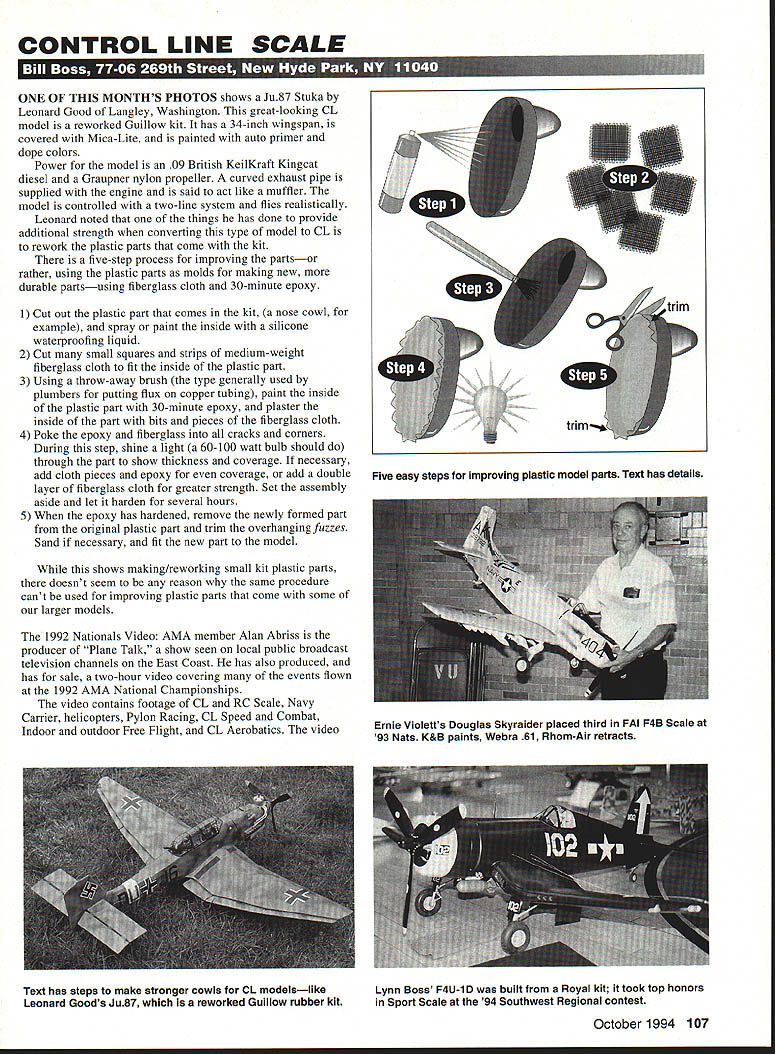
There is a five-step process for improving the parts—or rather, using the plastic parts as molds for making new, more durable parts—using fiberglass cloth and 30-minute epoxy.
- Cut out the plastic part that comes in the kit (a nose cowl, for example), and spray or paint the inside with a silicone waterproofing liquid.
- Cut many small squares and strips of medium-weight fiberglass cloth to fit the inside of the plastic part.
- Using a throw-away brush (the type generally used by plumbers for putting flux on copper tubing), paint the inside of the plastic part with 30-minute epoxy, and plaster the inside of the part with bits and pieces of the fiberglass cloth.
- Poke the epoxy and fiberglass into all cracks and corners. During this step, shine a light (a 60–100 watt bulb should do) through the part to show thickness and coverage. If necessary, add cloth pieces and epoxy for even coverage, or add a double layer of fiberglass cloth for greater strength. Set the assembly aside and let it harden for several hours.
- When the epoxy has hardened, remove the newly formed part from the original plastic part and trim the overhanging fuzzes. Sand if necessary, and fit the new part to the model.
While this shows making/reworking small kit plastic parts, there doesn't seem to be any reason why the same procedure can't be used for improving plastic parts that come with some of our larger models.
The 1992 Nationals Video
AMA member Alan Abriss is the producer of "Plane Talk," a show seen on local public broadcast television channels on the East Coast. He has also produced, and has for sale, a two-hour video covering many of the events flown at the 1992 AMA National Championships.
The video contains footage of CL and RC Scale, Navy Carrier, helicopters, Pylon Racing, CL Speed and Combat, indoor and outdoor Free Flight, and CL Aerobatics.
Engine mounting tip
Let the assembly soak overnight. Gently unscrew the bolts; they will feel quite stiff at first. They should release, thanks to the oil. Use a flat sanding block to level the surface of the filler with the inboard doubler. Hiding those ugly nuts and bolts will give your Profile a much better appearance.
Remember: never use longer engine mounting bolts! If the bolts are too long, shorten them to the proper length. With the engine, mounting pads and washers in place, engine bolts must never extend deep enough to damage the Epoxolite filler plugs.
Thanks go to Larry Cunningham and the Indy Sportliners' newsletter for this item.
Contest Activity: Ed Hagerlin
Ed Hagerlin of the Cholla Choppers MAC in Tucson, Arizona reported that entries in the February 5–6 Sport Scale event at the Southwest Regional CL Contest were just great.
All models were of high quality and flew extremely well, giving the spectators a great show. Some of the models were a Curtiss Hawk by Gerald Deneau, a red-and-white Red Baron Stearman by Ted Snow, a CAP-21 by Karl Marschinke, and an F4U-1D Corsair by Lynn Boss.
The Corsair was made from a Royal kit and is powered by an O.S. Max 91 four-stroke. Lynn Boss took top honors with a score of 194 — a 96 static score and 98 for an excellent flight that included taxi, bomb drop, touch-and-go, and throttle control. The model has a conventional three-line control system.
Gerald Deneau's Curtiss Hawk P-6E had the same static score as the Corsair, but it suffered in the flight scoring because of a premature engine shutdown. Total score for the P-6 was 182, giving Deneau a second place. Thanks to Ed Hagerlin and his "Scale Views" in the Cholla Choppers newsletter for this item.
Please send ideas, notice of upcoming CL Scale events, contest reports, and especially photos of CL Scale activity to me at the address at the top of this column.
Transcribed from original scans by AI. Minor OCR errors may remain.

