
CONTROL LINE: SCALE
Bill Boss 77-06 269th Street New Hyde Park, NY 11040
In last month's column I addressed the lack of participation by youth (or true beginners) in CL Scale, and some possible reasons for the same. One reason explored was that the complexity of the rules was thought to be high for possible junior participants or beginners.
To help beginners understand what it takes to get started in CL Scale, and to give them more confidence to try scale modeling, I will devote a portion of the next few columns to the subject. Most of what I'll be presenting is based on a series of articles found in Ed Hagerlin's "Scale Views" column in Hangar Talk, the newsletter of the Cholla Choppers MAC.
Some general comments: anyone wishing to get started in scale modeling should be kind to himself and do a few simple things before even considering what model to build. Following a few recommended steps will give you shortcuts in the long run and a better view of scale modeling.
The number one thing to do — and perhaps the most important part of scale modeling — is to obtain and read the AMA Competition Regulations section about Scale. Be sure to read the Scale General and Unified Scale Judging Regulations sections of the rules, as well as those pertaining to the individual CL events. No matter which class or scale event you decide to fly, read the rules first. You will learn what is expected of you and your model for each of the events: Profile, Sport, or Precision.
Understanding the rules is a must, because in many ways the events relate to one another. For example, you will find that Profile Scale rules are not specifically detailed (except for model requirements), but refer you to the Sport Scale rules for event operation, static judging, and flight judging. The Sport event, while highly detailed, refers you to the Precision or FAI CL events for allowable maneuvers or operational features beyond those listed in the Sport rules.
Jumping back and forth in the rules can cause some basic things to be overlooked: Are your flying lines the right size for the weight and size of the model? Do you have too little or too much documentation? What are the model weight requirements? Have you filled out your "4.6 Declaration of Parts Not Built"? Which of the CL Scale events is exempt from the 4.6 rule? Do you need a pilot in the cockpit? What maneuvers can (or should) I do in the flight program?
While the questions above may seem simple (and the answers obvious to many who have flown CL Scale for some time), they can pose problems for the scale beginner. With this in mind I will try to explore the areas where a newcomer might need help or guidance. We will cover a little more about the rules, model selection, documentation, static and flight judging, and scoring.
Workshop Hints
In a recent issue of the Orbiting Eagles' newsletter, George Lieb and Bob Furr presented ideas that go hand in hand. George wrote about making your own model fuel tank filler, while Bob wrote about fuel problems.
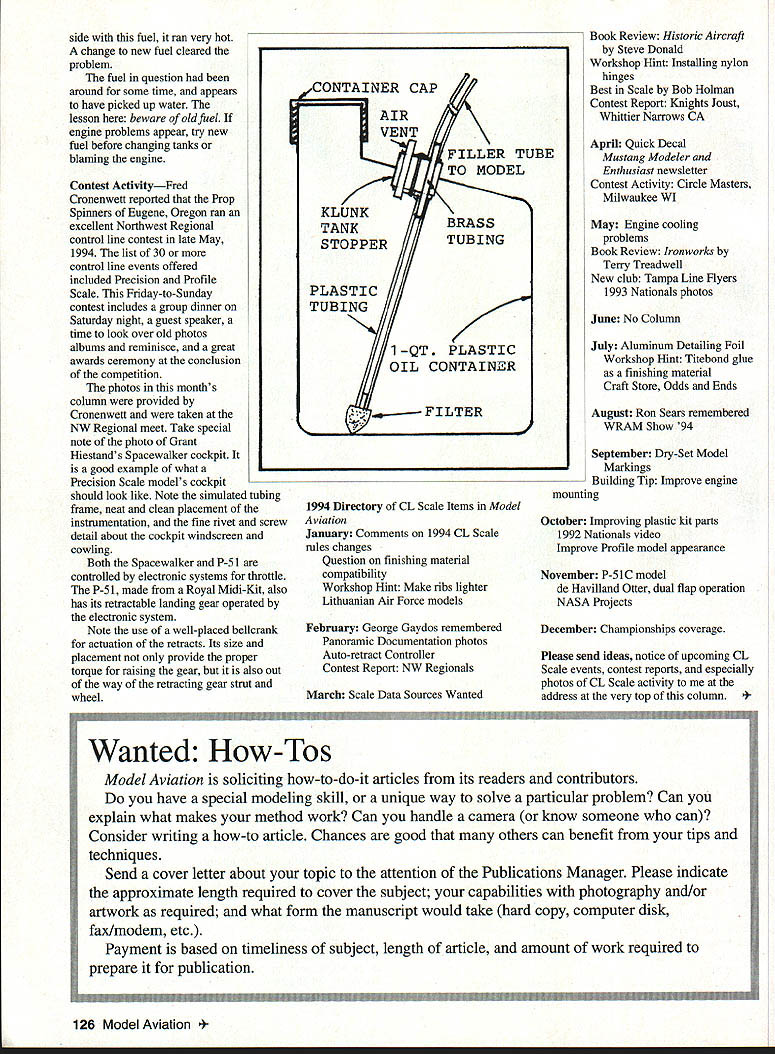
George said that a handy, inexpensive fuel filler can be made from almost any suitable plastic container. He notes that quart-size plastic oil bottles (like the yellow Pennzoil container) work well and hold enough fuel for an afternoon's flying. Containers for Dexron automatic transmission fluid and Quaker State motor oil are also suitable. They often have a clear strip down one side that is graduated in ounces, providing a convenient way to see or measure the amount of fuel in the container or being transferred to the model.
A hole is cut in the top of the container for installation of a replacement klunk tank stopper. The filler is easily filled through the large cap opening; the filter inside the container helps keep the fuel clean. To transfer fuel from the filler bottle to the model, attach the filler tubing to the model's tank inlet tube, put a finger over the air vent, and squeeze the bottle. When not in use, cap the air vent and model filler tube to prevent spillage.
Bob Furr related a problem he had recently with a model's engine that quit during maneuvers and at odd times. He changed tank configurations, but it didn't help. He tried some 15% nitro fuel rather than the 5% fuel he had been using, and the problem disappeared. When he ran out of 15% fuel and tried adding nitro to the 5%, the problem returned. Even when he ran the engine on the rich side with this fuel, it ran very hot. A change to new fuel cleared the problem.
The lesson here: beware of old fuel. If engine problems appear, try fresh fuel before changing tanks or blaming the engine.
Contest Activity
Fred Cronenwett reported that the Prop Spinners of Eugene, Oregon ran an excellent Northwest Regional control line contest in late May 1994. The list of 30 or more control line events offered included Precision and Profile Scale. This Friday-to-Sunday contest includes a group dinner on Saturday night, a guest speaker, time to look over old photo albums and reminisce, and a great awards ceremony at the conclusion of the competition.
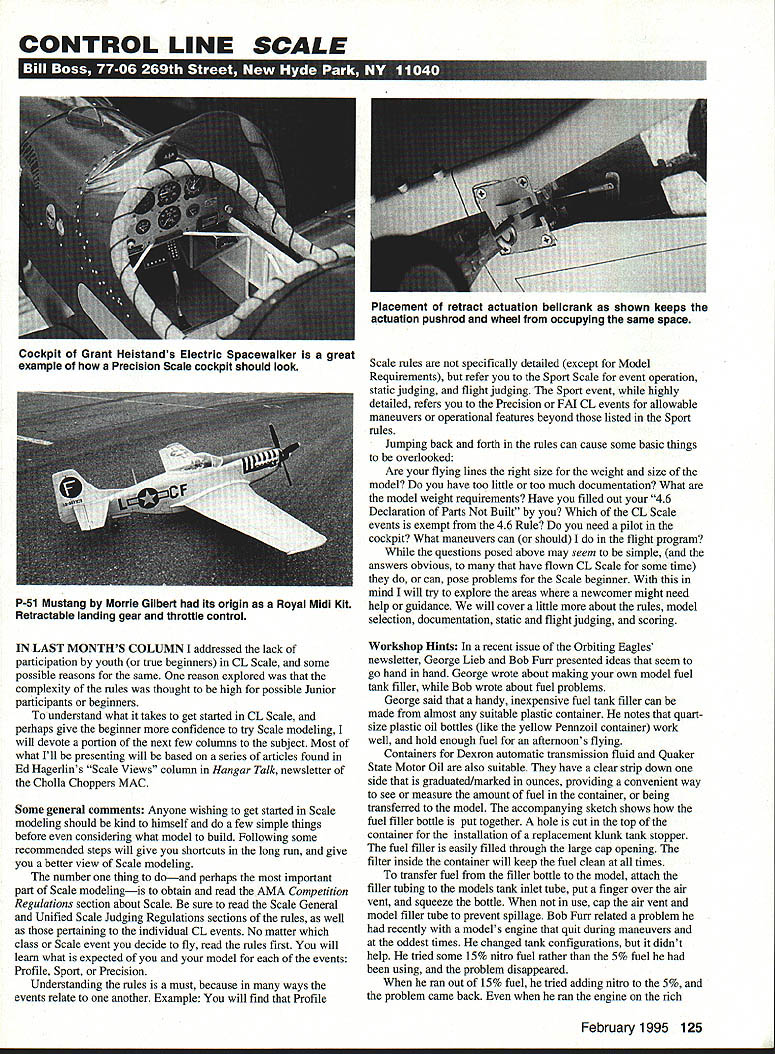
The photos in this month's column were provided by Cronenwett and were taken at the NW Regional meet. Take special note of the photo of Grant Hiestand's Spacewalker cockpit. It is a good example of what a precision scale model's cockpit should look like: simulated tubing frame, neat and clean placement of the instrumentation, and fine rivet and screw detail around the cockpit windscreen and cowling.
Both the Spacewalker and a P-51 shown are controlled by electronic systems for throttle. The P-51, made from a Royal midi-kit, also has its retractable landing gear operated by the electronic system. Note the use of a well-placed bellcrank for actuation of the retracts — its size and placement not only provide the proper torque for raising the gear, but also keep it out of the way of the retracting gear strut and wheel.
1994 Directory of CL Scale Items in Model Aviation
- January: Comments on 1994 CL Scale rules changes
- Question on finishing material compatibility
- Workshop Hint: Make ribs lighter
- Lithuanian Air Force models
- February: George Gaydos remembered
- Panoramic documentation photos
- Auto-retract controller
- Contest report: NW Regionals
- March: Scale data sources wanted
- April: Quick decal
- Mustang Modeler and Enthusiast newsletter
- Contest activity: Circle Masters, Milwaukee, WI
- May: Engine cooling problems
- Book review: Ironworks by Terry Treadwell
- New club: Tampa Line Flyers
- 1993 Nationals photos
- June: No column
- July: Aluminum detailing foil
- Workshop hint: Titebond glue as a finishing material
- Craft store, odds and ends
- August: Ron Sears remembered
- WRAM Show '94
- September: Dry-set model markings
- Building tip: Improve engine mounting
- October: Improving plastic kit parts
- 1992 Nationals video
- Improve profile model appearance
- November: P-51C model
- de Havilland Otter, dual flap operation
- NASA projects
- December: Championships coverage
Please send ideas, notice of upcoming CL Scale events, contest reports, and especially photos of CL Scale activity to me at the address at the very top of this column.
Transcribed from original scans by AI. Minor OCR errors may remain.

