
Control Line: Scale
By Bill Boss 77-06 269th Street, New Hyde Park, NY 11040
Scale Competition Rules Review
This month I cover the Unified Scale Judging Regulations and CL Precision Scale.
The Unified Scale Judging Regulations provide specific information about Precision Scale that is not included in the event rules. They define what type of aircraft can be modeled; give guidelines for the event director regarding a model's deviation from scale and the right to disqualify models that are grossly out of scale; explain Scale Judging Procedures for Precision and Display-only models; describe flight judging; and explain the release of official scores.
Unified Scale Judging Regulations — key items
- Definition of acceptable prototype subjects and modeling scope.
- Director authority to disqualify grossly out-of-scale entries.
- Procedures for static display and flight judging.
- Rules on release of official scores.
Proof of Scale
Proof of Scale (Parts a, b, and c) outlines acceptable documentation required for a model to be eligible for Fidelity to Scale points.
- Acceptable documentation: photos, three-view drawings, and color/markings references.
- The documentation package must state the scale to which the model is built.
- Engine cowling: rules address whether the model's engine must be completely cowled.
- Mufflers: use and installation requirements are described.
- Signed declaration: judges must be given a signed list of major model components not made by the modeler (this is distinct from Rule 4.6 Declaration on Page 127 of the 1994–95 Competition Regulations for Sport Scale).
- Other items: amount and type of documentation allowed; size requirements for three-views; model identification; and permitted alterations between static and flight judging.
Precision Scale
Precision Scale is intended for experienced scale modelers and is not recommended for beginners. The event requires duplication in the model of all prototype detail and a supporting documentation package (written material, photos, and drawings) to justify subject selection, color, and markings.
Scoring structure for static judging:
- Eight basic static categories (detailed on the Precision Scale score sheet, Page 118 of the 1994–95 Competition Regulations).
- Additional static categories: Fidelity to Scale and Craftsmanship.
- Scale Presentation category.
- Maximum static score: 450 points total:
- 200 points — Fidelity to Scale
- 200 points — Craftsmanship
- 50 points — Scale Presentation
Each of the eight judging categories specifies what is judged and the points awarded from Poor to Superior work.
Flight Scoring — overview
Flight Scoring (Pages 123–125, paragraphs 1 to 11.1) is organized into three main sections:
- Flight Points (Para. 7)
- Scale Operation (Para. 8)
- Flight Bonus Points (Para. 9)
Other paragraphs cover engine sizes, control lines, pull testing, contest scheduling, and other flight-judging administrative functions.
#### Flight Points
- Award: 2 points per airborne lap.
- Maximum: 20 points for 10 completed airborne laps.
- Note: only airborne laps count. Time spent taxiing on the ground prior to actual flight does not contribute to the lap count.
#### Scale Operation
- A modeler may select up to six (6) maneuvers/scale operations from the list in Paragraphs 8a–8n.
- Each option is scored on a 0–20 point scale; all options are judged on the same point range.
- Choices allow for aerobatic, civilian, or military subjects.
- Many modern control systems allow touch-and-go, taxi, engine and flap control, leaving the modeler to select two additional operations suitable to the subject.
#### Flight Bonus Points
- Range: 0–25 points awarded for Takeoff, Flight, Glide, and Landing (Landing bonus applies only if a scale-like flight of 10 laps is completed).
- Bonus points are awarded based on the scale-like quality of the performance.
- Flight points per lap are also awarded for laps completed.
Important procedural note: under Scale General Para. 8 (not explicitly in the Precision rules), a Precision entry must complete at least five (5) airborne laps for the flight to be declared official. If five laps are not completed, the attempt is charged.
While this summary does not cover every detail of Precision Scale, it highlights the major points and should encourage you to study the rules. Next month: the Sport and Profile events.
Photos and Contest Results
Photos this month were submitted by Fred Cronenwett and were taken at the June 1994 Knight's Joust held at Whittier Narrows, California. The event included Profile and Sport Scale classes.
Profile results:
- 1st — Fred Cronenwett: Havoc A-20
- 2nd — Steve Davis: Bearcat
- 3rd — Virgil Wilbur: 40-inch-span P-38
Sport Scale results:
- 1st — Grant Hiestand: electric-powered Spacewalker (the Spacewalker's cockpit appeared in the February column)
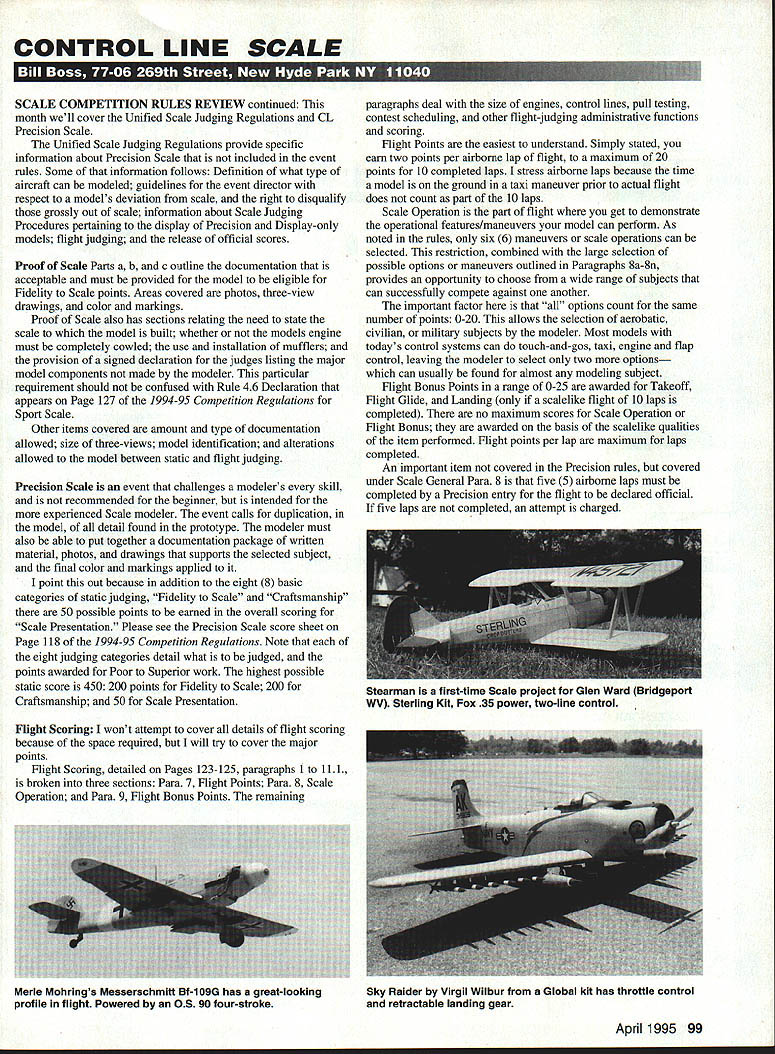
- 2nd — Merle Mohring: Messerschmitt Bf-109G (powered by an O.S. .90 four-stroke; retracts and scale flap operation controlled via a multichannel electronic system)
Featured hobbyist:
- The Stearman pictured is by 17-year-old Glen Ward. Built from a Sterling kit, it is his first scale project. Powered by a Fox .35 and flown on a basic two-line control system — an easy, uncomplicated way to start in Scale.
Covering note for Glen Ward's model:
- Covered with silkspan and painted using Color Creations Fashion Satin spray paint (available at Wal-Mart).
- Final coat of Dullcoat applied to fuelproof the finish and to give the textured fabric look typical of many older airplanes.
Caution: When trying paints other than established model finishes, experiment on scraps before applying to your model.
Workshop Hints
(The following appeared in the Indy Sportliners CL MAC newsletter; the items originated in the Crosswind.)
- Carving with a potato peeler: Ronnie Quarles recommends an ordinary potato peeler as an excellent tool for carving rough-shaped leading edges, rounded nose pieces, or any solid balsa. The peeler cuts only to a limited depth, making rough carving easier and safer.
- Marking black composites with Liquid Paper: Liquid Paper works well for making legible marks on black composite engine mounts or carbon-fiber parts. Apply one or two coats where marks will be made (for engine-bolt layouts). When dry, Liquid Paper accepts pencil, pen, or scribe marks. After drilling, remove the Liquid Paper with fingernail-polish remover to reveal the finished part. (No originator was listed for this hint.)
Contact / Submissions
Please send ideas, notices of upcoming CL Scale events, contest reports, and especially photos of CL Scale activity to the address at the top of this column.
Transcribed from original scans by AI. Minor OCR errors may remain.

