
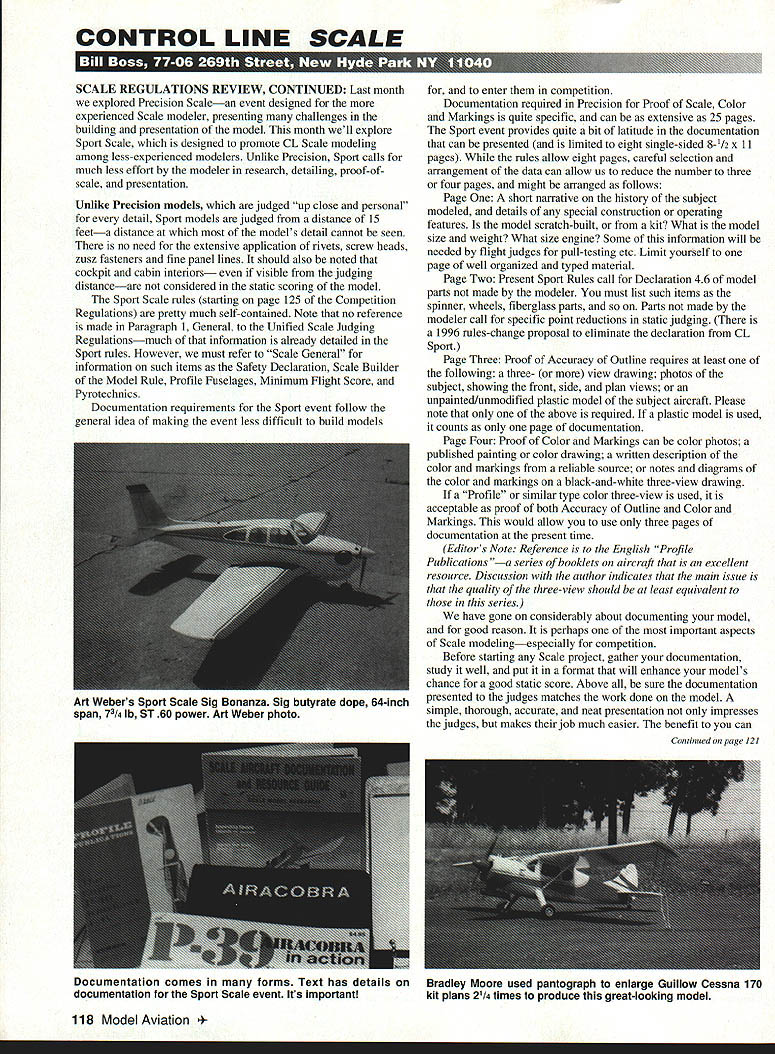
CONTROL LINE SCALE
Bill Boss 77-06 269th Street, New Hyde Park, NY 11040
Scale Regulations Review (continued)
Last month we explored Precision Scale—an event designed for the more experienced scale modeler, presenting many challenges in building and presenting the model. This month we'll explore Sport Scale, which is designed to promote CL Scale modeling among less-experienced modelers. Unlike Precision, Sport calls for much less effort by the modeler in research, detailing, proof-of-scale, and presentation.
Unlike Precision models, which are judged "up close and personal" for every detail, Sport models are judged from a distance of 15 feet—a distance at which most of the model's detail cannot be seen. There is no need for the extensive application of rivets, screw heads and fasteners, or fine panel lines. It should also be noted that cockpit and cabin interiors—even if visible from the judging distance—are not considered in the static scoring of the model.
The Sport Scale rules (starting on page 125 of the Competition Regulations) are largely self-contained. Note that Paragraph 1, General, does not refer to the Unified Scale Judging Regulations—much of that information is already detailed in the Sport rules. However, we must refer to "Scale General" for information on items such as the Safety Declaration, Scale Builder of the Model rule, profile fuselages, minimum flight score, and pyrotechnics.
Documentation Requirements
Documentation requirements for the Sport event follow the general idea of making the event less difficult to build models for, and to enter them in competition.
Documentation required in Precision for proof of scale, color and markings is quite specific and can be as extensive as 25 pages. The Sport event provides latitude in the documentation that can be presented and limits it to eight single-sided 8-1/2 x 11 pages. While the rules allow eight pages, careful selection and arrangement of the data can reduce the number to three or four pages. A suggested arrangement is as follows:
Suggested Documentation Layout
- Page One:
- A short narrative on the history of the subject modeled and details of any special construction or operating features.
- Indicate whether the model is scratch-built or from a kit, model size and weight, and engine size. Some of this information will be needed by flight judges for pull-testing, etc.
- Limit yourself to one page of well-organized and typed material.
- Page Two:
- Declaration (Sport Rules require Declaration 4.6) of model parts not made by the modeler.
- List items such as spinner, wheels, fiberglass parts, and so on. Parts not made by the modeler call for specific point reductions in static judging.
- (There is a 1996 rules-change proposal to eliminate this declaration from CL Sport.)
- Page Three: Proof of Accuracy of Outline (at least one of the following):
- A three-view drawing (or more), or
- Photos of the subject showing front, side, and plan views, or
- An unpainted/unmodified plastic model of the subject aircraft.
- Note: Only one of the above is required. If a plastic model is used, it counts as only one page of documentation.
- Page Four: Proof of Color and Markings (one of the following):
- Color photos, or
- A published painting or color drawing, or
- A written description of the color and markings from a reliable source, or
- Notes and diagrams of the color and markings on a black-and-white three-view drawing.
If a "profile" or similar type color three-view is used, it is acceptable as proof of both Accuracy of Outline and Color and Markings. This would allow you to use only three pages of documentation.
Editor's Note
Reference is to the English "Profile Publications"—a series of booklets on aircraft that is an excellent resource. The main issue is that the quality of the three-view should be at least equivalent to those in this series.
Advice on Documentation
We have emphasized documenting your model because it is one of the most important aspects of scale modeling—especially for competition. Before starting any scale project, gather your documentation, study it well, and put it in a format that will enhance your model's chance for a good static score. Above all, be sure the documentation presented to the judges matches the work done on the model. A simple, thorough, accurate, and neat presentation not only impresses the judges but makes their job much easier. The benefit to you can be a good static score.
Once again I'd like to thank Ed Hagerlin for his ideas and input from his "Scale Views" articles in Hangar Talk (the newsletter of the Cholla Choppers MAC).
Next month: the Profile event, and selecting your model.
Enlarging Three-View Drawings
Enlarging three-view drawings for model construction can be a problem, especially if the desired size is not available in ready-made drawings. One alternative is to have three-views enlarged by a commercial service; however, this can be costly.
Bradley Moore (Hummelstown, PA) had such a problem in scaling up a Cessna 170 from a Guillows rubber kit. Moore made enlarged drawings (2 1/4 times the original size) of the parts and plans using a pantograph—a device used by draftsmen, technical engravers, artists, map-makers, students, and others for enlarging or reducing drawings, patterns, plans, and pictures. Depending on the model, the pantograph comes in ratios such as 4:1, 12:1, or 30:1. The device used by Moore is made by the C-Thru Ruler Co. Alvin & Co. is another source. Both companies' devices are generally available in art-supply stores and range in price from about $15–$25.
If you want to try enlarging your own drawings, the pantograph can be used on most any flat or tilted surface. The only other item required is the paper on which the enlarged item will be made.
Example: Bradley Moore's Cessna 170
Moore's fine-flying Cessna has:
- Span: 34 inches
- Length: 38 inches
- Power: K&B .45 RC Sportster engine
- Throttle control: standard three-line control system
Workshop Hints
These hints were found in the Indy Sportliners MAC newsletter and originated in other club publications.
- Engine cleaning: When you remove an engine from your airplane it's generally quite dirty. An easy way to clean the engine is to liberally squirt it with Wynn's Brake & Parts Cleaner (aerosol). The dirt will run off like magic.
- Finish care: To keep your model's finish bright and shiny, mix a little Armor All into the model-cleaning solution you use. Two ounces to a quart is suggested. Caution: while the mix may work well for some, it is wise to test the solution before applying it to your model.
Submissions
Please send ideas, notice of upcoming CL Scale events, contest reports, and especially photos of CL Scale activity to me at the address at the top of this column.
Transcribed from original scans by AI. Minor OCR errors may remain.

