
CONTROL LINE SCALE
Bill Boss 77-06 269th Street, New Hyde Park, NY 11040
SPORT SCALE was designed to reduce the effort required to document, build, and enter a model in competition. It provides an event for the non-Scale, but experienced modeler to try his or her hand at CL Scale modeling without having to spend the extensive time and effort required to document and build a Precision-class model.
This leaves us with the need for a means to attract the true beginner — a person just starting in CL modeling, or one who hasn't yet tried building full-bodied models. The Profile Scale event is intended to fill that need.
Profile Scale
Profile Scale, which was offered at local contests for several year under club or area rules, was adopted officially in 1992 as an AMA Supplemental Event (#521) and is intended to attract beginners in the Junior or Senior age class. Adoption of Profile as a Supplemental event also provides a uniform set of rules to be followed by all for competition.
Rules governing the Profile event are the same as those for Sport Scale except for the following:
- Only profile fuselage models are permitted in the event.
- The Profile Scale event is exempt from rule 4.6, "Declaration of parts not built by the modeler."
- A dummy pilot figure is not required in the model at any time.
Profile also has specific requirements regarding the model's fuselage:
- The fuselage and/or engine nacelles are not to exceed 1 inch in width, except for simulated cowl(s) which may be up to 1 1/2 inches in total width.
- The engine(s) must be equipped with a muffler or silencer, as required in all Scale events. Ducted fans and electric motors are exempt from the muffler requirement.
Documentation required to prove accuracy of outline, color, and markings is the same as the Sport Scale event. The object is to provide documentation that is as simple as possible, yet thorough, accurate, neat, and with a minimum of effort.
Rules pertaining to static and flight judging of Profile models are identical to those for Sport Scale, and use the score sheet found on pages 128 and 129 of the 1994–95 Competition Regulations. General rules concerning line sizes, safety, and event administration also apply.
The bottom line is that Profile provides the beginner or non-Scale experienced modeler the best opportunity to get started in CL Scale.
Model Selection
When choosing a subject for the Scale events, consider the following four basic items:
- Which of the events will I be building for?
- Have I selected the engine to be used, and will it provide the power needed?
- Have I gathered all the documentation for accuracy of outline, color, and markings for the subject?
- Have I chosen a model size that will fly well and be capable of performing a full flight plan?
These items apply no matter which Scale event you build for and should be given serious consideration. You don't want to build a model for competition only to find the subject you chose is not capable of a full flight plan, is underpowered, or is too small to perform well. Many builders select a subject because it is a favorite of a certain era, only to find it doesn't live up to expectations in competition. Be careful when selecting your subject.
If your first model is to be a profile, several good kits with wingspans of 38–42 inches can be found in various mail-order catalogs. Documentation such as three-views and color photos can be obtained from one of the plan services generally advertised in the AMA.
Depending on the model, the engine should be large enough that the model flies well. Models of the size mentioned above do best with a throttle-equipped engine in the .35 to .40 cubic inch displacement range. The three-line bellcrank system for throttle control is recommended for beginners.
Advice and Recommendations
Advice to the beginner
- Seek out an experienced Scale modeler who can help you understand the rules, the collection of data, and model selection.
- Use a three-line bellcrank throttle system if new to throttle control.
- Be sure the engine is well broken-in and that proper cooling is provided when constructing the engine cowling. Overheating can damage the engine and cause the loss of a model during flight.
- Consider ground handling: tricycle or wide-stance landing gear usually provide better handling during landing, touch-and-goes, and taxiing.
For experienced builders considering Sport Scale
If you're an experienced model builder and want to try CL Scale, the Sport event might be for you. The four basic selection items above still apply.
A model for the Sport event should be larger than the Profile type. Experience indicates a Sport model should have a wingspan of approximately 60 inches, powered by a good .45 to .60 engine.
While the term "RC" may not be liked by many CL fliers, many RC kits make excellent-flying CL models. The kit must be modified to accept a bellcrank control system, whether you use a three-line system or are experienced enough to employ a two-line system for electronic controls. (See the December 1982 and February 1990 columns for information on RC kit conversion.)
Compare your three-views to the kit plans to be sure scale dimensions and outlines match. If not, modify the model accordingly — you'll want it to match the three-view for static judging.
Other Important Considerations
- Ensure the engine is well broken-in and cooling is adequate.
- Design the cowl for proper cooling; overheating is detrimental.
- Consider ground handling characteristics when selecting landing gear.
- For first-time scale projects, choose proven kits and keep documentation simple but accurate.
Next month: some words about Precision Scale, static judging, and flight judging.
Book Review
If you want data for American or British WWII airplanes, consider two volumes from Zenith Books by David Mondey:
- The Concise Guide to American Aircraft of WWII
- The Concise Guide to British Aircraft of WWII
Each book contains color artwork, technical details, and text on the origin and variants of more than 100 airplanes illustrated in each volume. The 230-plus page hardbound books measure 6 7/8 x 9 3/4 inches and are available from Zenith Books (Box 1, Osceola, WI 54020) for $10.98 plus S&H. They are a good addition to any aviation library and provide useful information for many Scale projects.
This Month's Photos and Models
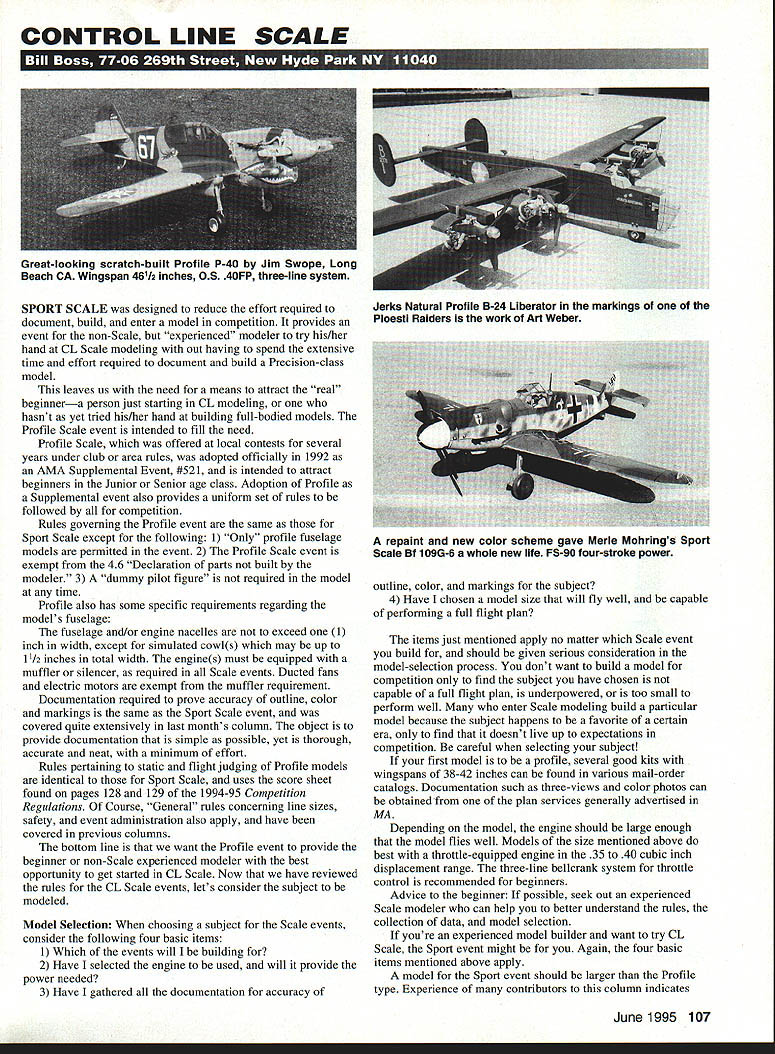
Jim Swope's P-40 has some special features; the most innovative is the concealed fuel tank. Taking advantage of the one-inch-thick fuselage rule, Jim hollowed out the 1/2-inch-thick balsa plank fuselage and installed a homemade fuel tank equipped with a clunk fuel pickup that is 1/2 inch deep, two fuel lines, and five inches long. The plank was then laminated with 1/8-inch balsa and plywood doublers, bringing the fuselage to its full one-inch thickness.
Model control was via a three-line bellcrank and Sullivan nylon pushrod (concealed in the fuselage) for throttle and elevator control. These ideas give the model a very clean look.
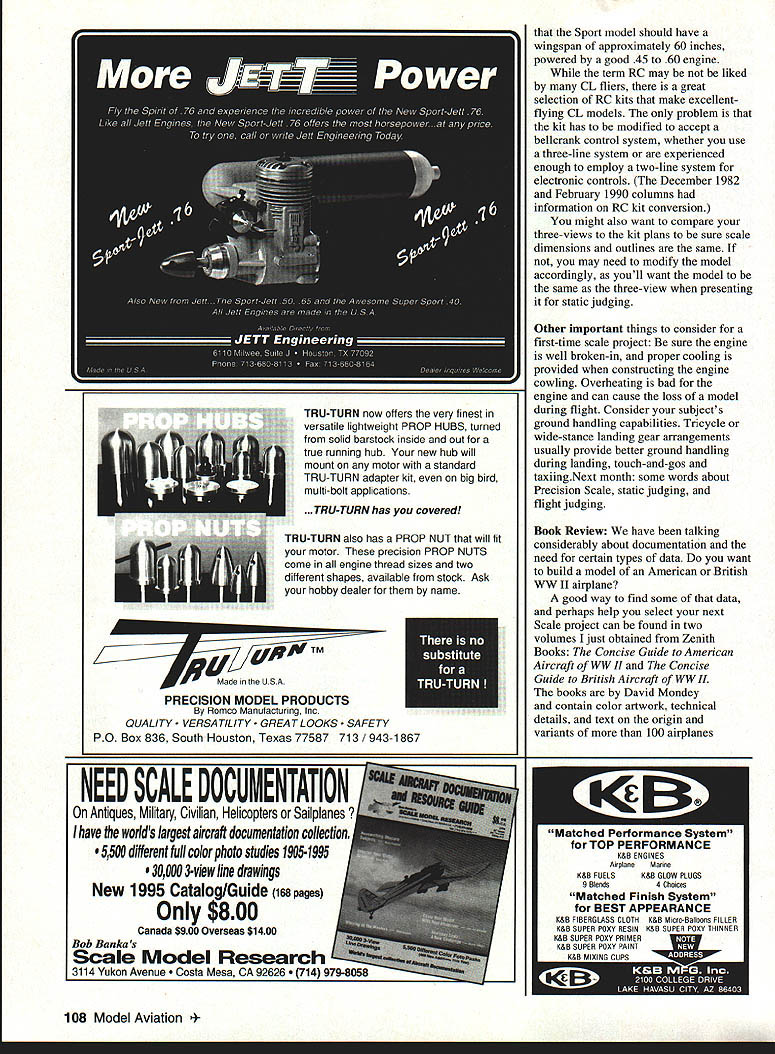
Art Weber's four-engine Consolidated Liberator also takes advantage of the one-inch-thick fuselage; nicely done panel lines give the model a great appearance. Art has plans available for his B-24 and a 63-inch-span Profile P-38 Lightning. Contact him at (414) 783-4079 for full details. Art is also in need of color documentation for the 5,000th P-38, all red "YIPPEE" — give him a call if you can help.
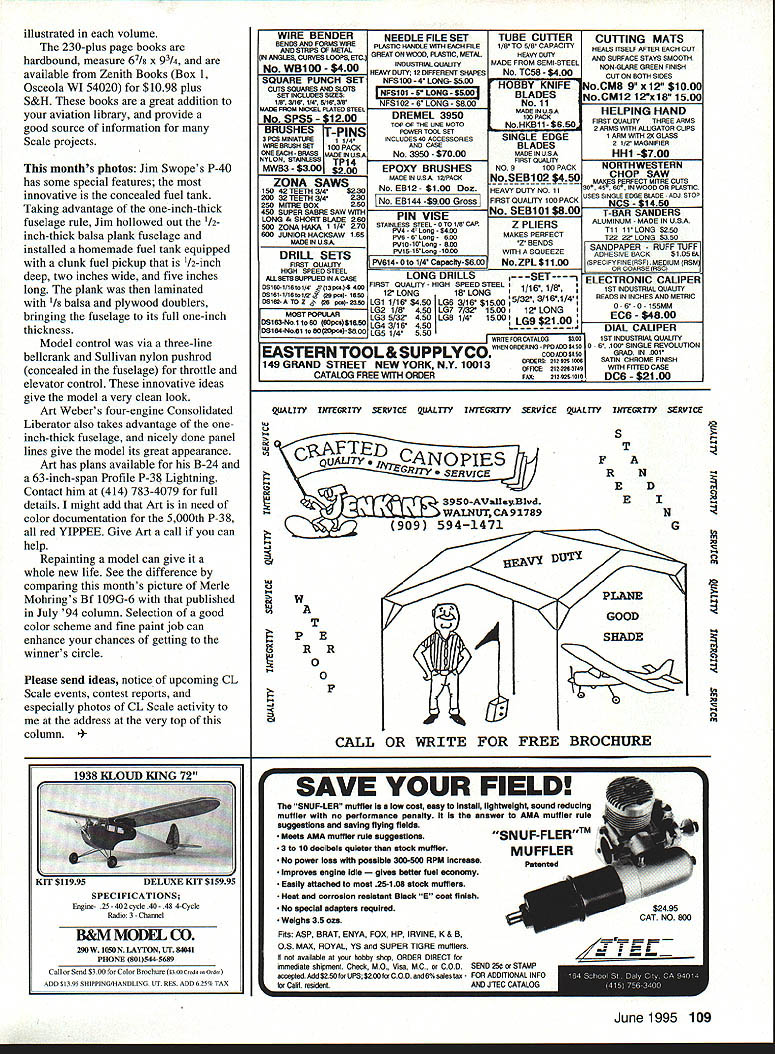
Repainting a model can give it a whole new life. See the difference by comparing this month's picture of Merle Mohring's Bf 109G-6 with that published in the July 1994 column. A good color scheme and fine paint job can enhance your chances of getting into the winner's circle.
Please send ideas, notice of upcoming CL Scale events, contest reports, and especially photos of CL Scale activity to the address at the top of this column.
Transcribed from original scans by AI. Minor OCR errors may remain.

