
CONTROL LINE SCALE
Bill Boss 77-06 269th Street, New Hyde Park, NY 11040
Control Line Scale events: For the past several months we have reviewed the Competition Regulations governing the control line Precision, Sport, and Profile Scale events. We have covered the General and Unified Scale Judging Regulations; the basics of the Precision, Sport and Profile events: documentation and model selection. This month we'll conclude with some discussion on static and flight judging.
Static judging is the process where judges compare the documentation (proof of scale) you have provided against the model you entered in a particular Scale event. If you entered a model in Precision, the judging form on Page 118 of the Competition Regulations will be used. You will be judged in the eight categories shown on the form and graded from 1–25 points according to how well you duplicated the details of the prototype.
In this event, model detail really counts. While Precision models are no longer measured and compared to the three-view drawings for proper scale interpretation, they are judged "up close and personal." In this event every nut, bolt, rivet, hatch, and access panel is looked at for accuracy.
It is essential that your model matches the documentation. You're allowed up to 25 single-sided pages of documentation in which to provide three-views, photos, and written material about your model. In Precision you must provide a photo of the subject aircraft. Keep in mind that there are up to 50 points that can be earned for your documentation presentation. Review, in full, the Proof of Scale section of the Unified Scale Judging Regulations.
Sport and Profile Scale have static judging done in a more relaxed format. These models are generally placed on a table and judged from 15 feet — a distance at which most detail found on a Precision model wouldn't be seen.
It is the intention that judges disregard the fine nuts-and-bolts detail and concentrate on only three judging categories. The CL Sport Scale Worksheet (Part 1) found on Page 128 of the Competition Regulations shows the three categories; we are dealing, in a more general way, with the model's outline, color and markings, and craftsmanship, and not the fine detail required in the Precision event.
The maximum number of static points is 100: 40 for the model's outline, 30 for craftsmanship, and 30 for color and markings.
The Profile and Sport events are designed to promote scale modeling among beginners, and to encourage the non-scale (but experienced) modeler to try CL Scale. They also provide a means for a scale modeler to progress, with time and experience, to Precision.
Flight Judging
The April column covered the basics of the Precision event flight requirements; now we will cover the Profile and Sport events. Profile and Sport use the same flight rules, and use of the Sport Scale Worksheet (Part 2) is highly recommended for scoring the flight.
- Items 1 and 2 deal with line length, size, and pull-test requirements of the model's control system. See the table at the bottom of the Worksheet for the flying line size, length, and pull tests to be applied to the model's control system based on model weight and engine size used.
- Item 3 reminds the flight judge to inspect the flying lines and control handle to be sure they are in good condition and that appropriate size flying lines are used. You don't want to lose a model by using undersized lines or lines in poor condition.
- An "OK" for Item 4 indicates you were able to get your model airborne within the three-minute time limit. Once on the flight circle, time starts when you start cranking the engine. If the model is not started and airborne within the three-minute limit, you will be charged with an attempt. Multiengine models are allowed an additional two minutes for each extra engine.
- Items 5a to 5e cover the Flight Plan. Scoring of all flight items in Profile and Sport is quite different than Precision. In Sport and Profile the four mandatory flight options (a, b, d, & e) and six optional flight options (c 1–6) have a maximum of 10 points each except for retract gear, touch & go, and taxi, which, if chosen, each count for two of the six optional flight options (20 points each).
Maximum flight score is 100 points. Please note there is a limit of 10 minutes for any single flight, and a flight becomes official after the fifth lap.
To close this series of articles, let me once more stress the following:
- Start at a level of building and competition that fits your experience. Be careful in the choice of the subject aircraft.
- You'll want your model to be able to perform well, and be able to complete a full flight plan. The key to successful flights is knowing how well your model flies, and practice.
- Take care to collect the necessary documentation such as three-views and data for color and markings. Present your documentation in a neat, precise manner.
- Know the rules before entering competition.
Because of space limitations, I may not have covered the rules in great detail, but I do hope that what was presented will ignite a spark of interest in some of our non-scale but experienced CL modelers or beginners.
A hearty thanks to Ed Hagerlin of the Cholla Choppers MAC for many of the thoughts and ideas found in this series on CL Scale competition regulations.
Plan enlargements
Drawings for documentation and building have been mentioned often during our discussion of the regulations governing CL Scale events. A good three-view drawing is essential for building, the application of details, and your static judging presentation.
If you are working with a magazine drawing or small three-view, detail may be hard to see. There is a solution to the problem.
R. W. Friestad has a plan enlargement service that you might want to try. Friestad can provide computer-generated copies of plans and three-views in an array of sizes up to 36 x 48 inches, or rolled paper up to 100 inches long.
All you have to do is provide the three-view or drawing to be enlarged, and tell him the size drawing you want or the scale to which the enlargement should be made. For complete details about this service, write to Roland Friestad, RR 1 Box 163, Cameron, IL 61422; Tel.: (309) 342-7474 (8 a.m.–7 p.m. Central time).
Hint from the Workshop
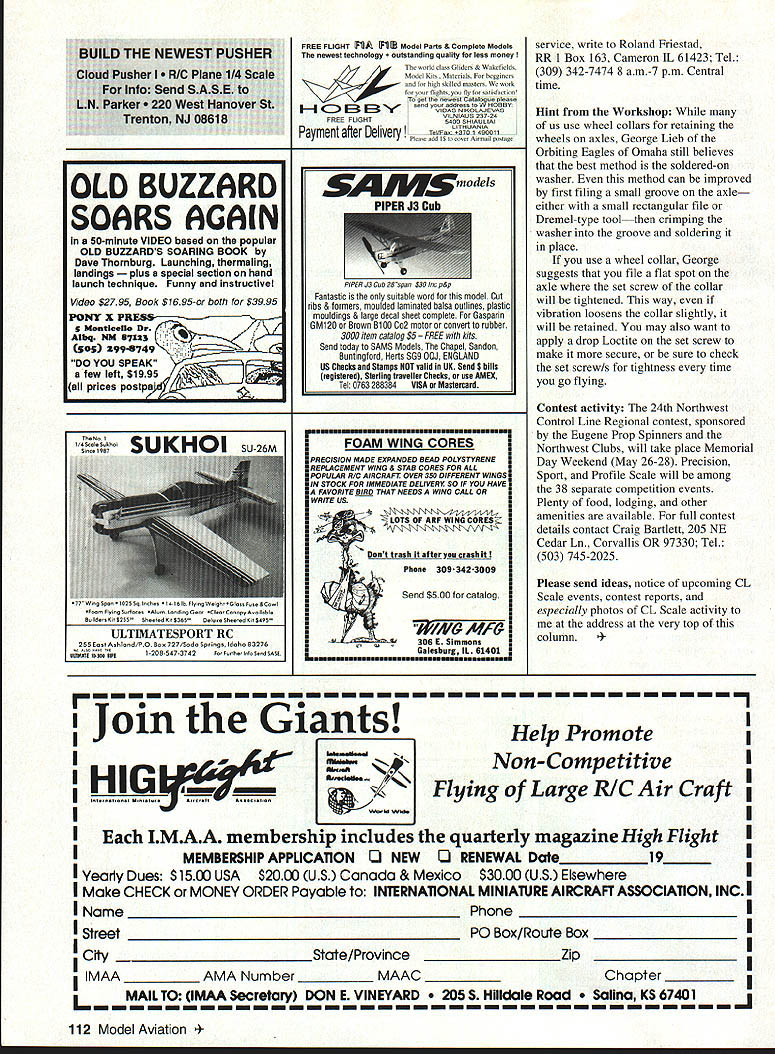
While many of us use wheel collars for retaining the wheels on axles, George Lieb of the Orbiting Eagles of Omaha still believes that the best method is the soldered-on washer. Even this method can be improved by first filing a small groove on the axle—either with a small rectangular file or a Dremel-type tool—then crimping the washer into the groove and soldering it in place.
If you use a wheel collar, George suggests that you file a flat spot on the axle where the set screw of the collar will be tightened. This way, even if vibration loosens the collar slightly, it will be retained. You may also want to apply a drop of Loctite on the set screw to make it more secure, or be sure to check the set screw(s) for tightness every time you go flying.
Contest activity
The 24th Northwest Control Line Regional contest, sponsored by the Eugene Prop Spinners and the Northwest Clubs, will take place Memorial Day Weekend (May 26–28). Precision, Sport, and Profile Scale will be among the 38 separate competition events. Plenty of food, lodging, and other amenities are available. For full contest details contact Craig Bartlett, 205 NE Cedar Ln., Corvallis, OR 97330; Tel.: (503) 745-2025.
Please send ideas, notice of upcoming CL Scale events, contest reports, and especially photos of CL Scale activity to me at the address at the very top of this column.
Transcribed from original scans by AI. Minor OCR errors may remain.

