
CONTROL LINE SCALE
Bill Boss 77-06 269th Street, New Hyde Park, NY 11040
SCALE COMPETITION RULES review has been the main subject of discussion in this column for the past few months. I've attempted to provide a better understanding of the rules, and perhaps interest some non-scale modelers in CL Scale.
This month I would like to call your attention to some proposed changes to the 1996 CL Scale rules that passed the initial vote of the AMA Scale Board (see pages 136–137 of the April 1995 Model Aviation). If these proposals are approved on the final vote, they will certainly change some of what I have recently presented.
Proposal SC-96-3 — Replace Precision Scale with Designer Scale
Proposal SC-96-3 would eliminate Precision Scale and replace it with Designer Scale, an untried event. This new event would use current Sport rules, except for the following differences:
- Craftsmanship will be judged at zero distance.
- All flight options will be scored from 0–10 points.
- Only models of original contestant design are eligible. Models built from kits, commercially available plans, modified kits or plans, or scaled commercial plans are not eligible.
I have received considerable negative reaction to this proposal from across the country and for many reasons. The Precision event is used successfully by clubs on both the East and West Coasts. What will a Precision Scale modeler do with his models? Unless he can prove it is his own design, he can't enter it in Designer Scale. Then what? Does he enter Sport? How will Sport entries feel about competing against Precision models? If Precision is eliminated, what event does CL Scale use as a stepping-stone to FAI or World competition? CL Scale does not have an intermediate Sport "Expert" step, as RC Scale events do.
Many who commented felt that Designer Scale should have been proposed as a Supplemental event before removing the Precision event.
Proposal SC-96-4 — Changes to flying-line size table
Proposal SC-96-4 would make major changes in the flying-line size table. The current table has been used for Scale events since 1974. The original table was established by a committee of scale modelers on the basis of laboratory stress tests and wire analysis to establish the various wire sizes and pull-test criteria. The current proposal does not offer any scientific reasoning behind the proposed changes. The proposer noted that the line-size table will need to be changed if Designer Scale is approved.
The big question is why. Shouldn't a 5-, 10-, 15-, or 20-pound Designer Scale model be subjected to the same line-size and pull-test criteria as a current Precision or Sport model of the same weight?
I believe that the safety of ourselves, our models, and above all our spectators should be first and foremost in our minds. Let's not change something that has been successful for more than 20 years.
Proposal SC-96-5 — Changes to the CL Sport Scale Worksheet (Part I)
Proposal SC-96-5 would make major changes in the AMA-approved CL Sport Scale Worksheet (Part I). This is page 128 of the current Competition Regulations. This proposal de-emphasizes the Accuracy of Outline and Craftsmanship scoring, and puts more emphasis on the model's finish.
The current score sheet was developed by a committee of Scale modelers from across the country and was accepted to provide a good breakdown of the points awarded. Of the 100 points awarded under the current system:
- Accuracy of Outline: 40 points
- Craftsmanship: 30 points
- Finish: 30 points
The current proposal reduces Accuracy of Outline to 30 points, Craftsmanship to 24 points, and raises Finish to 46 points. This change affects the character of the event. It makes it more of a model finish (or beauty) event, rather than one where the model's accuracy of outline and craftsmanship play the major role.
Because space does not permit me to go over each CL Scale proposal in this column, I urge Scale modelers to review all of the current CL Scale proposals and tell their district Scale Board member if the rules change should pass or fail. Let him know now—it's too late after a proposal is passed and you find it's not to your liking.
I hope that in the future AMA Headquarters can improve the published narrative that describes the proposals. I feel that the description of the proposed changes published in Model Aviation did not give a true picture of the contents. I needed a copy of the actual proposals from AMA Headquarters to fully understand the content and intent of each proposal.
Proposal-review suggestion: CL Scale Special Interest Group
I believe the time has come for CL Scale modelers to consider the formation of a Control Line Scale Special Interest Group, perhaps within the National Association of Scale Aeromodelers (NASA). This would be similar to the system used by Navy Carrier and Stunt organizations, and would review CL Scale proposals before they go to the Scale Board for consideration. After all, who is more qualified to judge and comment on a CL Scale proposal than a CL Scale modeler?
A group of experienced CL Scale modelers could eliminate "way out" proposals. This would allow AMA Scale Board members to spend their time on meaningful proposals in both the initial and final voting stages of the rules cycle.
Next month
Next month I'll be reporting on modelers and clubs on both coasts who are promoting CL Scale activities by trying some non-AMA events. These not only put fun into building and flying scale, but also allow young and old modelers to compete without worrying about restrictive contest rules. I'll include Team Scale, fun scale, and Bomb Drop.
Contest Report
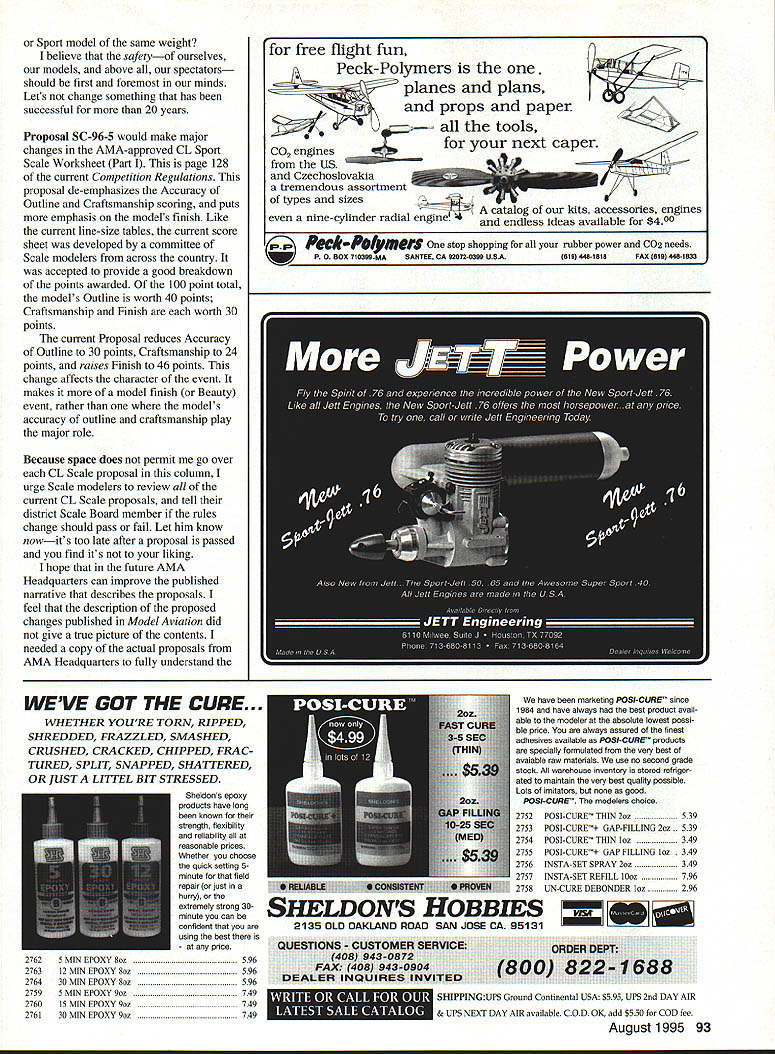
Fred Cronenwett reports that on March 12 the 101st Squadron Screaming Eagles held the Roland Baltes Memorial Scale and Carrier Contest at Whittier Narrows, CA. The contest was held in memory of Roland Baltes, one of the West Coast's well-known Control Line Scale modelers. Proceeds from the meet were donated to the American Cancer Society. A commemorative plaque was presented to Mrs. Baltes by club president Virgil Wilbur.
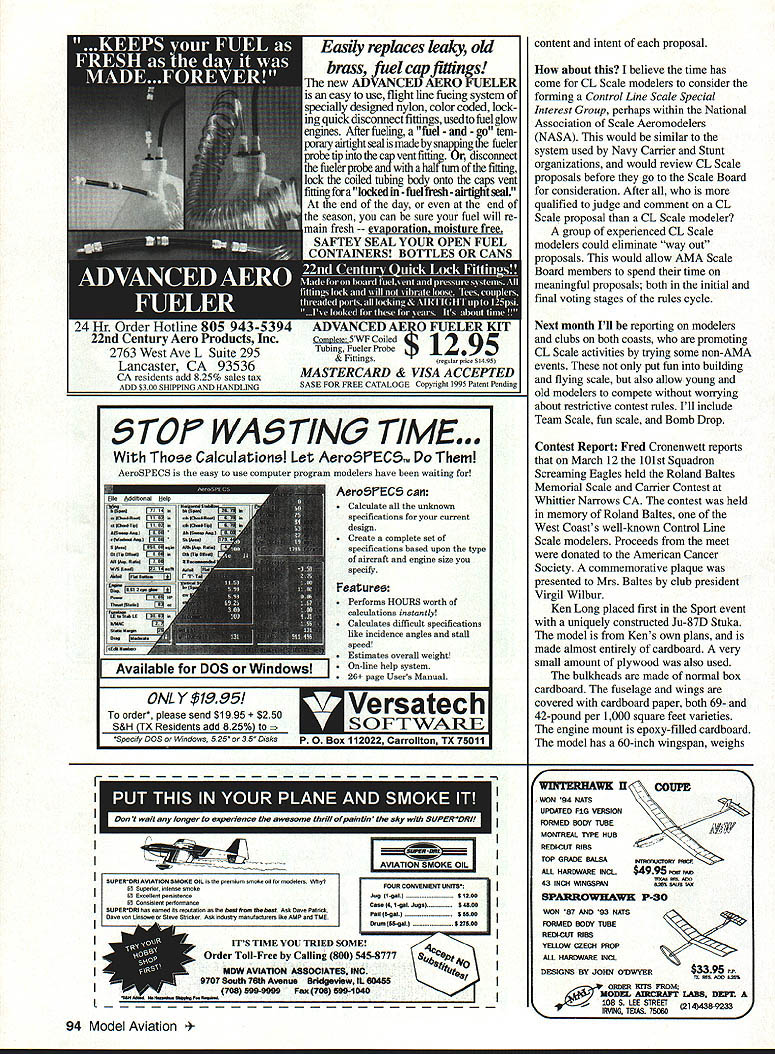
- Ken Long placed first in the Sport event with a uniquely constructed Ju-87D Stuka. The model is from Ken's own plans and is almost entirely of cardboard, with a very small amount of plywood. The bulkheads are made of normal box cardboard. The fuselage and wings are covered with cardboard paper (both 69- and 42-pound per 1,000 square feet varieties). The engine mount is epoxy-filled cardboard. The model has a 60-inch wingspan, weighs seven pounds, and is powered with a SuperTigre .51. Ken designed multichannel electronics for bomb drop and throttle controls. The Stuka scored 86.10 points, with 96.6 static points and 89.5 flight points.
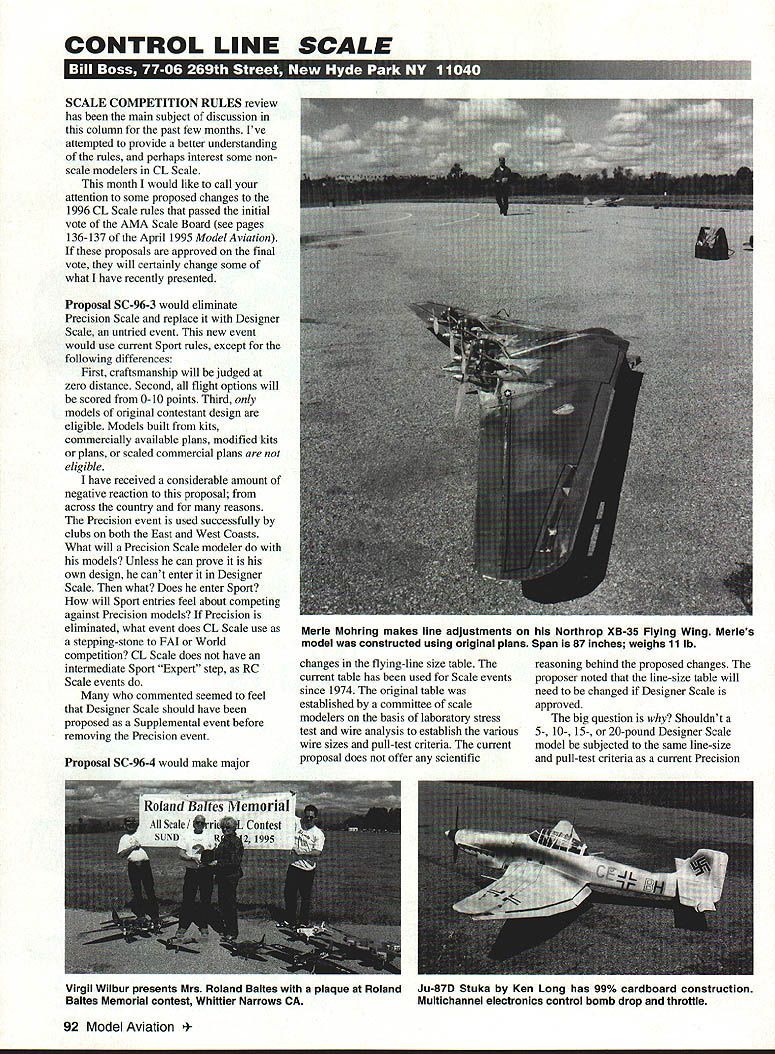
- Merle Mohring placed third in the Profile event. The XB-35's airframe is a combination of balsa and cardboard, constructed from a set of original plans. It's covered with chrome MonoKote, has an 87-inch wingspan, weighs 11 pounds, and is powered by four O.S. .20 engines.
- Fred Cronenwett placed first in Profile with his electronically controlled Douglas A-20G. Jim Swope placed second with a scratch-built Spitfire powered with an O.S. .40P, using a conventional three-line system for throttle control.
Workshop Hints
The following were found in the Indy Sportsliner and T.O.R.K.S. newsletters.
- If you have problems with your cyanoacrylate (CyA) glue applicator clogging, tie a 12-inch piece of string around the neck of the CyA container and put a loop in the loose end of the string. When you are through gluing, put your finger in the loop and twirl the bottle in a circle. Centrifugal force will push the glue out of the applicator tube and back into the bottle.
- To keep your X-Acto knife from rolling off the table, drill a hole in the end of the handle and insert a key ring into the hole. The knife won't roll off the workbench and will have a nice hanger as well.
- Turn empty soda and beer cans over and use the concave bottoms for mixing small amounts of epoxy.
Contact and submissions
Please send ideas, notice of upcoming CL Scale events, and contest reports to me at the address at the top of this column. I would especially appreciate photos of CL Scale activity.
A note to club newsletter editors: If your club or group has CL Scale activities or provides building tips and ideas, I would be interested in receiving your newsletter as a possible source of material for this column.
Transcribed from original scans by AI. Minor OCR errors may remain.

