
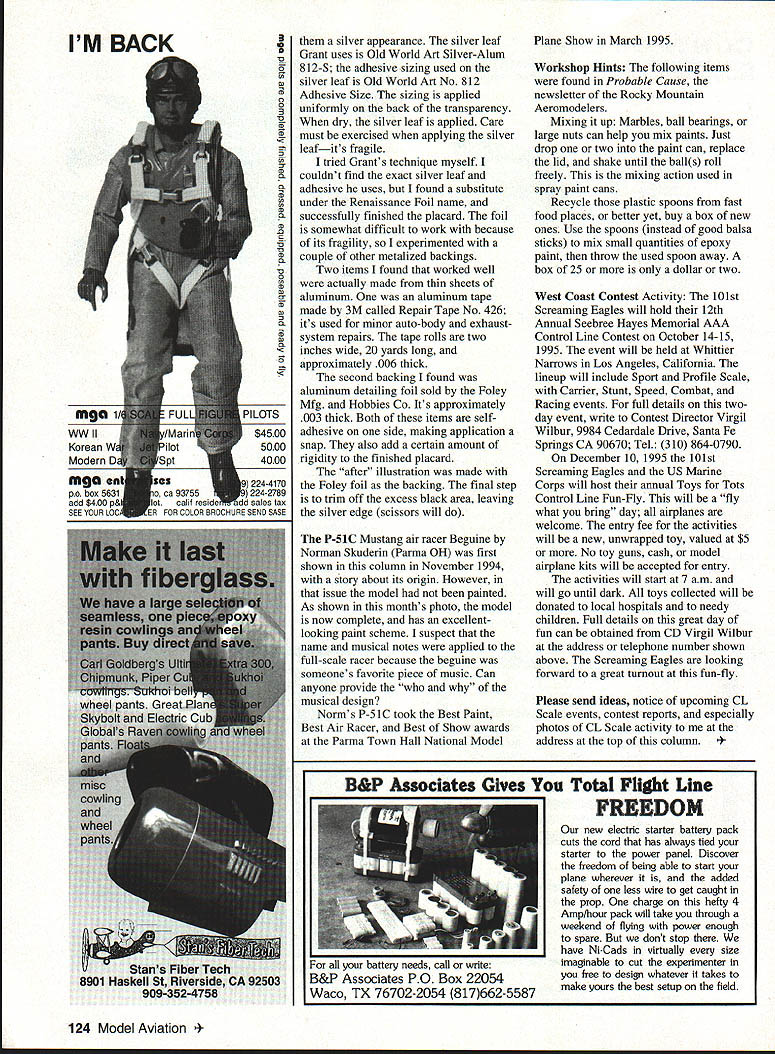
CONTROL LINE SCALE
Bill Boss, 77-06 269th Street, New Hyde Park, NY 11040
CONGRATULATIONS GO to Bob Furr of Omaha, Nebraska, of the Orbiting Eagles. In July 1994 Bob was honored with membership in AMA's Aero Honor Society for newsletter editors. Bob was honored because the newsletter he edits is a quality product and is very enjoyable reading. Bob is in his twelfth year as editor of the Orbiting Eagles newsletter; the April/May 1995 installment was his 100th issue.
The Academy has inducted fewer than 60 newsletter editors into the Aero Honor Society; Bob is one of only five control line newsletter editors so honored.
Over the years Bob has provided a considerable amount of material (especially his Workshop Hints) to this column, both through the newsletter and his personal contributions. Once again, congratulations to a great control line modeler who's doing a great job.
Various types of placards or nomenclature plates appear in the cockpits of most full-scale aircraft. They denote the manufacturer, provide warnings, show instructions, and so on. Some of the scale models we build require reproduction of these placards.
In last month's column I showed how Grant Heistand reproduces instrument faces—he draws the faces in black ink on a white background, then uses a copy machine to reverse the colors and reduce the instruments to the correct size. This month we'll explore the same method (with a couple of additional steps) to make and metalize the placards.
The first step used to make the placards is the same one used for the instruments—make a black-and-white drawing of the panels. This is shown in the "before" illustration. Make the drawing several times larger than the size you need for the model. This makes the placards easier to work on; they will be reduced to the proper size later. The lettering on both of the example items was set up using a computer word processor, then printed with a laser printer. The drawing is completed by creating the solid black border and bars.
The completed drawing is taken to a local print shop with a copy machine that can reverse the drawing colors and reduce the drawing to the proper size for the model. Unlike the instrument faces, the reversed-and-reduced copy is printed on transparency material that's normally used for overhead projection purposes.
The next step is to give the transparency the metalized look. Grant applies silver leaf to the back of the transparency. On the front of the placard, the leaf shows through the transparent lettering and bars, giving the silver appearance.
Grant uses Old World Art Silver-Alum 812-S adhesive sizing for the silver leaf. The sizing is applied uniformly to the back of the transparency; when dry, silver leaf is applied. Care must be exercised applying silver leaf—it's fragile. I tried Grant's technique myself but couldn't find the exact silver leaf adhesive he uses. I found a substitute under the Renaissance Foil name and successfully finished the placard. Foil is somewhat difficult to work with because of its fragility.
I experimented with a couple other metalized backings. Two items I found worked well are actually made of thin sheets of aluminum. Aluminum tape made by 3M called Repair Tape No. 426 is used for minor auto-body and exhaust-system repairs. Tape rolls are two inches wide, 20 yards long, and approximately .006" thick. The second backing is aluminum detailing foil sold by Foley Mfg. & Hobbies Co. It's approximately .003" thick. Both items are self-adhesive, making application a snap, and also add a certain amount of rigidity to the finished placard. In the "after" illustration I used Foley foil for the backing. The final step is to trim off the excess black area, leaving a silver edge. Scissors will do.
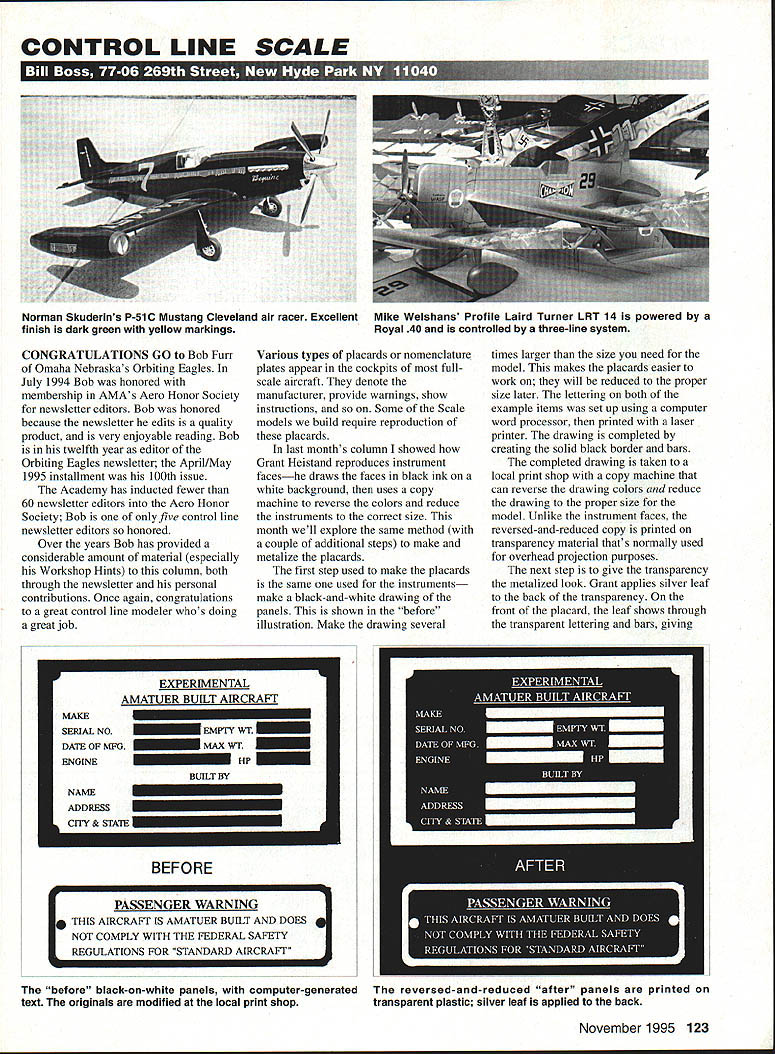
The P-51C Mustang air racer Beguine by Norman Skuderin (Parma, OH) was first shown in this column in November 1994, with a story about its origin. However, in that issue the model had not been painted. As shown in this month's photo, the model is now complete and has an excellent-looking paint scheme. I suspect that the name and musical notes were applied to the full-scale racer because the beguine was someone's favorite piece of music. Can anyone provide the "who and why" of the musical design?
Norm's P-51C took the Best Paint, Best Air Racer, and Best of Show awards at the Parma Town Hall National Model Plane Show in March 1995.
Workshop Hints
The following items were found in Probable Cause, the newsletter of the Rocky Mountain Aeromodelers.
- Mixing it up: Marbles, ball bearings, or large nuts can help you mix paints. Just drop one or two into the paint can, replace the lid, and shake until the ball(s) roll freely. This is the mixing action used in spray paint cans.
- Recycle those plastic spoons from fast food places, or better yet, buy a box of new ones. Use the spoons (instead of good balsa sticks) to mix small quantities of epoxy or paint, then throw the used spoon away. A box of 25 or more is only a dollar or two.
West Coast Contest Activity
The 101st Screaming Eagles will hold their 12th Annual Seebree Hayes Memorial AAA Control Line Contest on October 14-15, 1995. The event will be held at Whittier Narrows in Los Angeles, California. The lineup will include Sport and Profile Scale, Carrier, Stunt, Speed, Combat, and Racing events. For full details on this two-day event, write to Contest Director Virgil Wilbur, 9984 Cedardale Drive, Santa Fe Springs, CA 90670; Tel: (310) 864-0790.
On December 10, 1995 the 101st Screaming Eagles and the US Marine Corps will host their annual Toys for Tots Control Line Fun-Fly. This will be a "fly what you bring" day; all planes are welcome. The entry fee for the activities will be $5. All proceeds will be donated to Toys for Tots, and a collection box will be at the field. All toys collected will be donated to local hospitals and to needy children. Full details on this great day of fun can be obtained from CD Virgil Wilbur at the address or telephone number shown above. The Screaming Eagles are looking forward to a great turnout at this fun-fly.
Please send ideas, notice of upcoming CL Scale events, contest reports, and especially photos of CL Scale activity to me at the address at the top of this column.
Transcribed from original scans by AI. Minor OCR errors may remain.

