
CONTROL LINE SCALE
Fred Cronenwett 7352 Independence #201, Canoga Park CA 91303
RICHLAND, Washington hosted the Scale portion of the Nationals, and the weather was fantastic. Driving east from Portland along the Columbia River, competitors left behind clouds for blue skies. First thing Monday morning all of the Control Line Scale models were judged at the Shilo Inn; pilots who stayed there had a short walk to the ballroom for static judging.
Precision Scale
The battle for Precision Scale started early Monday, July 10.
- Charlie Bauer (Norridge, IL) — F-86
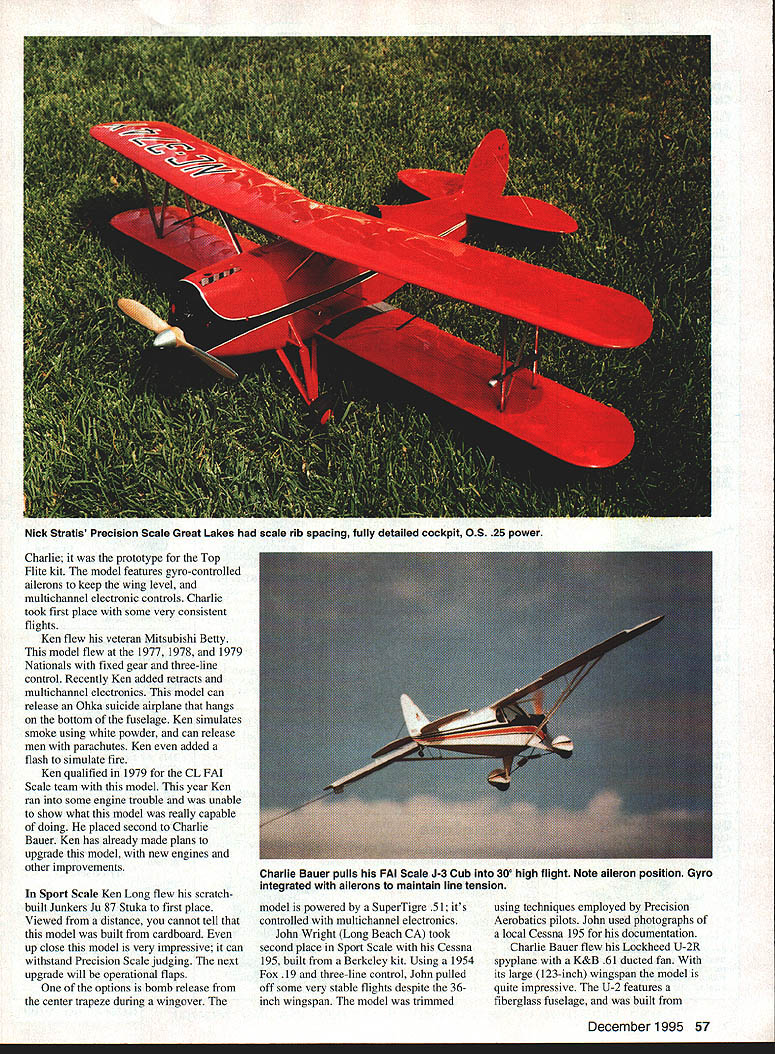
The 1/5-scale F-86, built from a Bob Violett kit, weighed 11.5 pounds and was judged for over an hour. Charlie powered the model with a K&B .61 ducted fan. Precision Scale drop tanks add considerable drag; Charlie elected to drop the tanks during the 10-level laps. The F-86 landed very smoothly with flaps deployed. Charlie uses multichannel electronic controls for throttle, flaps, tank drop, and retracts. After the first flight his handlers joked he needed a high-protein diet to handle the beast. In the second round Charlie improved his flight score to 141.5 and finished second overall with 444.5 points.
- Grant Hiestand — Spacewalker (1/3-scale, 103" span)
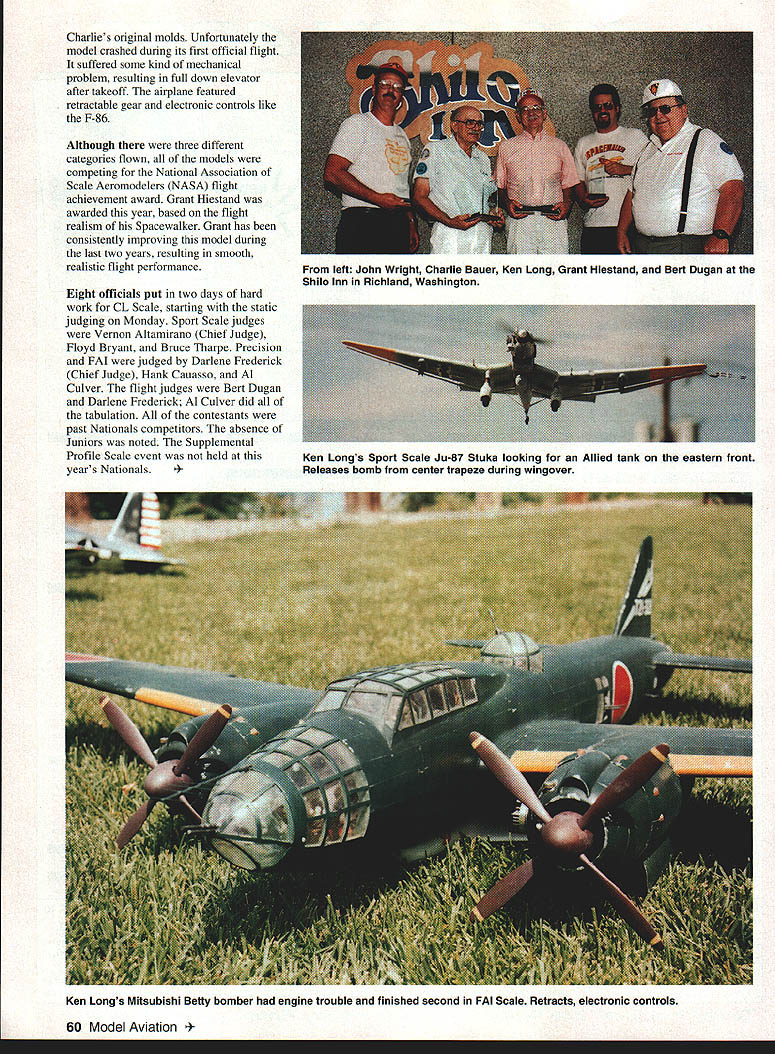
Grant’s Spacewalker barely fit on the judging table. Built in 1993 (he also took it to the 1993 Nationals), Grant rebuilt the cockpit and added considerable detail. To weigh in under the 20-pound CL Scale limit he lightened the airplane’s structure. The model is powered by an Astro 90 electric motor and can be started from the center circle; a modified Custom Electronics servo driver regulates the speed control. Grant installed single-channel electronics to meet the proportional throttle-control requirement. The engine batteries are mounted on rails and secured with Velcro so they can be moved to change the model’s center of gravity; Grant trimmed the model by positioning batteries until the tail comes up on the takeoff run. It flies very smoothly but, although it has flaps, it cannot perform 300-foot-high aerobatics. Grant pulled off consecutive flights scoring 125.5 and 126, and captured first place in Precision Scale with 487 points.
During Precision judging Nick Stratis (Auburn, WA) was unable to fly an official Precision Scale flight. His Great Lakes 2T-1 biplane features a fully detailed cockpit, three-line control throttle, a 36-inch span, aluminum N-struts and shock-absorbing gear. Nick obtained factory drawings of the full-scale aircraft and changed the model’s rib spacing to match. The model is powered by an OS .25 and weighs 2 pounds 12 ounces.
FAI Competition
FAI competition consisted of a flight plan of takeoff realism, five options, landing and taxi demonstration. Static judging stresses attention to details such as belts, panel lines and rivets. FAI team trials are flown one year and World Championships the following year. The top three pilots in the team trials earn a place on the Scale team that attends the World Championships the following year. The next team trials will be in 1997.
Read the rules carefully; the FAI rules allow large engines on models. AMA-sanctioned events may allow, for example, Grant’s Spacewalker to be FAI-legal due to the number of motor cells and the model’s overall weight. Contact AMA Headquarters for further information about the FAI rule book and team trials.
Other Notable Models and Results
- Charlie Bauer — Lockheed U-2R spyplane
Charlie flew a U-2R with a K&B .61 ducted fan. With its large 123-inch wingspan and fiberglass fuselage the model was impressive and built using techniques employed by Precision Aerobatics pilots. Unfortunately the U-2 crashed during its first official flight due to a mechanical problem that resulted in full down elevator after takeoff. The model featured retractable gear and electronic controls.
- Ken (last name not specified) — Mitsubishi Betty
Ken flew a veteran Mitsubishi Betty that had appeared at the 1977–1979 Nationals with fixed gear and three-line control. Recently he added retracts and multichannel electronics. The model can release an Ohka suicide airplane mounted under the fuselage; Ken simulates smoke with white powder, can release parachuted figures, and has added a flash to simulate fire. Ken qualified in 1979 for the CL FAI Scale team with this model. This year he ran into engine trouble and was unable to show the model’s full capabilities; he placed second to Charlie Bauer in the relevant event. Ken has plans to upgrade the model with new engines and other improvements.
- Ken Long — Junkers Ju 87 Stuka (Sport Scale)
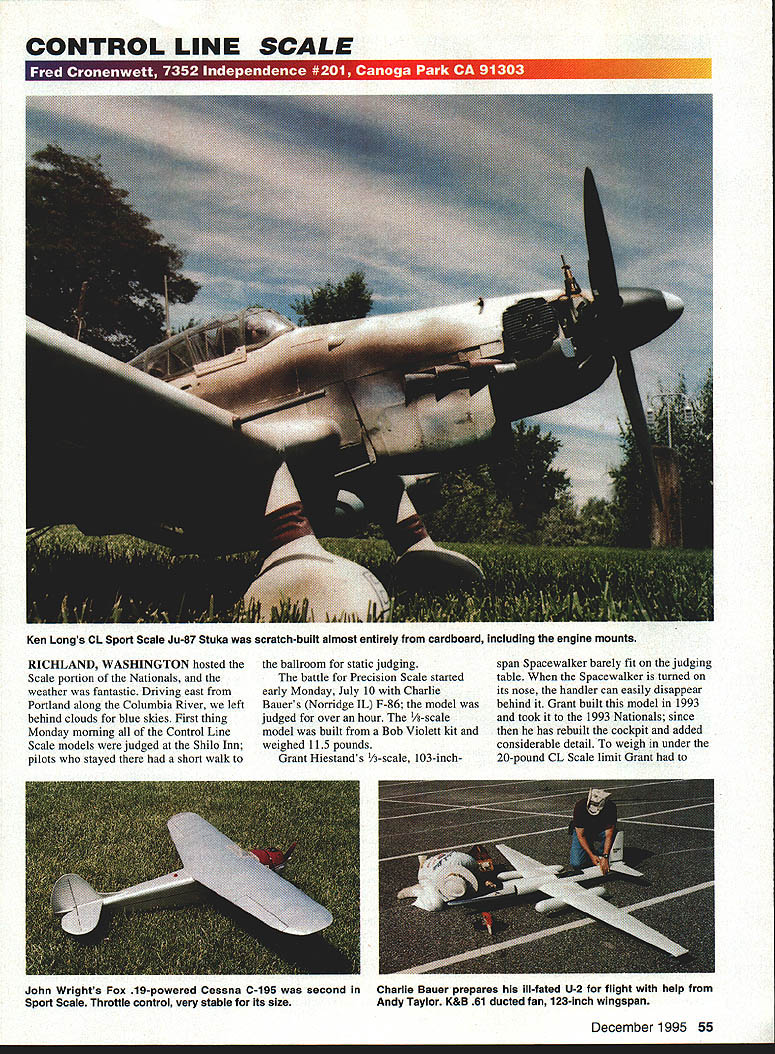
Ken Long flew his scratch-built Stuka to first place in Sport Scale. Built largely from cardboard, the model is impressive even up close and can withstand Precision Scale judging. The next planned upgrade is operational flaps. One of the Sport Scale options is bomb release from the center trapeze during a wingover. The Stuka is powered by a SuperTigre .51 and is controlled with multichannel electronics.
- John Wright (Long Beach, CA) — Cessna 195 (Sport Scale)
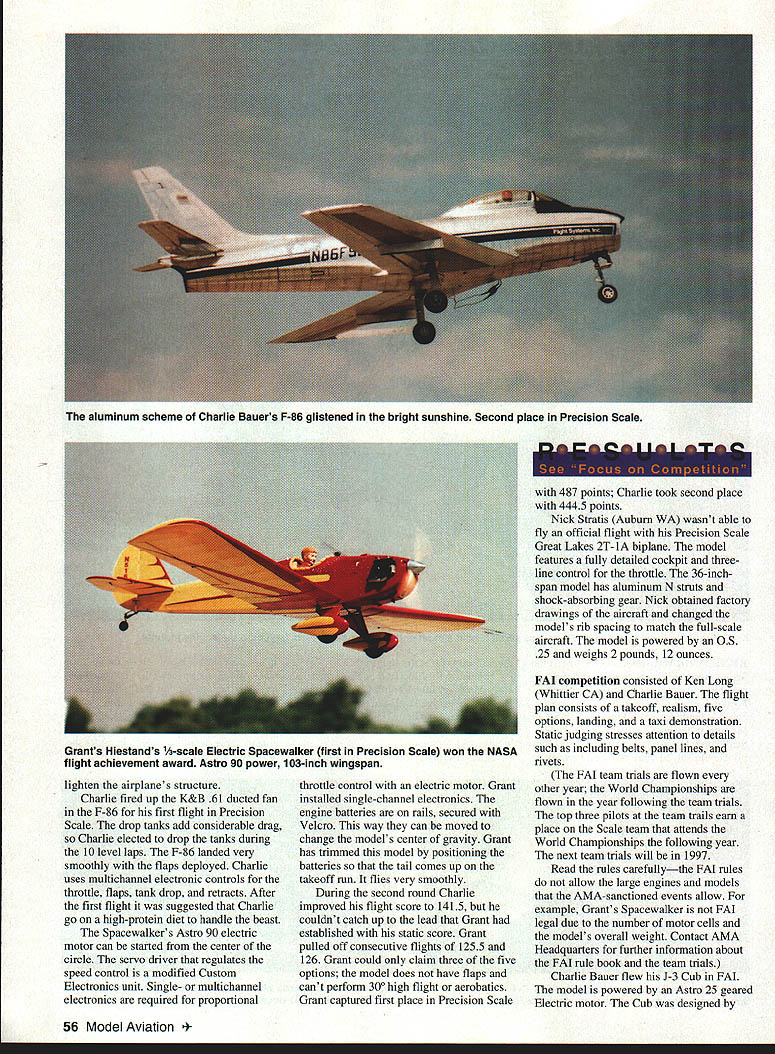
John took second place in Sport Scale with a Cessna 195 built from a Berkeley kit. Using a 1954 Fox .19 and three-line control, John achieved very stable flights despite the model’s 36-inch wingspan. He used photographic documentation of a local Cessna 195 for detailing and trimmed the model using techniques employed by Precision Aerobatics pilots.
Awards and Officials
Although three different categories were flown, all the models competed for the National Association of Scale Aeromodelers (NASA) flight achievement award. Grant Hiestand received this year’s award based on the flight realism of his Spacewalker; he has been consistently improving the model over the past two years.
Eight officials worked two days for CL Scale, beginning with static judging on Monday.
- Sport Scale judges: Vernon Altamirano (Chief Judge), Floyd Bryant, Bruce Tharpe
- Precision and FAI judges: Darlene Frederick (Chief Judge), Hank Causasso, Al Culver
- Flight judges: Bert Dugan, Darlene Frederick
- Tabulation: Al Culver
All contestants were past Nationals competitors; the absence of Juniors was noted. The Supplemental Profile Scale event was not held at this year’s Nationals.
Transcribed from original scans by AI. Minor OCR errors may remain.

