
Control Line: Scale
FUN SCALE, TEAM SCALE, and other ways of promoting Scale activity were the subjects of the September column; ideas came from Bill Reynolds (of New Jersey's Garden State Circle Burners) and Fred Cronenwett (of the West Coast's 101st Screaming Eagles).
A report from Bill Reynolds noted that the Circle Burners tried fun scale events at their April 1995 Profile Scale meet and their June 1995 Carrier meet. The April meet drew 16 entries, nine of which were in fun scale. The June meet's fun event also brought out nine entries. A good beginning.
Reynolds noted that the Scale purist may not agree with such events, but this type of event is starting to bring out more entrants—especially those who haven't previously tried their hand at Scale contest activity.
The object of these fun-type events is to introduce the newcomer (and the not-so-new modeler) to Scale activity without the pressure that usually accompanies a full-blown Scale meet. The main theme here is having some fun while trying something new (and perhaps even going home with an award).
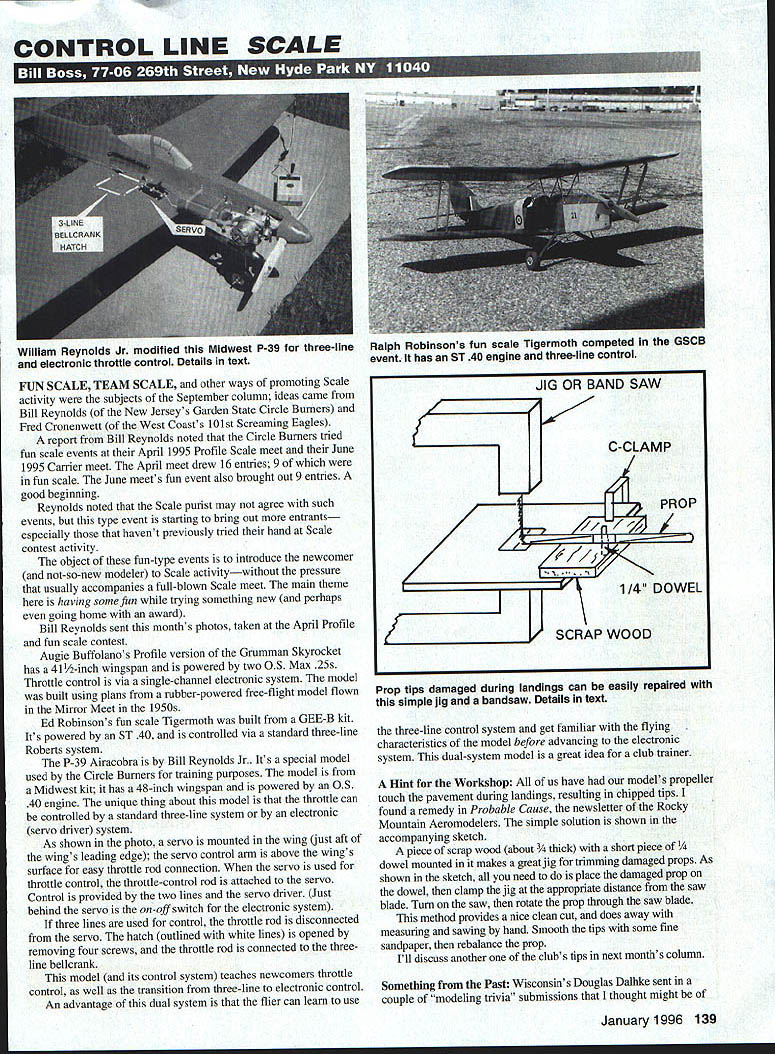
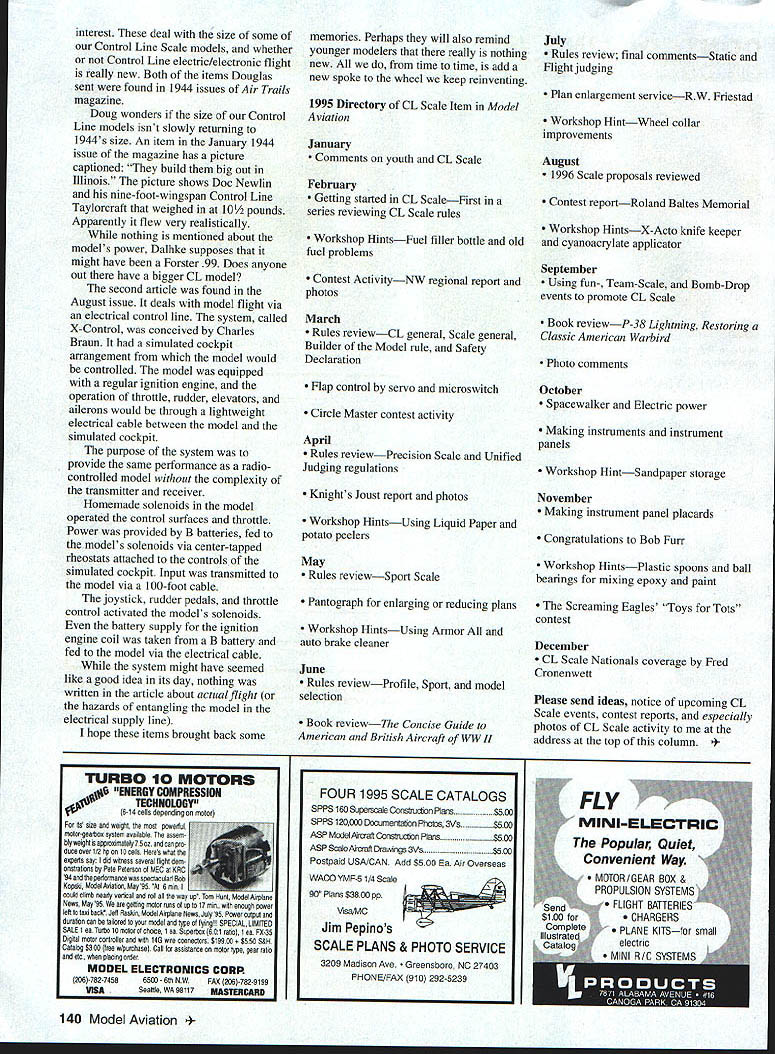
Bill Reynolds sent this month's photos, taken at the April Profile and fun scale contest.
Featured models and photos
- Augie Buffolano's Profile version of the Grumman Skyrocket has a 4-1/2-inch wingspan and is powered by two O.S. Max .25s. Throttle control is via a single-channel electronic system. The model was built using plans from a rubber-powered free-flight model flown in the Mirror Meet in the 1950s.
- Ed Robinson's fun scale Tigermoth was built from a GEE-B kit. It's powered by an ST .40 and is controlled via a standard three-line Roberts system.
- The P-39 Airacobra is by Bill Reynolds Jr. It's a special model used by the Circle Burners for training purposes. The model is from a Midwest kit; it has a 48-inch wingspan and is powered by an O.S. .40 engine. The unique thing about this model is that the throttle can be controlled by a standard three-line system or by an electronic (servo driver) system.
As shown in the photo, a servo is mounted in the wing just aft of the leading edge; the servo control arm is above the wing's surface for easy throttle-rod connection. When the servo is used for throttle control, the throttle-control rod is attached to the servo. Control is provided by the two lines and the servo driver (just behind the servo is the on-off switch for the electronic system).
If three lines are used for control, the throttle rod is disconnected from the servo. The hatch (outlined with white lines) is opened by removing four screws, and the throttle rod is connected to the three-line bellcrank.
This model (and its control system) teaches newcomers throttle control, as well as the transition from three-line to electronic control. An advantage of this dual system is that the flier can learn to use the three-line control system and get familiar with the flying characteristics of the model before advancing to the electronic system. This dual-system model is a great idea for a club trainer.
Workshop hint
All of us have had our model's propeller touch the pavement during landings, resulting in chipped tips. I found a remedy in Probable Cause, the newsletter of the Rocky Mountain Aeromodelers. The simple solution is shown in the accompanying sketch.
A piece of scrap wood (about 3/4" thick) with a short piece of 1/4" dowel mounted in it makes a great jig for trimming damaged props. As shown in the sketch, place the damaged prop on the dowel and clamp the jig at the appropriate distance from the saw blade. Turn on the saw, then rotate the prop through the saw blade. This method provides a nice clean cut and does away with measuring and sawing by hand. Smooth the tips with some fine sandpaper, then rebalance the prop.
I'll discuss one of the club's tips in next month's column.
Something from the past
Wisconsin's Douglas Dalhke sent in a couple of "modeling trivia" submissions that I thought might be of interest.
One deals with the size of some Control Line Scale models and whether Control Line electric/electronic flight is really new. Both items Douglas sent were found in 1944 issues of Air Trails magazine. Doug wonders if the size of Control Line models isn't slowly returning to 1944 sizes.
An item in the January 1944 issue of the magazine has a picture captioned "Build Big Out in Illinois." The picture shows Doc Newlin's nine-foot-wingspan Control Line Taylorcraft that weighed 10-1/2 pounds. Apparently it flew very realistically; nothing was mentioned about the model's power. Dalhke supposes it might have been a Forster 99. Does anyone out there have a bigger CL model?
The second article, found in the August issue, deals with model flight via an electrical control-line system called X-Control, conceived by Charles Braun. The simulated-cockpit-arrangement model would be a model equipped with a regular ignition engine, and the operation of throttle, rudder, elevators, and ailerons would be through a lightweight electrical cable between the model and the simulated cockpit.
The purpose of the system was to provide the same performance as a radio-controlled model without the complexity of the transmitter and receiver. Homemade solenoids in the model operated the control surfaces and throttle. Power was provided by B batteries, fed to the model's solenoids via center-tapped rheostats attached to the controls of the simulated cockpit. Input was transmitted to the model via a 100-foot cable.
The joystick, rudder pedals, and throttle control activated the model's solenoids. Even the battery supply for the ignition engine coil was taken from a B battery and fed to the model via the electrical cable.
While the system might have seemed like a good idea in its day, nothing was written in the article about actual flight (or the hazards of entangling the model in the electrical supply line).
I hope these items brought back some memories. Perhaps they will also remind younger modelers that there really is nothing new. All we do, from time to time, is add a new spoke to the wheel we keep reinventing.
1995 Directory of CL Scale Items in Model Aviation
January
- Comments on youth and CL Scale
February
- Getting started in CL Scale — First in a series reviewing CL Scale rules
- Workshop Hints — Fuel filler bottle and old fuel problems
- Contest Activity — NW regional report and photos
March
- Rules review — CL general, Scale general, Builder of the Model rule, and Safety Declaration
- Flap control by servo and microswitch
- Circle Master contest activity
April
- Rules review — Precision Scale and Unified Judging regulations
- Knight's Joust report and photos
- Workshop Hints — Using Liquid Paper and potato peelers
May
- Rules review — Sport Scale
- Pantograph for enlarging or reducing plans
- Workshop Hints — Using Armor All and auto brake cleaner
June
- Rules review — Profile, Sport, and model selection
- Book review — The Concise Guide to American and British Aircraft of WW II
July
- Rules review; final comments — Static and Flight judging
- Plan enlargement service — R.W. Freistad
- Workshop Hint — Wheel collar improvements
August
- 1996 Scale proposals reviewed
- Contest report — Roland Baltes Memorial
- Workshop Hints — X-Acto knife keeper and cyanoacrylate applicator
September
- Using fun-, Team-Scale, and Bomb-Drop events to promote CL Scale
- Book review — P-38 Lightning, Restoring a Classic American Warbird
- Photo comments
October
- Spacewalker and Electric power
- Making instruments and instrument panels
- Workshop Hint — Sandpaper storage
November
- Making instrument panel placards
- Congratulations to Bob Furr
- Workshop Hints — Plastic spoons and ball bearings for mixing epoxy and paint
- The Screaming Eagles' "Toys for Tots" contest
December
- CL Scale Nationals coverage by Fred Cronenwett
Please send ideas, notice of upcoming CL Scale events, contest reports, and especially photos of CL Scale activity to me at the address at the top of this column.
Transcribed from original scans by AI. Minor OCR errors may remain.

