
CONTROL LINE SCALE
Bill Boss, 77-06 269th Street, New Hyde Park NY 11040
MAKING PINKED-EDGE RIB TAPE
From silkspan or paper to simulate the rib-stitching covering on fabric-covered models was mentioned in last month's Workshop Hints. The process involves using the saw-toothed metal strip that's found on waxed paper and plastic wrap boxes. One problem involves how to hold the flimsy steel edge while making the pinked-edge tape strips.
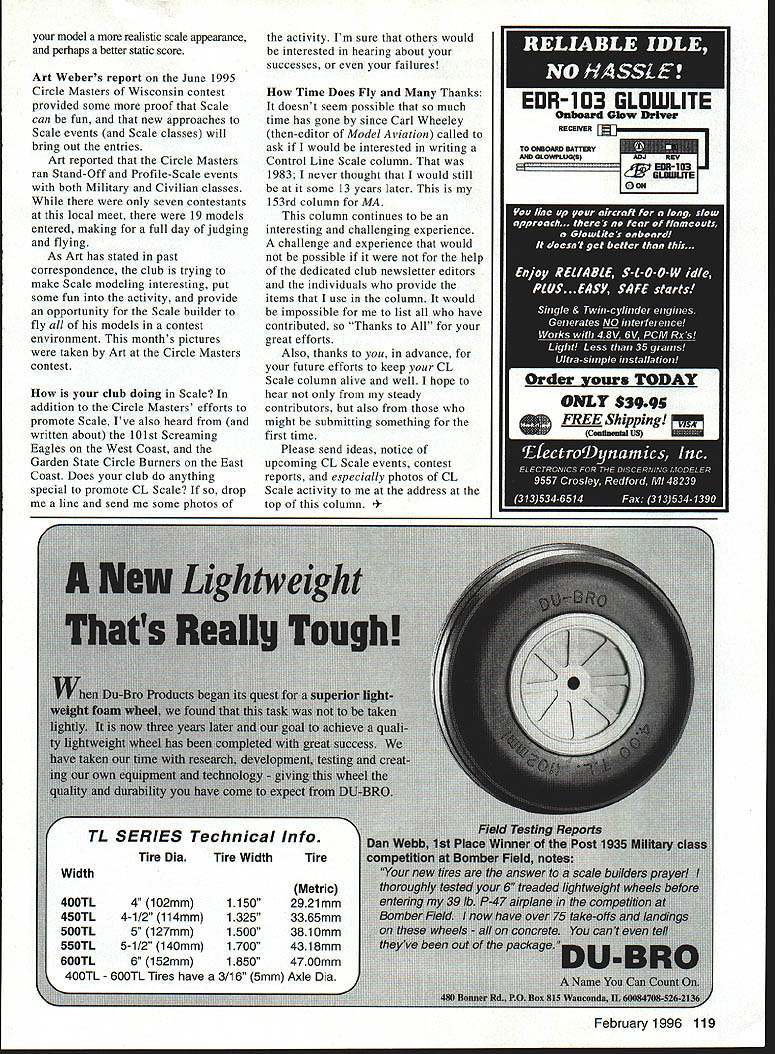
The solution for holding the metal strip (and the paper from which the tape is made) is shown in the accompanying sketch. The idea for this tool originated with the Chicago Scale Masters Club back in the 1970s; it was featured in this column in November 1984. That was more than 11 years ago, so I thought we might revisit the subject and provide the information to some of our newer Scale modelers.
To fabricate the holder:
- Fasten the saw-toothed edge to a piece of hardwood or a brass strip.
- If wood is used, epoxy the metal strip in place; if brass is used, solder the strip in place.
- After the strip is in place, add a filler strip the thickness of the metal behind the blade.
- Add a thin strip of rubber the full length of the unit, keeping the rubber fairly close to the serrated cutting edge. The rubber strip will enable you to hold the paper in place while making the pinked rib tapes. Attach the rubber strip with a contact adhesive.
Pinked rib tape is better known in technical manuals as surface or finishing tape and (quoted from a Tech Order): "Should be applied over all lacing, over all seams, both machine- and hand-sewn, and over corners, edges, and covered structural members where hard wear occurs. Reinforcing patches are also to be used wherever the fabric covering is pierced by wires, control cables, bolts, or any projections."
The width of the tape will be governed by the scale of the model. On full-scale aircraft the wing-rib tape is approximately two inches wide; the tape used on leading, trailing, and tip edges is usually three inches wide. If a model is quarter-scale, the wing-rib tape should be about 1/2 inch wide.
Tape and reinforcing patches for models are generally made from silkspan, and are applied after the first coat of dope has dried. Apply a second coat of dope to the area where the tape will be applied. Place the tape on top of the freshly applied second coat (before it dries), then follow it immediately with another coat of dope over the tape.
An alternative to silkspan is to use gridded rag-vellum tracing paper. Using the gridded paper helps to maintain consistent tape width; the long blue lines can be followed as the cutter is moved along the length of the paper. The vellum strips are applied to the model in a slightly different way than the silkspan.
Vellum application steps:
- Apply the first coat of dope to the model, especially to the areas where the tape will be applied. Allow it to dry.
- Lightly sand the area where the tape will be applied.
- Dip the tape in a cup of water—add two drops of liquid detergent to act as a wetting agent.
- Apply the tape to the surface using a solution of Elmer's glue and water (approximately 50/50) to which a drop of liquid detergent has been added.
- Press (and stretch) the tape in place, keeping the tape wetted with the thinned glue solution. When the tape is firmly in place, wipe off the excess residue with a damp cloth.
- When the tape is dry, cover the area with a coat of slightly thinned clear dope.
When all of the taping is complete (using either method) the model is ready for painting. Tape made from the vellum-type paper gives a little better definition; silkspan, because of its very thin nature, tends to blend into the surrounding area if it's covered with too many coats of dope.
Adding the tape and reinforcing patches in the right places should give the model a realistic scale appearance, perhaps resulting in a better static score.
Scale events
Art Weber's report on the Circle Masters of Wisconsin's Scale contest (June 1995) provided some proof that Scale can be fun and bring out new approaches.
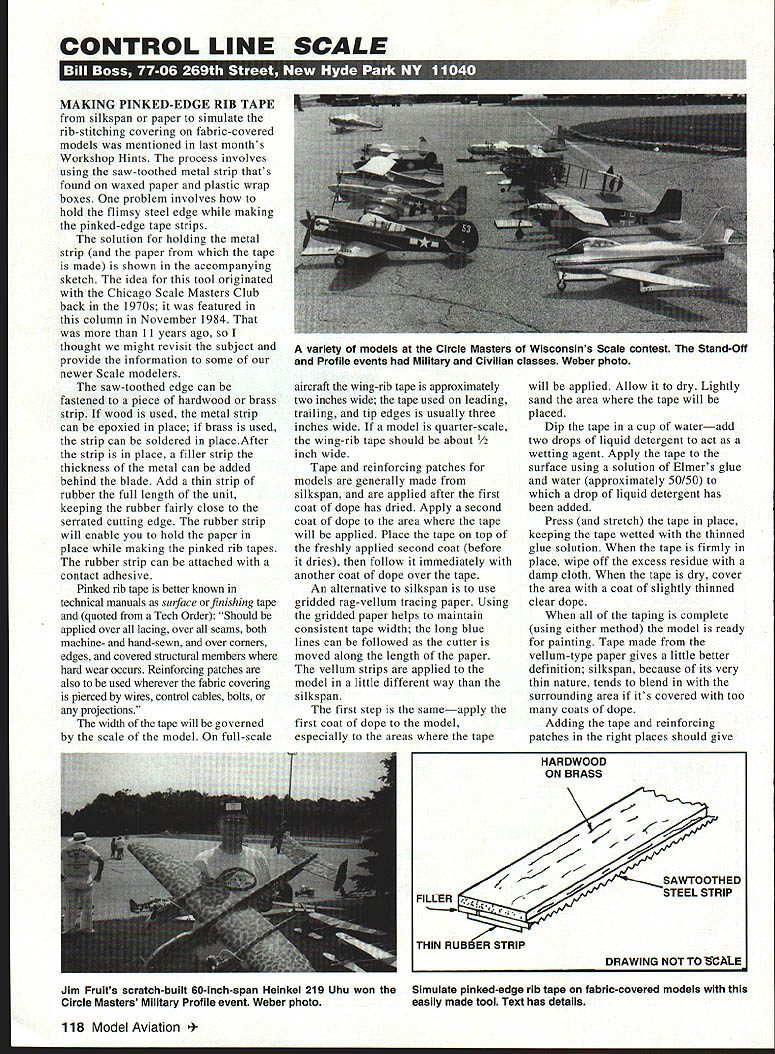
Art reported Circle Masters ran Stand-Off and Profile events in both Military and Civilian classes. Seven contestants at the local meet entered 19 models, making a full day of judging and flying.
As Art has stated in past correspondence, the club is trying to make Scale modeling interesting, put some fun activity into it, and provide an opportunity for the Scale builder to fly models in a contest environment. The photos taken at the Circle Masters contest show the club doing Scale in addition to Circle Masters' efforts to promote Scale.
I've also heard and read about the 101st Screaming Eagles (West Coast) and the Garden State Circle Burners (East Coast). Does your club do anything special to promote CL Scale? Drop a line and send some photos of your activity. I'm sure others would be interested in hearing about your successes, or even your failures!
How Time Does Fly and Many Thanks
It doesn't seem possible that so much time has gone by since Carl Wheeler (then-editor of Model Aviation) called to ask if I would be interested in writing a Control Line Scale column. That was 1983; I never thought that I would still be at it some 13 years later. This is my 153rd column for MA.
This column continues to be an interesting and challenging experience. A challenge and experience that would not be possible if it were not for the help of the dedicated club newsletter editors and the individuals who provide the items that I use in the column. It would be impossible for me to list all who have contributed, so "Thanks to All!" for your great efforts.
Also, thanks to you, in advance, for your future efforts to keep your CL Scale column alive and well. I hope to hear not only from my steady contributors, but also from those who might be submitting something for the first time.
Please send ideas, notice of upcoming CL Scale events, contest reports, and especially photos of CL Scale activity to me at the address at the top of this column.
Transcribed from original scans by AI. Minor OCR errors may remain.

