
Control Line: Scale
Mike Stott
OVER THE PAST few weeks I've received some letters asking for a little advice on some problem. I'd like to answer these questions and pass along a few tips.
One letter concerned the problem of making decals instead of painting directly on the model. The trouble with painting your lettering or designs directly on the model is that, by the time you are done, you probably will have a king-size headache. In doing this painting you must be careful not to make an error as there isn't much room for correction. Once it's on, it's on. So let's take a look at making your own decals.
First, order some decal paper from Sig Mfg. Co. Spray the decal paper with five to ten coats of clear dope. Then you can use dry transfer sheets for your lettering. These can be obtained at an art supply house and some hobby shops. Apply the dry transfers over the clear dope and spray again with three to five light coats of clear dope.
This method also can be used to reproduce any decorations, designs, or logos on the model. Examples are squadron markings, stars, etc. After the five to ten coats of clear dope is applied to the decal sheet you may paint your design right on this paper using colored dope. Let dry and lightly spray a couple of coats of clear dope over the top.
Applying these decals to the model can be difficult so be very careful in sliding them off the decal sheet. They easily tear and stretch. To reduce this problem use more clear dope base coats. After the decals have been applied to the model and allowed sufficient time to dry, you can spray over them with more coats of clear dope. This will permanently bond your decal to the model. After a few coats of clear dope all edges should disappear and you will not have the faint edges that regular decals leave. Again, let me remind you, this style of decal is very difficult to work with. So have patience and try a few samples to begin with.
Here's a tip on painting the decals. Try to paint all the light colored parts of your decals first, and the darker colors last. Dark colors cover better over light, rather than light over dark.
The other letter I received was from a young man who was asking my advice on the idea of his building a multi-engined model.
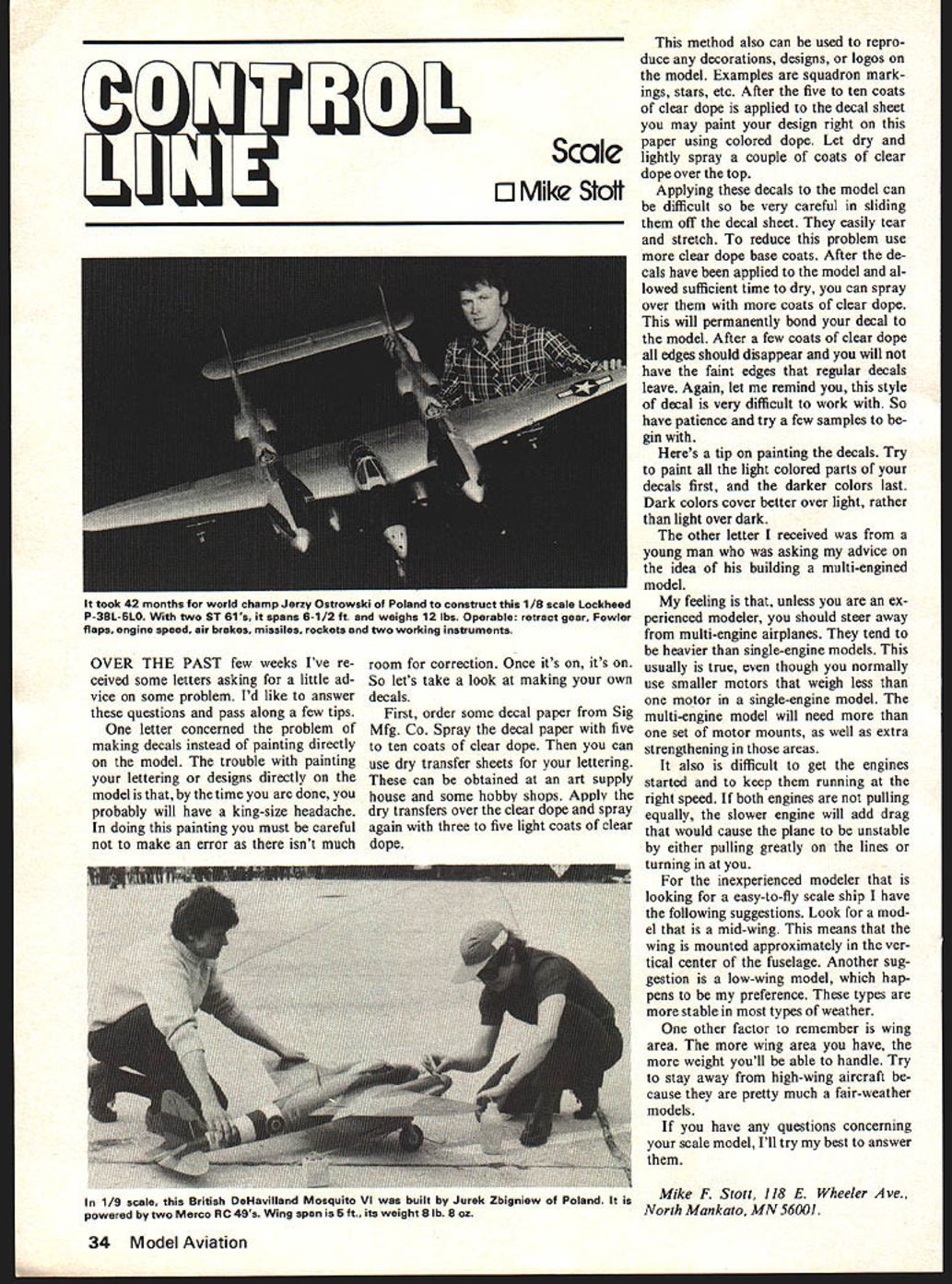
My feeling is that, unless you are an experienced modeler, you should steer away from multi-engine airplanes. They tend to be heavier than single-engine models. This usually is true, even though you normally use smaller motors that weigh less than one motor in a single-engine model. The multi-engine model will need more than one set of motor mounts, as well as extra strengthening in those areas.
It also is difficult to get the engines started and to keep them running at the right speed. If both engines are not pulling equally, the slower engine will add drag that would cause the plane to be unstable by either pulling greatly on the lines or turning in at you.
For the inexperienced modeler that is looking for an easy-to-fly scale ship I have the following suggestions. Look for a model that is a mid-wing. This means that the wing is mounted approximately in the vertical center of the fuselage. Another suggestion is a low-wing model, which happens to be my preference. These types are more stable in most types of weather.
One other factor to remember is wing area. The more wing area you have, the more weight you'll be able to handle. Try to stay away from high-wing aircraft because they are pretty much fair-weather models.
If you have any questions concerning your scale model, I'll try my best to answer them.
Mike F. Stott, 118 E. Wheeler Ave., North Mankato, MN 56001.
Transcribed from original scans by AI. Minor OCR errors may remain.

