
CONTROL LINE SCALE
Bill Boss 77-06 269th Street, New Hyde Park, NY 11040
Aviation museums can be great fun to visit and are fine sources of scale documentation. In a recent issue of Replica, the newsletter of the National Association of Scale Aeromodelers (NASA), Mike Weishans told of his visit to modeling friend Bill Logan in London, Ontario, and the Canadian National Aviation Museum in Ottawa, Ontario.
The museum is approximately 80 miles north of the U.S. border and approximately 175 miles north of Syracuse — within easy reach of most northern locations in the Midwest and eastern United States. Ottawa is also the home of the Parliament buildings, which are interesting to visit, especially if you catch the changing-of-the-guard ceremony.
Mike noted that the museum has 109 aircraft, from the dawn of Canadian aviation to present-day jet fighters. There are 47 aircraft on permanent display inside the museum and eight on display outside. The remainder are in storage awaiting restoration.
The large number of airplanes provides a great opportunity to obtain up-close photos of many subjects; these can be used as documentation for a current or future project. If you plan to make a trip to the Canadian (or any other) museum, it might be a good idea to buy several rolls of film close to home, as the price of film (especially outside the U.S.) can be quite expensive. Film with a 200 or 400 ISO rating is recommended, especially for indoor use.
If your camera has interchangeable-lens capability, consider taking a telephoto lens to capture finer detail. A little ingenuity will enable you to photograph most aircraft from several angles.
While Mike spoke of the Canadian museum, we have many good museums in the U.S. within reach of many modelers. One that comes to mind is the museum at Warner Robins Air Force Base in Warner Robins, Georgia. I have visited this museum several times while in the area visiting family. The museum has a great assortment of aircraft indoors as well as outdoors, and both areas provide excellent picture-taking opportunities.
While I have cited only two museums, there are many around the world that are worth visiting. A book titled Great Aircraft Collections of the World by Bob Ogden covers 70 museums in 23 countries. Of the 70 museums listed, the United States has 33 museums in 20 states. The listings contain addresses, telephone numbers (if available), and times of operation. Visit your local bookstore to see if they have a copy of the guidebook; it is priced around $15–$20. ISBN: 0-8317-4066-3.
Museums are great places for the whole family to visit. For dad they are places for photos and documentation; for the rest of the family — especially the young — they are places to learn a little about aviation history.
CONTEST ACTIVITY
Fred Cronenwett, our West Coast reporter, tells us that the 12th Annual Seebree Hayes CL Contest went off well; it was held at Whittier Narrows in Los Angeles, California, in October 1995. Mild temperatures and light winds prevailed throughout the day. The site conditions were great, with a concrete carrier deck, a 12-foot-high fence around the Speed circle, and flat macadam circle areas for all of the other events (especially good for scale model take-offs and landings).
Fred noted that while scale entries were down, the quality of the airplanes and flights made for a great day of scale modeling. Merle Mohring, current Precision CL Scale national champ, directed the scale events.
Results and highlights:
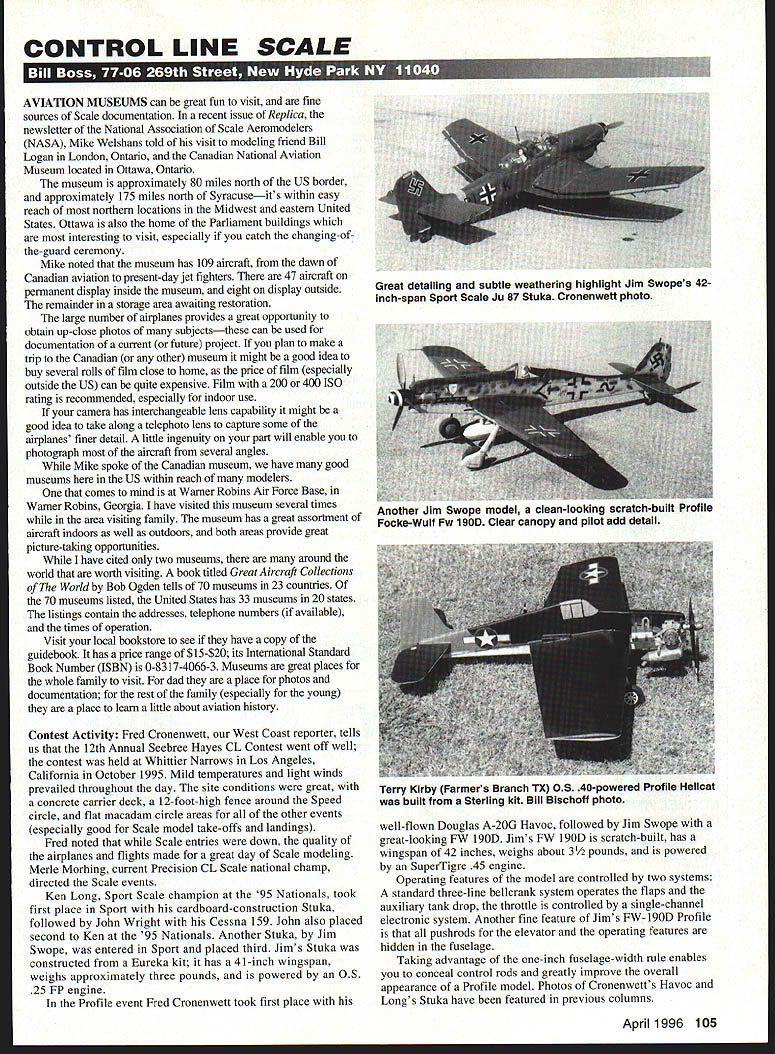
- Sport Scale: Ken Long (first) with his cardboard-construction Stuka; John Wright (second) with his Cessna 159; Jim Swope (third) with a Stuka built from an Eureka kit. Jim’s Stuka has a 41-inch wingspan, weighs approximately three pounds, and is powered by an O.S. .25 FP engine.
- Profile: Fred Cronenwett (first) with a well-flown Douglas A-20G Havoc; Jim Swope (second) with a great-looking Fw 190D. Jim’s Fw 190D is scratch-built, has a 42-inch wingspan, weighs about 3½ pounds, and is powered by a Super Tigre .45 engine.
Operating features of Jim’s Fw 190D are controlled by two systems. A standard three-line bellcrank system operates the flaps and the auxiliary tank drop. The throttle is controlled by a single-channel electronic system. Another fine feature is that all pushrods for the elevator and the operating features are hidden in the fuselage.
Taking advantage of the one-inch fuselage-width rule enables you to conceal control rods and greatly improve the overall appearance of a profile model. Photos of Cronenwett’s Havoc and Long’s Stuka have been featured in previous columns.
Hints for the Workshop
Hints this month are from our good friend Bob Furr of the Orbiting Eagles of Omaha.
- Cardboard pattern durability: If you use cardboard patterns repeatedly, they tend to develop ragged edges after three or four uses. If you have scraps of vinyl flooring, use them in place of cardboard to make patterns. Vinyl cuts easily with a sharp modeling knife and is far more durable than cardboard. It isn’t affected by humidity, and because the back is usually a little rough it won’t slide when you lay it on balsa to trace a part.
- Cutting sheet balsa: When you cut parts out of sheet balsa, lay your patterns out carefully to minimize waste. When you need to cut a lot of pieces for a project, cut the longest pieces first. If you make a mistake on one of the long pieces, you can often use it to make the smaller parts.
- Engine head bolts: If you have trouble removing Phillips-head head bolts from older engines because the slots strip, try this trick. Wet the tip of your screwdriver and dip it into an abrasive cleanser such as Ajax or Comet. The coated tip will grip the screw slot better and help prevent stripping when you turn it. The cleanser is corrosive, so when you’re done make sure to clean it off the screwdriver and the bolt.
Please send ideas, notices of upcoming CL scale events, contest reports, and especially photos of CL scale activity to me at the address at the top of this column.
Transcribed from original scans by AI. Minor OCR errors may remain.

