
CONTROL LINE SCALE
Bill Boss 77-06 269th Street, New Hyde Park, NY 11040
THE NEWCOMER
Just what is a newcomer? I suppose one can be defined in many ways when it comes to model aviation. Descriptions might include:
- one who is entirely new to the sport;
- one who returns to the sport after many years of absence;
- one who has been in the sport for some time and is now trying a different phase of activity.
To get a feel for what category the newcomer to CL Scale might be placed in, I requested information from several clubs, newsletter editors, and individuals around the country. Most responses included information on those who have changed from Radio Control to CL Scale, the impact of electronic controls, and comments on promoting our sport to attract newcomers.
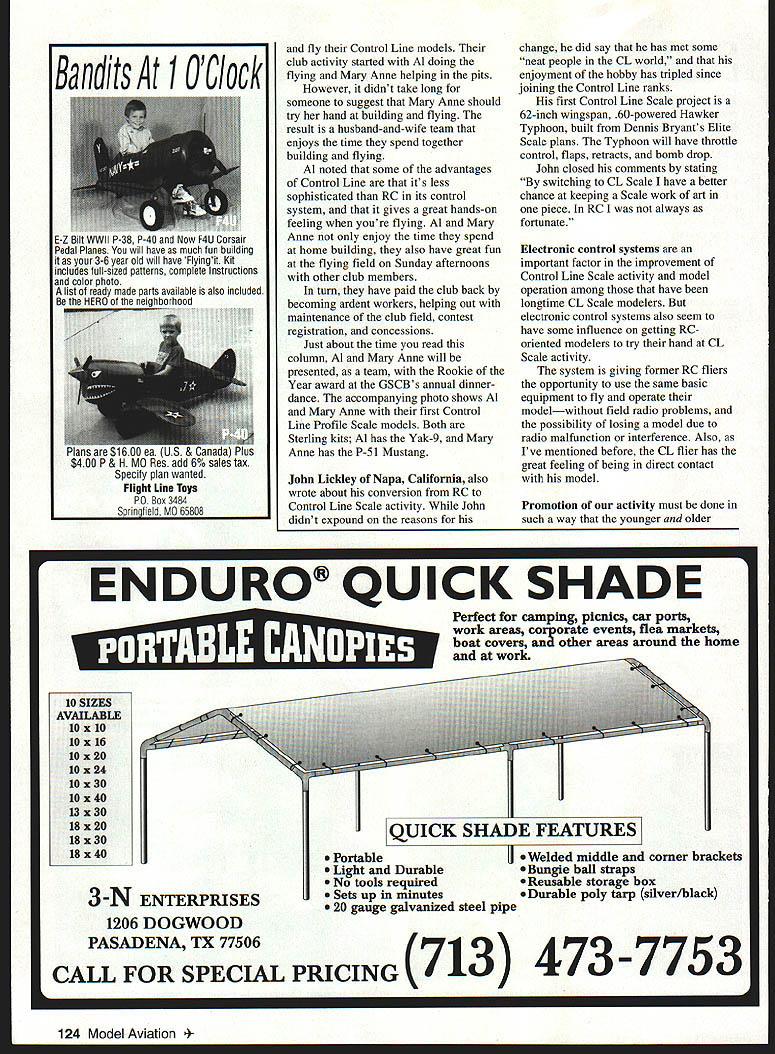
Through Fred Cronenwett on the West Coast (one of this column's constant contributors) I heard about Los Angeles' Howard Lazerson. Fred's correspondence with Howard led to the following.
"While I fly RC power and gliders, I always wanted to give Control Line flying a try, and wondered what it was like to have a model in direct control," Howard wrote.
He started his Control Line venture by building a .15-size model, and after several crashes and prop changes he made some successful flights. He noted that while he liked CL flying, he wasn't satisfied with his model — it looked only vaguely like an airplane and just went round and round until the fuel ran out.
He then read an article in Brodak's catalog by Fred Cronenwett and Merle Morhing on electronic control systems. In a short time he had a Profile Wildcat powered by an O.S. .20 with throttle control via an electronic system.
Since this first successful CL model he has built a Profile P-47 and a super Profile of the SBD Dauntless. The Dauntless has a 43-inch span and a multichannel electronic system to control the throttle, dive brakes, flaps, retracts, bomb drop, and hook drop. It also has aileron control for low-speed flight.
The bottom line for Howard is that he is having great fun, and has no frequency problems or long waits to get in a flight. Two of the main things Howard likes about Control Line are that he can feel the model flying and that he can see the model's operations as he applies the controls. He also noted that, like most Control Line fliers, he is never visually aware of the lines when he is flying his models. It sounds like we have a solid convert to the Control Line Scale ranks.
ROOKIES OF THE YEAR
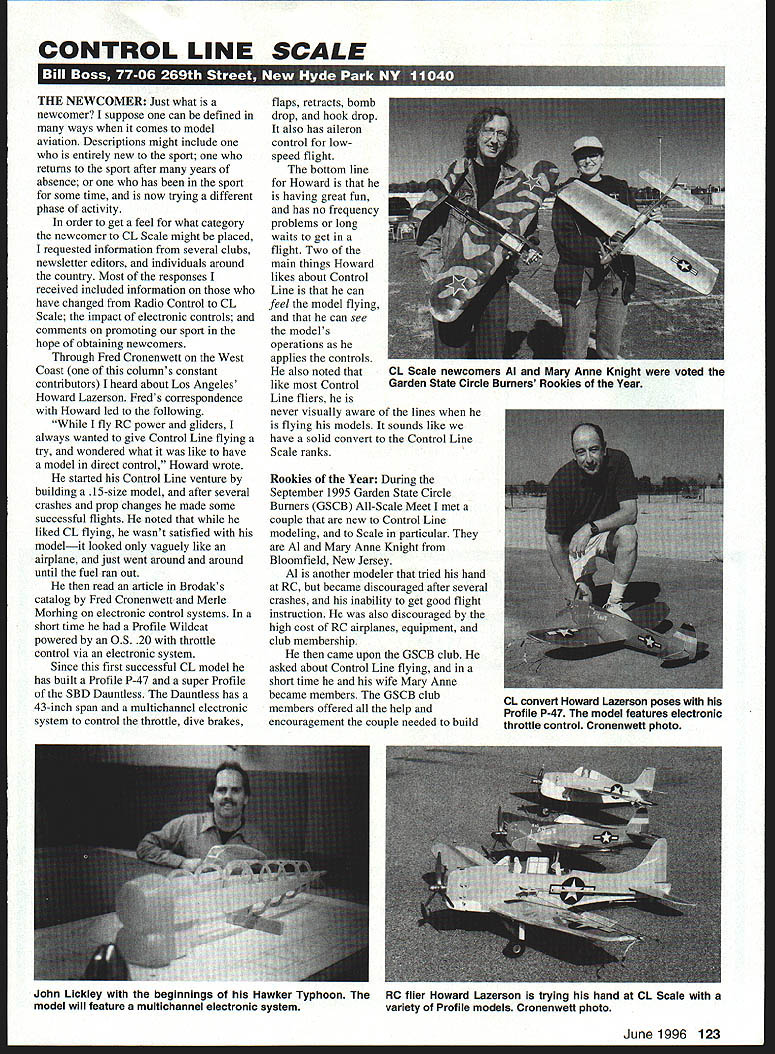
During the September 1995 Garden State Circle Burners (GSCB) All-Scale Meet I met a couple that are new to Control Line modeling, and to Scale in particular. They are Al and Mary Anne Knight from Bloomfield, New Jersey.
Al is another modeler who tried his hand at RC but became discouraged after several crashes and his inability to get good flight instruction. He was also discouraged by the high cost of RC airplanes, equipment, and club membership.
He then came upon the GSCB club. He asked about Control Line flying, and in a short time he and his wife Mary Anne became members. The GSCB club members offered all the help and encouragement the couple needed to build and fly Control Line models; club activity started Al doing flying, Mary Anne helping in the pits.
However, it didn't take long before someone suggested Mary Anne should try her hand at building and flying; as a result the husband-and-wife team enjoy the time they spend together building and flying. Al noted some advantages of Control Line: it's less sophisticated than RC and its control system gives a great hands-on feeling that you're flying. Al and Mary Anne enjoy the time spent at home building and have great fun flying at the field Sunday afternoons when the other club members turn out. They have paid the club back by becoming ardent workers helping out with maintenance, club field, contest registration, and concessions.
Just about the time I read Fred's column, Al and Mary Anne were to be presented the team Rookie of the Year award at the GSCB annual dinner-dance. Both are flying Sterling kits — Al has a Yak-9; Mary Anne has a P-51 Mustang.
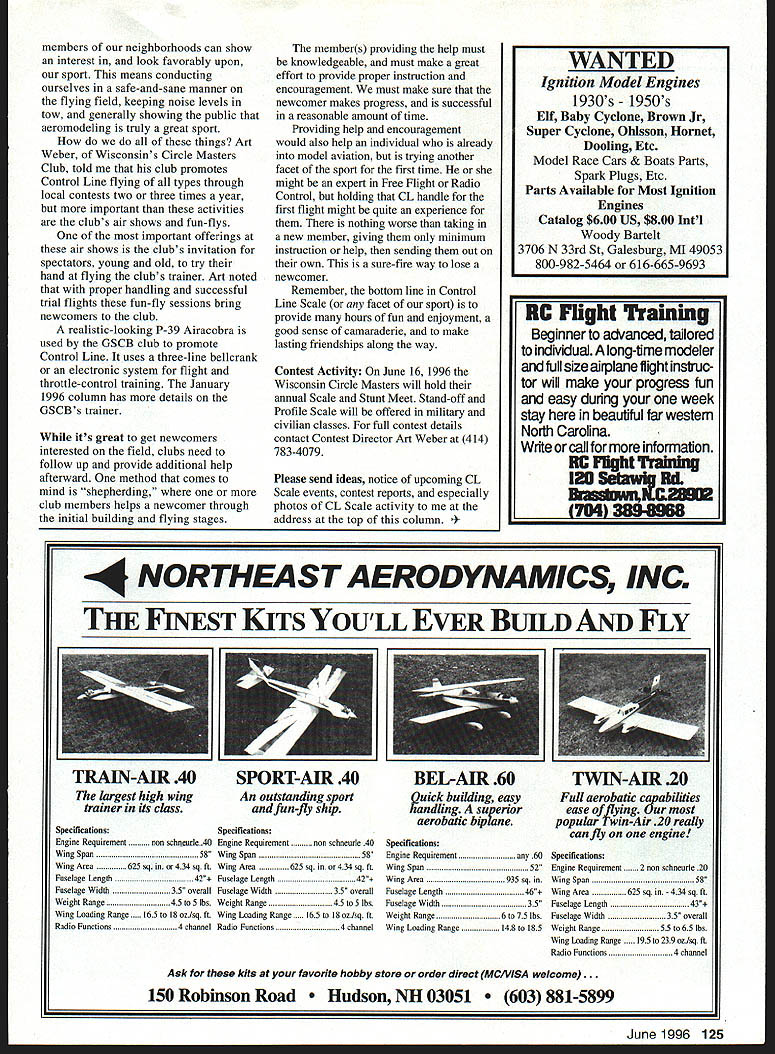
John Lickley of Napa, California, also wrote about his conversion to Control Line Scale activity. John didn't expound the reasons for the change; he did say he has met some neat people in the CL world and that his enjoyment of the hobby has tripled since joining the Control Line ranks. His first Control Line Scale project is a 62-inch wingspan, .60-powered Hawker Typhoon built from Dennis Bryant's Elite Scale plans. The Typhoon will have throttle control, flaps, retracts, and bomb drop.
John closed his comments by stating, "By switching to CL Scale I have a better chance at keeping a Scale work of art in one piece. In RC I was not always as fortunate."
ELECTRONIC CONTROL SYSTEMS
Electronic control systems are an important factor in the improvement of Control Line Scale activity and model operation among those who have been longtime CL Scale modelers. But electronic control systems also seem to have influence in getting RC-oriented modelers to try their hand at CL Scale activity.
The system is giving former RC fliers the opportunity to use the same basic equipment to fly and operate their models — without field radio problems and the possibility of losing a model due to a radio malfunction or interference. Also, as I've mentioned before, the CL flier has the great feeling of being in direct contact with his model.
PROMOTION AND RECRUITING
Promotion of our activity must be done in such a way that the younger and older members of our neighborhoods can show an interest in, and look favorably upon, our sport. This means conducting ourselves in a safe-and-sane manner on the flying field, keeping noise levels in tow, and generally showing the public that aeromodeling is truly a great sport.
How do we do all of these things? Art Weber of Wisconsin's Circle Masters Club told me that his club promotes Control Line flying of all types through local contests two or three times a year, but more important than these activities are the club's air shows and fun-flys.
One of the most important offerings at these air shows is the club's invitation for spectators, young and old, to try their hand at flying the club's trainer. Art noted that with proper handling and successful trial flights these fun-fly sessions bring newcomers to the club.
A realistic-looking P-39 Airacobra is used by the GSCB club to promote Control Line. It uses a three-line bellcrank or an electronic system for flight and throttle-control training. The January 1996 column has more details on the GSCB's trainer.
While it's great to get newcomers interested on the field, clubs need to follow up and provide additional help afterward. One method that comes to mind is "shepherding," where one or more club members helps a newcomer through the initial building and flying stages.
The member(s) providing the help must be knowledgeable and must make a great effort to provide proper instruction and encouragement. We must make sure that the newcomer makes progress and is successful in a reasonable amount of time.
Providing help and encouragement would also help an individual who is already into model aviation but is trying another facet of the sport for the first time. He or she might be an expert in Free Flight or Radio Control, but holding that CL handle for the first flight might be quite an experience. There is nothing worse than taking in a new member, giving them only minimum instruction or help, then sending them out on their own. This is a sure-fire way to lose a newcomer.
Remember, the bottom line in Control Line Scale (or any facet of our sport) is to provide many hours of fun and enjoyment, a good sense of camaraderie, and to make lasting friendships along the way.
CONTEST ACTIVITY
On June 16, 1996 the Wisconsin Circle Masters will hold their annual Scale and Stunt Meet. Stand-off and Profile Scale will be offered in military and civilian classes. For full contest details contact Contest Director Art Weber at (414) 783-4079.
Please send ideas, notices of upcoming CL Scale events, contest reports, and especially photos of CL Scale activity to me at the address at the top of this column.
Transcribed from original scans by AI. Minor OCR errors may remain.

