
CONTROL LINE SCALE
Bill Boss 77-06 269th Street, New Hyde Park, NY 11040
Profile Scale: Fred Cronenwett’s Kawanishi N1K2-J Shiden-Kai
Profile Scale has become a major part of Control Line Scale activity in many areas around the country. Reasons for its increasing popularity include that profile models are generally easier to build, take less time, and cost less than full-bodied models. The Profile event is also used by many clubs to interest non-Scale modelers and beginners in CL Scale activity and to promote the fun aspects of Scale modeling.
This month I’ll describe a new project by Canoga Park, California’s Fred Cronenwett — a strong proponent of Profile Scale modeling.
Fred’s latest project is the Kawanishi N1K2-J Shiden-Kai. The full-scale airplane was put into service by the Japanese in December 1943. Classified as a fighter, the airplane was powerful, fast, well-protected, and heavily armed. Its characteristics included:
- Span: 39 ft 4½ in
- Weight: approximately 8,800 lb
- Maximum level speed: 369 mph
- Ceiling: 35,000 ft
- Range: approximately 1,500 miles
- Armament: four 20 mm cannons and 1,110 lb of bombs
The N1K2-J was derived from the Kawanishi N1K1 Kyofu seaplane and, in the hands of Japan’s aces, was said to be comparable to US Hellcats and Corsairs.
Fred’s model:
- Span: 48 in
- Weight: approximately 4 lb
- Power: O.S. .40 Surpass engine with throttle control via a single-channel electronic system
Fred based his model on Koku-Fan three-views and photos from Bob Bankas’s Scale Model Research collection. He was inspired by a restored full-scale example on display at the Champlin Air Museum in Phoenix, Arizona.
Construction and features
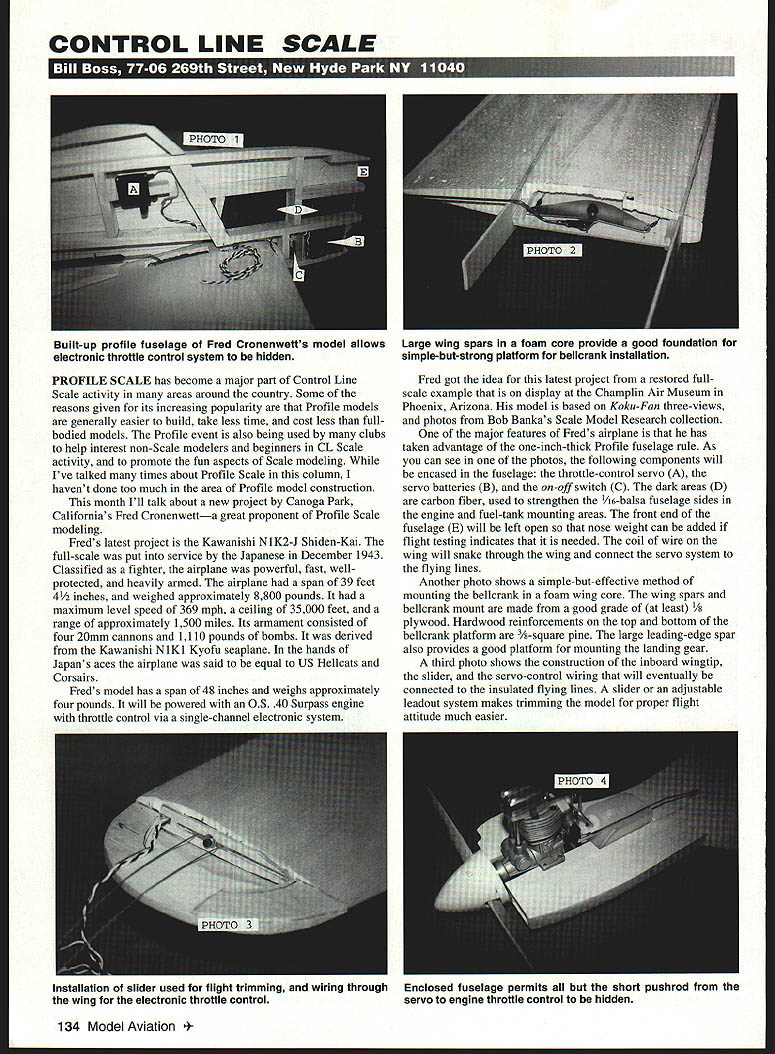
One major feature of Fred’s airplane is his use of the one-inch-thick profile fuselage rule. Components encased in the fuselage include:
- (A) Throttle-control servo
- (B) Servo batteries
- (C) On-off switch
Other construction details:
- Dark areas (D) are carbon fiber, used to strengthen the 1/16-inch balsa fuselage sides in the engine and fuel-tank mounting areas.
- The front end of the fuselage (E) will be left open so nose weight can be added if flight testing indicates it is needed.
- The coil wire in the wing will snake through the wing and connect the servo system to the flying lines.
Wing and bellcrank:
- A simple but effective method of mounting the bellcrank in a foam wing core is used.
- Wing spars and bellcrank mount are made from a good grade of at least 3/16-inch plywood.
- Hardwood reinforcements on the top and bottom of the bellcrank platform are 3/8-inch-square pine.
- The large leading-edge spar also provides a good platform for mounting the landing gear.
Additional features:
- Inboard wingtip construction, the slider, and the servo-control wiring will be connected to the insulated flying lines.
- A slider or adjustable leadout system makes trimming the model for proper flight attitude much easier.
- The enclosed fuselage permits all but the short pushrod from the servo to the engine throttle control to be hidden.
- The one-inch fuselage thickness allows hiding approximately one-half of the fuel tank; the exposed portion will be painted the same color as the fuselage to reduce its conspicuousness.
- The overall advantage of the one-inch-thick fuselage is that it makes it possible to hide controls, leadout wires, and the elevator pushrod, resulting in a better-looking model more competitive during static judging.
Fred has promised to send photos of the completed model in the near future.
Rules Correction
If you have reviewed the C/L Sport Scale event rules in the 1996–1997 Competition Regulations, note that the static judging section of the C/L Sport Scale Worksheet (Part I) on page 132 is incorrect as published. Specifically:
- Some scoring values were changed under Outline Accuracy.
- The area for scoring Authenticity of Finish was blacked out.
- As published, the score sheet only allows 80 points for static score.
AMA’s Technical Director Steve Kaluf said a correction will be published and the Competition Regulations book will be corrected with the next issue. In the meantime, the score sheet published in the 1994–1995 Competition Regulations is correct and should be used. A proposal to change C/L Sport Scale scoring (SC-96-5) was defeated in the final contest board vote during the last rules change cycle.
Contest and Club Activity
Fred Cronenwett sent information on the following California events:
- July 21, 1996 — Knights CL Club judging and scoring clinic (including all Control Line events) at the Whittier Narrows flying site. The clinic will include discussion of scoring procedures and flight demonstrations. Contact:
- Kenn Smith, Knights Club
- 521 Jansen Ave., San Dimas, CA 91773
- Tel.: (909) 592-2100
- August 4, 1996 — Blacksheep Squadron Electric Scale and Stunt event at the Sepulveda Basin flying site. For details contact:
- Tony Naccarato
- 2121 Hollywood Way, Burbank, CA 91505
- Tel.: (818) 842-5062
Workshop Hint
This month’s hint is from Hangar Talk, newsletter of the Cholla Choppers model airplane club. Lou Crane noted that volatility is the tendency of a liquid to escape in vapor or gaseous form, and that many liquids we use are volatile.
Key points and storage tips:
- Liquid fuel doesn't burn with useful power until vaporized or turned into fine droplets; vaporized fuel is highly combustible.
- If you keep fuel longer than a month or two in plastic containers, nitromethane and propylene oxide can evaporate through the plastic, resulting in dud fuel.
- For long-term fuel storage, consider transferring fuel from plastic to metal containers.
Notes on cyanoacrylate (CYA) accelerator ("kicker"):
- CYA accelerator is very volatile and expensive; spritz bottles can evaporate between uses.
- To reduce evaporation:
- Save the thicker pump bottle’s plastic tube with cap.
- Put the cap on the pump, stand the bottle on it, then drop the tube over it to reduce evaporation loss.
- Buy refill kicker bottles instead of more pump bottles and keep refills tightly sealed between uses.
- With practice, you can remove the bottle with one hand while using this protective tube arrangement.
Please send ideas, notices of upcoming C/L Scale events, contest reports, and especially photos of C/L Scale activity to me at the address at the top of this column.
Transcribed from original scans by AI. Minor OCR errors may remain.

