
CONTROL LINE SCALE
Bill Boss, 77-06 269th Street, New Hyde Park, NY 11040
"BACK TO THE FUTURE" was the headline in a recent issue of Replica, the newsletter of the National Association of Scale Aeromodelers (NASA). The headline referred to the fact that after 20 years Bob Underwood is once again NASA president. Bob was the driving force for the formation of the NASA group in 1976, and he provided a great foundation for its longevity. I am sure that once again the scale modelers of the country can look forward to great progress in things scale.
Bob noted that while current NASA activities will continue, we should take up challenges in other areas. These challenges are as follows:
- A greater level of national competition involvement due to the evolving Nationals structure.
- Update and expansion of the Scale Data Source List.
- Greater involvement in the rule-making process. (Amen to that.)
- Possible involvement at some level with US Scale Masters, possibly to include control line.
- Training programs for clubs and individuals interested in promoting scale through contests and fly-ins.
- Closer liaison with publications.
- Your personal goals go here.
What Bob is referring to in the last item is that he is looking forward to hearing from (or having the assistance of) NASA members in meeting the new challenges.
The program sounds great, and if you're not a NASA member this would be a good time to join so you can benefit from the things to come. As a new member you'll give the new slate of officers that needed boost to go on with the challenges ahead.
Congratulations to Bob as the new president; Stan Alexander as vice president; Cliff Tacie as editor of Replica; Gerald Deneau as production manager of Replica; and Burt Dugan as the club's secretary/treasurer. Burt will be happy to issue new membership cards for an $8 check or money order. Send funds to Burt Dugan, 11090 Phyllis Dr., Clio, MI 48420.
Thanks to John Guenther for all the work and effort he put forth as NASA's president for the past several years.
Controlling engine cutoff can be a problem, whether you're using the standard three-line control system or a newer electronic system. Neither the standard three-line handle nor single-channel electronic throttle-control systems have built-in adjustments or stops to prevent premature engine cutoff.
One of the flight options we deal with in the scale events is engine control, and in order to obtain maximum points for the operation we must be able to demonstrate engine cutoff after completing a flight and landing. To accomplish engine cutoff we generally set the engine's carburetor intake rotor so that it closes off all air, or we provide a fuel cutoff. When using the throttle-setting method we can very easily close the throttle down too far (usually at the most inopportune times), cutting off the engine prematurely.
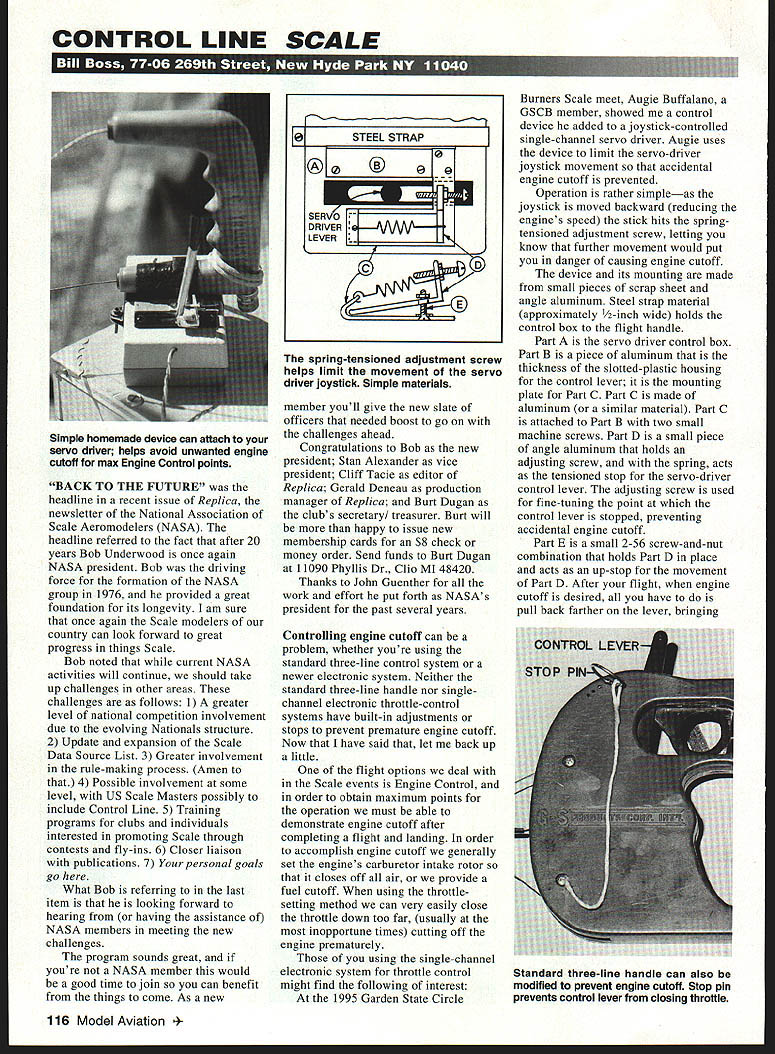
Those of you using the single-channel electronic system for throttle control might find the following of interest: at the 1995 Garden State Circle Burners scale meet, Augie Buffalano, a GSCB member, showed me a control device he added to a joystick-controlled single-channel servo driver. Augie uses the device to limit the servo-driver joystick movement so that accidental engine cutoff is prevented.
Operation is simple — as the joystick is moved backward (reducing the engine's speed) the stick hits a spring-tensioned adjustment screw, letting you know that further movement would put you in danger of causing engine cutoff.
The device and its mounting are made from small pieces of scrap sheet and angle aluminum. Steel strap material (approximately 1/2 inch wide) holds the control box to the flight handle.
- Part A: the servo driver control box.
- Part B: a piece of aluminum the thickness of the slotted-plastic housing for the control lever; it is the mounting plate for Part C.
- Part C: made of aluminum (or a similar material); attached to Part B with two small machine screws.
- Part D: a small piece of angle aluminum that holds the adjusting-screw spring and acts as the tensioned stop for the servo-driver control lever. The adjusting screw is used for fine-tuning the point at which the control lever is stopped, preventing accidental engine cutoff.
- Part E: a small 2-56 screw-and-nut combination that holds Part D in place and acts as an up-stop for the movement of Part D.
After your flight, when engine cutoff is desired, all you have to do is pull back farther on the lever, bringing the servo driver into the zone of control that shuts down the engine. No specific measurements have been given, as the size of the control box or the type of flight handle you use may be different from that shown.
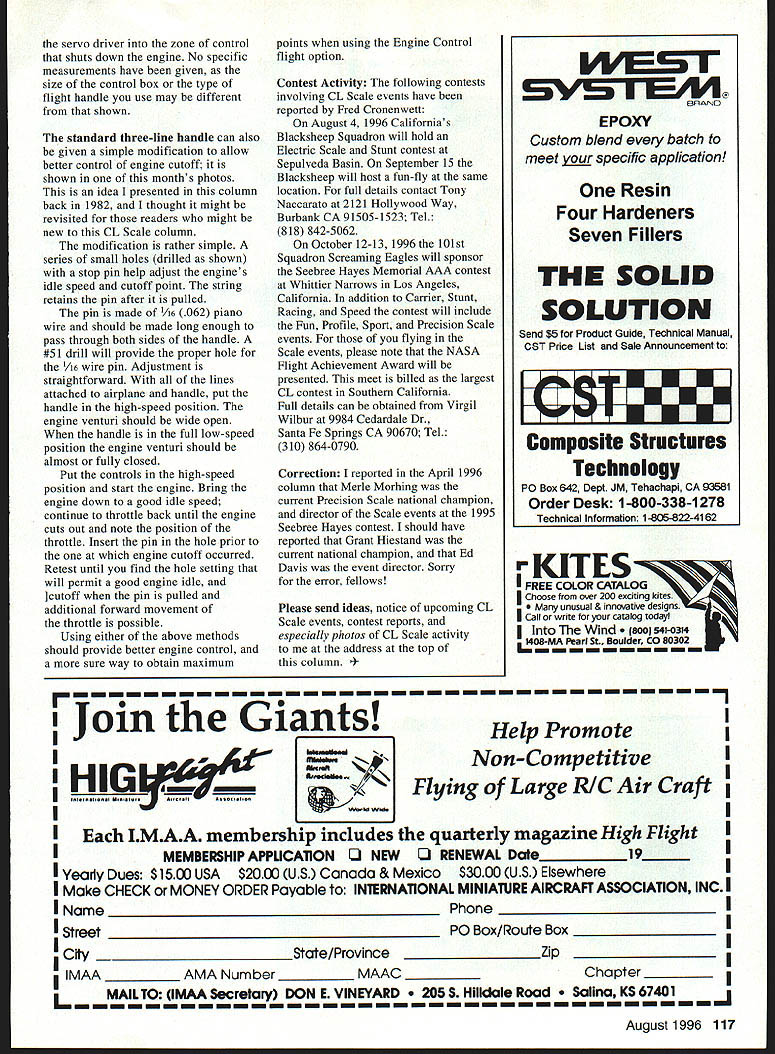
The standard three-line handle can also be given a simple modification to allow better control of engine cutoff; it is shown in one of this month's photos. This is an idea I presented in this column back in 1982, and I thought it might be revisited for those readers who are new to this CL Scale column.
The modification is simple. A series of small holes (drilled as shown) with a stop pin help adjust the engine's idle speed and cutoff point. A string retains the pin after it is pulled.
The pin is made of 1/16 inch (.062) piano wire and should be long enough to pass through both sides of the handle. A #51 drill will provide the proper hole for the 1/16-inch wire pin.
Adjusting is straightforward. With all of the lines attached to airplane and handle, put the handle in the high-speed position. The engine venturi should be wide open. When the handle is in the full low-speed position the engine venturi should be almost or fully closed.
Put the controls in the high-speed position and start the engine. Bring the engine down to a good idle speed; continue to throttle back until the engine cuts out and note the position of the throttle. Insert the pin in the hole prior to the one at which engine cutoff occurred. Retest until you find the hole setting that will permit a good engine idle, and cutoff when the pin is pulled and additional forward movement of the throttle is possible.
Using either of the above methods should provide better engine control, and a more sure way to obtain maximum points when using the engine-control flight option.
Contest Activity
The following contests involving CL Scale events have been reported by Fred Cronenwett:
- August 4, 1996 — California's Blacksheep Squadron will hold an Electric Scale and Stunt contest at Sepulveda Basin.
- September 15, 1996 — The Blacksheep will host a fun-fly at the same location.
For full details contact Tony Naccarato, 2121 Hollywood Way, Burbank, CA 91505-1523; Tel.: (818) 842-5062.
- October 12–13, 1996 — The 101st Squadron Screaming Eagles will sponsor the Seebree Hayes Memorial AAA contest at Whittier Narrows in Los Angeles, California. In addition to carrier, stunt, racing, and speed, the contest will include the fun, profile, sport, and precision scale events. For those flying in the scale events, please note that the NASA Flight Achievement Award will be presented. This meet is billed as the largest CL contest in Southern California.
Full details can be obtained from Virgil Wilbur, 9984 Cedardale Dr., Santa Fe Springs, CA 90670; Tel.: (310) 864-0790.
Correction
I reported in the April 1996 column that Merle Mohning was the current Precision Scale national champion, and director of the scale events at the 1995 Seebree Hayes contest. I should have reported that Grant Hiestand was the current national champion, and that Ed Davis was the event director. Sorry for the error, fellows!
Please send ideas, notices of upcoming CL Scale events, contest reports, and especially photos of CL Scale activity to me at the address at the top of this column.
Transcribed from original scans by AI. Minor OCR errors may remain.

