
CONTROL LINE: SCALE
Bill Boss 77-06 269th Street, New Hyde Park NY 11040
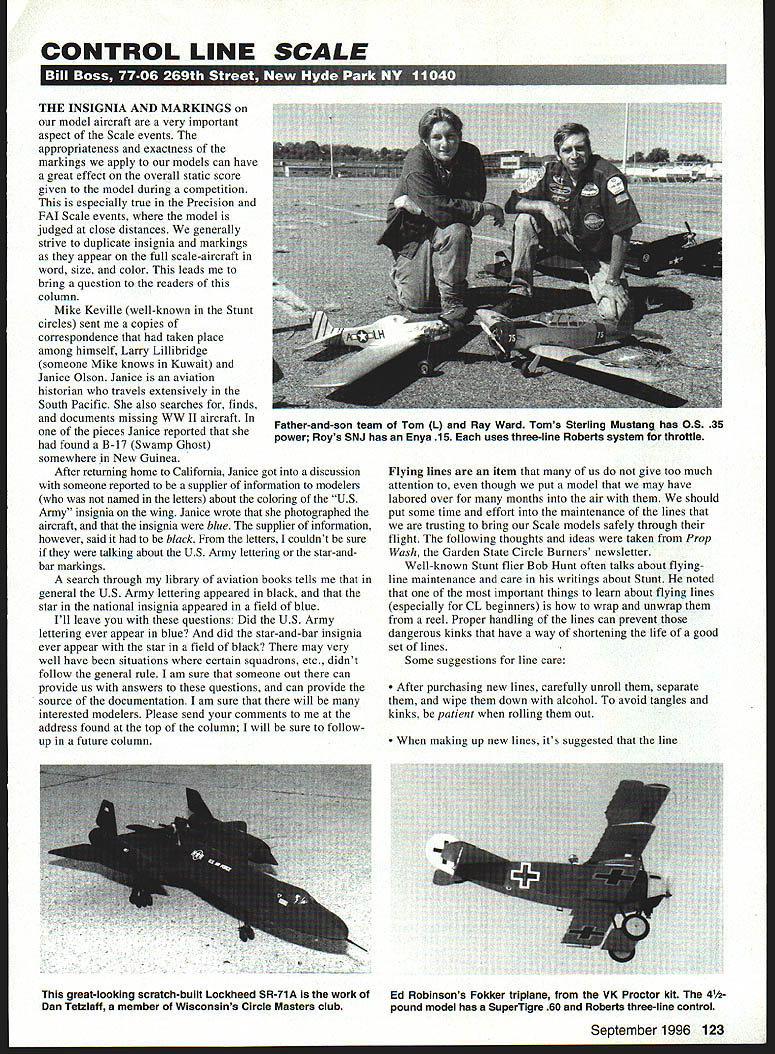
The insignia and markings on our model aircraft are a very important aspect of the Scale events. The appropriateness and exactness of the markings we apply to our models can have a great effect on the overall static score given to the model during a competition. This is especially true in the Precision and FAI Scale events, where the model is judged at close distances. We generally strive to duplicate insignia and markings as they appear on the full-scale aircraft in word, size, and color. This leads me to bring a question to the readers of this column.
Mike Keville (well-known in the Stunt circles) sent me copies of correspondence that had taken place among himself, Larry Lillibridge (someone Mike knows in Kuwait), and Janice Olson. Janice is an aviation historian who travels extensively in the South Pacific. She also searches for, finds, and documents missing WWII aircraft. In one of the pieces Janice reported that she had found a B-17 (the "Swamp Ghost") somewhere in New Guinea.
After returning home to California, Janice got into a discussion with someone reported to be a supplier of information to modelers (who was not named in the letters) about the coloring of the "U.S. Army" insignia on the wing. Janice wrote that she photographed the aircraft and that the insignia were blue. The supplier of information, however, said it had to be black. From the letters, I couldn't be sure if they were talking about the U.S. Army lettering or the star-and-bar markings.
A search through my library of aviation books tells me that, in general, the U.S. Army lettering appeared in black, and that the star in the national insignia appeared in a field of blue.
I'll leave you with these questions: Did the U.S. Army lettering ever appear in blue? And did the star-and-bar insignia ever appear with the star in a field of black? There may very well have been situations where certain squadrons, etc., didn't follow the general rule. I am sure that someone out there can provide us with answers to these questions and can provide the source of the documentation. I am sure that there will be many interested modelers. Please send your comments to me at the address found at the top of the column; I will be sure to follow up in a future column.
Flying Lines
Flying lines are an item that many of us do not give too much attention to, even though we put a model that we may have labored over for many months into the air with them. We should put some time and effort into the maintenance of the lines that we are trusting to bring our Scale models safely through their flight. The following thoughts and ideas were taken from Prop Wash, the Garden State Circle Burners' newsletter.
Well-known Stunt flier Bob Hunt often talks about flying-line maintenance and care in his writings about Stunt. He noted that one of the most important things to learn about flying lines (especially for CL beginners) is how to wrap and unwrap them from a reel. Proper handling of the lines can prevent those dangerous kinks that have a way of shortening the life of a good set of lines.
Some suggestions for line care:
- After purchasing new lines, carefully unroll them, separate them, and wipe them down with alcohol. To avoid tangles and kinks, be patient when rolling them out.
- When making up new lines, it's suggested that the line terminations be made in accordance with the wire-wrapping method shown in the 1996–1997 AMA Competition Regulations. The wire-wrap method is suggested over the crimped-tube method because the crimped-tube method can kink the wire during assembly or fray the wire tube during use.
- Cleanliness is a very important part of keeping lines in good condition. Lines laid out on asphalt parking lots and concrete pick up a considerable amount of dirt. Therefore cleaning lines after use is important. Wiping down with an alcohol-soaked paper towel is recommended. Brand-new lines should be thoroughly cleaned; any oils, preservatives, and dirt can cause sticking action between lines and possibly cut down control response.
- Proper storage of lines is also an important factor in keeping them in good condition. Most top-notch fliers store lines on larger reels (five-inch diameter or larger). Evidently a larger reel makes it easier to wrap and unwrap lines.
Bottom line: line care will provide better service, last longer, and provide a better sense of safety for a model that has been properly maintained. After all, you don't want to lose a project you've spent months on because of kinked or faulty flying lines.
Workshop Hints
The following hints were found in the Indy Sportliners newsletter. Working with epoxy, Clyde Ray suggests that after mixing two parts you should spread the epoxy out before using. Doing so will lengthen the epoxy's working time. Epoxy generates heat as it cures; if left in a small concentrated area it generates heat and cures faster. Spreading out slows the process.
Kevin Cline suggests that before spreading epoxy on your airplane, try dipping the spreading tool in denatured alcohol. This process is said to cause the tool to run on top of the epoxy instead of through it, providing a smoother finish.
Photos
The SR-71A shown in this month's photos is the work of Dan Tetzlaff, a member of the Wisconsin Circle Masters. This great-looking scratch-built model was worked up from three-view drawings. The model is 47 inches long and 25 inches wide. The model weighs about six pounds and is powered with an O.S. .40 with a tuned pipe. The rear of the fuselage has a cutout to accommodate the pusher prop. The landing gear is spring-loaded, and the model has made successful test flights.
Contest Activity
The big CL Scale meet on the East Coast will be held September 15, 1996. The Garden State Circle Burners (GSCB) will be hosting the 19th annual all-Scale meet in memory of George L. Gaydos. The meet will take place at the Benckx Corp. parking lot at Teterboro Airport in New Jersey.
The meet will feature the Precision, Sport, and Profile events, along with the GSCB's Fun Scale and Team Scale events. Trophies, prizes, and awards will be presented in all events. Any Scale buff in the Northeast who misses this meet will be missing out on a fine day of Scale flying and the camaraderie of some great Scale modelers. For full details of this year's meet please contact Bill Reynolds at 18 Myrtle Ave., Caldwell NJ 07006; Tel. (201) 226-5611.
A Reminder
Anyone wishing to have Control Line Scale contest activity mentioned in this column must get the information to me at least four months before the activity's date. Many items are sent to me only a month or two before the event is scheduled. Please send ideas, notices of upcoming CL Scale events, contest reports, and especially photos of CL Scale activity to me at the address at the top of this column.
Transcribed from original scans by AI. Minor OCR errors may remain.

