
Control Line: Scale
Bill Boss 77-06 269th Street New Hyde Park, NY 11040
This Month's Photos
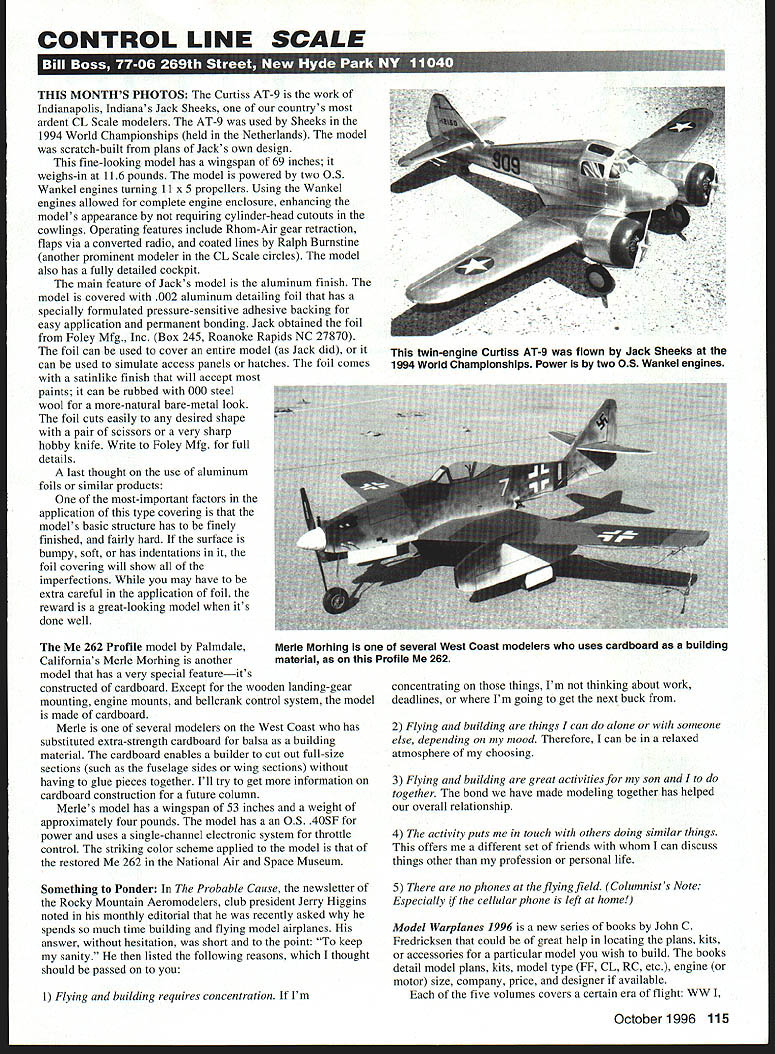
The Curtiss AT-9 is the work of Indianapolis, Indiana's Jack Sheeks, one of our country's most ardent CL Scale modelers. Jack used the AT-9 in the 1994 World Championships (held in the Netherlands). The model was scratch-built from plans of Jack's own design.
The model has a wingspan of 69 inches and weighs 11.6 pounds. It is powered by two O.S. Wankel engines turning 11 x 5 propellers. Using Wankel engines allowed for complete engine enclosure, enhancing the model's appearance by not requiring cylinder-head cutouts in the cowlings. Operating features include Rhom-Air gear retraction, flaps via a converted radio, coated lines by Ralph Burnstine, and a fully detailed cockpit.
Aluminum Finish
The main feature of Jack's model is the aluminum finish. The model is covered with .002-inch aluminum detailing foil that has a specially formulated pressure-sensitive adhesive backing for easy application and permanent bonding. Jack obtained the foil from Foley Mfg., Inc. (Box 245, Roanoke Rapids, NC 27870). The foil can be used to cover an entire model (as Jack did), or it can be used to simulate access panels or hatches.
The foil comes with a satinlike finish that will accept most paints; it can be rubbed with 000 steel wool for a more natural bare-metal look. The foil cuts easily to any desired shape with a pair of scissors or a very sharp hobby knife. Write to Foley Mfg. for full details.
A last thought on the use of aluminum foil or similar products: one of the most important factors in the application of this type of covering is that the model's basic structure must be finely finished and fairly hard. If the surface is bumpy, soft, or has indentations, the foil covering will show all of the imperfections. While you may have to be extra careful in the application of foil, the reward is a great-looking model when it's done well.
Me 262 Profile (Cardboard Construction)
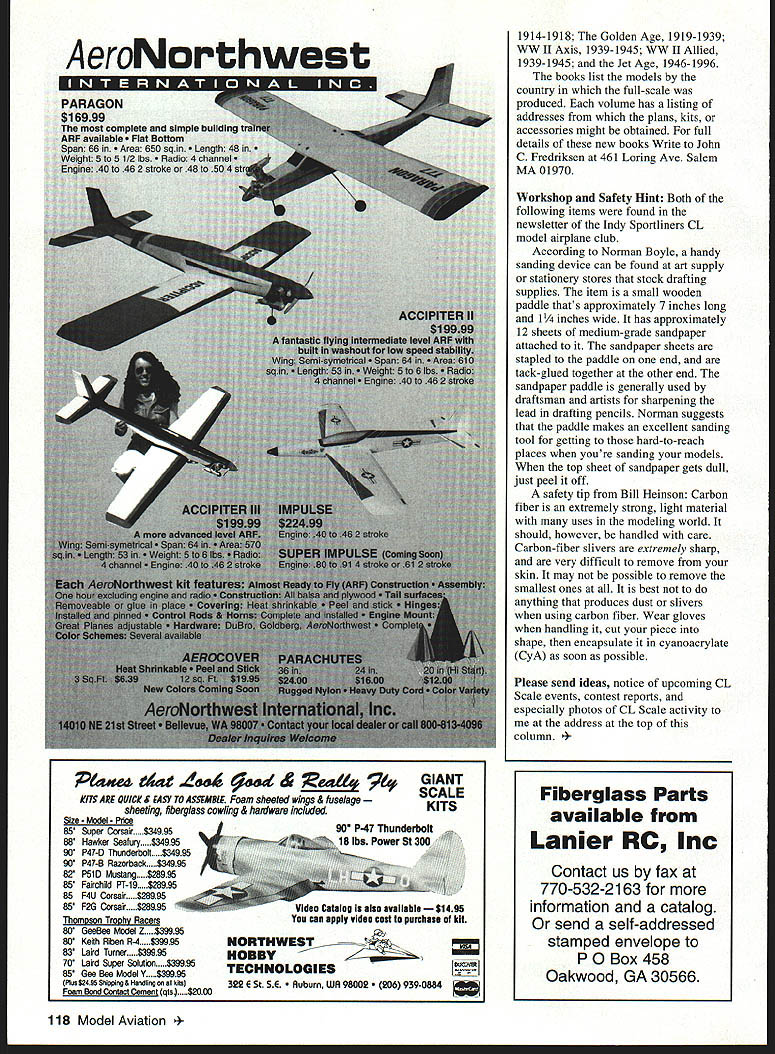
The Me 262 profile model by Palmdale, California's Merle Morhing has a very special feature—it's constructed of cardboard. Except for the wooden landing-gear mounting, engine mounts, and bellcrank control system, the model is made of cardboard.
Merle is one of several modelers on the West Coast who have substituted extra-strength cardboard for balsa as a building material. The cardboard enables a builder to cut out full-size sections (such as fuselage sides or wing sections) without having to glue pieces together. I'll try to get more information on cardboard construction for a future column.
Merle's model has a wingspan of 53 inches and a weight of approximately four pounds. The model is powered by an O.S. .40SF and uses a single-channel electronic system for throttle control. The striking color scheme applied to the model is that of the restored Me 262 in the National Air and Space Museum.
Something to Ponder
In The Probable Cause, the newsletter of the Rocky Mountain Aeromodelers, club president Jerry Higgins noted in his monthly editorial that he was recently asked why he spends so much time building and flying model airplanes. His answer, without hesitation, was short and to the point: "To keep my sanity." He then listed the following reasons, which I thought should be passed on to you:
- Flying and building requires concentration. If I'm concentrating on those things, I'm not thinking about work, deadlines, or where I'm going to get the next buck from.
- Flying and building are things I can do alone or with someone else, depending on my mood. Therefore, I can be in a relaxed atmosphere of my choosing.
- Flying and building are great activities for my son and me to do together. The bond we have made modeling together has helped our overall relationship.
- The activity puts me in touch with others doing similar things. This offers me a different set of friends with whom I can discuss things other than my profession or personal life.
- There are no phones at the flying field. (Columnist's note: Especially if the cellular phone is left at home!)
Model Warplanes 1996
Model Warplanes 1996 is a new series of books by John C. Fredriksen that could be of great help in locating plans, kits, or accessories for a particular model you wish to build. The books detail model plans, kits, model type (FF, CL, RC, etc.), engine (or motor) size, company, price, and designer if available.
Each of the five volumes covers a certain era of flight:
- WW I, 1914–1918
- Golden Age, 1919–1939
- WW II Axis, 1939–1945
- WW II Allied, 1939–1945
- Jet Age, 1946–1996
The books list models and full-scale aircraft produced by country and include listings and addresses where plans, kits, and accessories might be obtained. For full details on the new books, write John C. Fredriksen, 461 Loring Ave., Salem, MA 01970.
Workshop Safety Hint
Both of the following items were found in the newsletter of Indy Sportliners CL model airplane club.
- Sanding paddle (from Norman Boyle): A handy sanding device can be found at art supply and stationery stores. It's stocked by drafting shops and is a small wooden paddle approximately 7 inches long and 1/4 inch wide with about 12 sheets of medium-grade sandpaper attached. The sandpaper sheets are stapled to the paddle on one end and tack-glued together at the other. The sandpaper paddle is generally used by draftsmen and artists for sharpening the lead in drafting pencils. Norman suggests that the paddle makes an excellent sanding tool for getting to those hard-to-reach places when you're sanding your models. When the top sheet of sandpaper gets dull, just peel it off.
- Carbon-fiber safety tip (from Bill Heinsohn): Carbon fiber is an extremely strong, light material with many uses in the modeling world, but it should be handled with care. Carbon-fiber slivers are extremely sharp and very difficult to remove from your skin; the smallest ones may be impossible to remove. Avoid doing anything that produces dust or slivers when using carbon fiber. Wear gloves when handling it, cut your piece into shape, then encapsulate it in cyanoacrylate (CyA) as soon as possible.
Please send ideas, notice of upcoming CL Scale events, contest reports, and especially photos of CL Scale activity to me at the address at the top of this column.
Transcribed from original scans by AI. Minor OCR errors may remain.

