
Control Line: Scale
By Bill Boss 77-06 269th Street, New Hyde Park, NY 11040
This Month's Photos
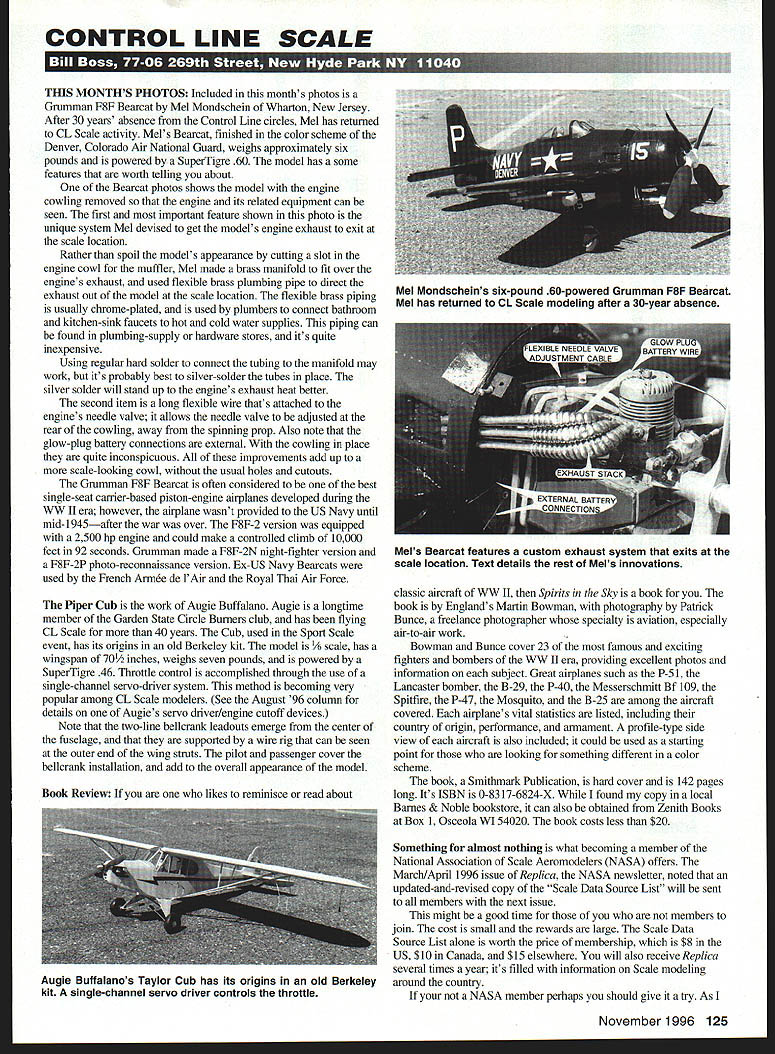
Included in this month's photos is a Grumman F8F Bearcat built by Mel Mondschein of Wharton, New Jersey. After a 30-year absence from control-line circles, Mel has returned to CL Scale activity. Mel's Bearcat is finished in the color scheme of the Denver, Colorado Air National Guard, weighs approximately six pounds, and is powered by a SuperTigre .60. The model has some features worth noting.
Highlights of Mel's installation:
- Exhaust routing: Rather than cutting a slot in the engine cowl for the muffler, Mel made a brass manifold to fit over the engine's exhaust and used flexible brass plumbing tubing to direct the exhaust out of the model at the scale location. The flexible brass piping (usually chrome-plated) is the type plumbers use to connect faucets to water supplies and is inexpensive and available at plumbing-supply or hardware stores.
- Joining technique: Regular hard solder may work to attach the tubing to the manifold, but silver solder is recommended because it withstands exhaust heat better.
- Remote adjustments and connections: A long flexible wire is attached to the engine's needle valve to allow adjustment at the rear of the cowl, away from the spinning prop. Glow-plug battery connections are external but inconspicuous with the cowl in place.
All of these improvements contribute to a more scale-looking cowl without the usual holes and cutouts.
Background on the F8F Bearcat:
- The Grumman F8F Bearcat is often considered one of the best single-seat, carrier-based piston-engine airplanes developed during the World War II era; however, it did not reach the U.S. Navy until mid-1945—after the war ended.
- The F8F-2 version was equipped with a 2,500 hp engine and could make a controlled climb of 10,000 feet in 92 seconds.
- Variants included the F8F-2N night-fighter and the F8F-2P photo-reconnaissance version. Ex-U.S. Navy Bearcats were later used by the French Armée de l'Air and the Royal Thai Air Force.
Piper Cub
The Piper Cub featured this month is the work of Augie Buffalano, a longtime member of the Garden State Circle Burners club who has flown CL Scale for more than 40 years. The Cub, used in the Sport Scale event, originates from an old Berkeley kit. The model is 1/2-scale, has a wingspan of 70.5 inches, weighs seven pounds, and is powered by a SuperTigre .46.
Notable features:
- Throttle control is accomplished with a single-channel servo-driver system—a method becoming very popular among CL Scale modelers. (See the August 1996 column for details on one of Augie's servo-driver/engine-cutoff devices.)
- The two-line bellcrank leadouts emerge from the center of the fuselage and are supported by a wire rig at the outer end of the wing struts. The pilot and passenger figures cover the bellcrank installation and enhance the model's overall appearance.
Book Review: Spirits in the Sky
If you enjoy reading about classic World War II aircraft, Spirits in the Sky is recommended. The book is by England's Martin Bowman, with aviation photography by Patrick Bunce.
Book details:
- Coverage: 23 famous fighters and bombers of the WWII era, with excellent photos and information on each subject.
- Aircraft featured include the P-51, Lancaster, B-29, P-40, Messerschmitt Bf 109, Spitfire, P-47, Mosquito, and B-25.
- Each entry lists vital statistics (country of origin, performance, armament) and includes a profile-type side view useful as a starting point for color-scheme ideas.
- Publication: Smithmark Publications, hardcover, 142 pages. ISBN 0-8317-6824-X.
- Availability: Found at Barnes & Noble and from Zenith Books (Box 1, Osceola, WI 54020). Price: under $20.
National Association of Scale Aeromodelers (NASA)
Joining NASA offers excellent value. The March/April 1996 issue of Replica (the NASA newsletter) noted that an updated and revised copy of the "Scale Data Source List" will be sent to all members with the next issue.
Membership benefits and costs:
- The Scale Data Source List alone is worth the price of membership.
- Membership fees: $8 (U.S.), $10 (Canada), $15 (elsewhere).
- Members also receive Replica several times a year, filled with information on scale modeling around the country.
If you're not a NASA member, consider joining.
For the Workshop
"Choosing the Right Stuff" is the title of an item by Carl Holzwarth in PROP Wash, the newsletter of the Garden State Circle Burners. Carl noted that with today's adhesives, choosing the right glue for the job can literally "make or break" a modeling project. A wide variety of adhesives is available—from the old standby Ambroid to modern instant glues and everything in between—each with its recommended uses.
Good bonding basics:
- Adhesives are not a substitute for craftsmanship. Cut, shape, fit, and clamp carefully.
- Start with a properly fitted joint. Parts should fit snugly without forcing; excessive pressure can warp the structure.
- A thin film of glue bonds wood to wood, often creating a joint stronger than the wood itself. Thick over-application is not a solution.
- Fast-drying or instant glues are good for field repairs; slower-curing adhesives are better in the shop for permanent assemblies.
Safety and best practices:
- Follow manufacturers' directions and heed health and safety warnings.
- Work in a well-ventilated area, especially with instant glues and epoxies.
- Use eye protection when appropriate.
- The modeler is responsible for applying precautions—it's better to be safe than sorry.
Please send ideas, notices of upcoming CL Scale events, contest reports, and especially photos of CL Scale activity to the address at the top of this column.
Transcribed from original scans by AI. Minor OCR errors may remain.

