
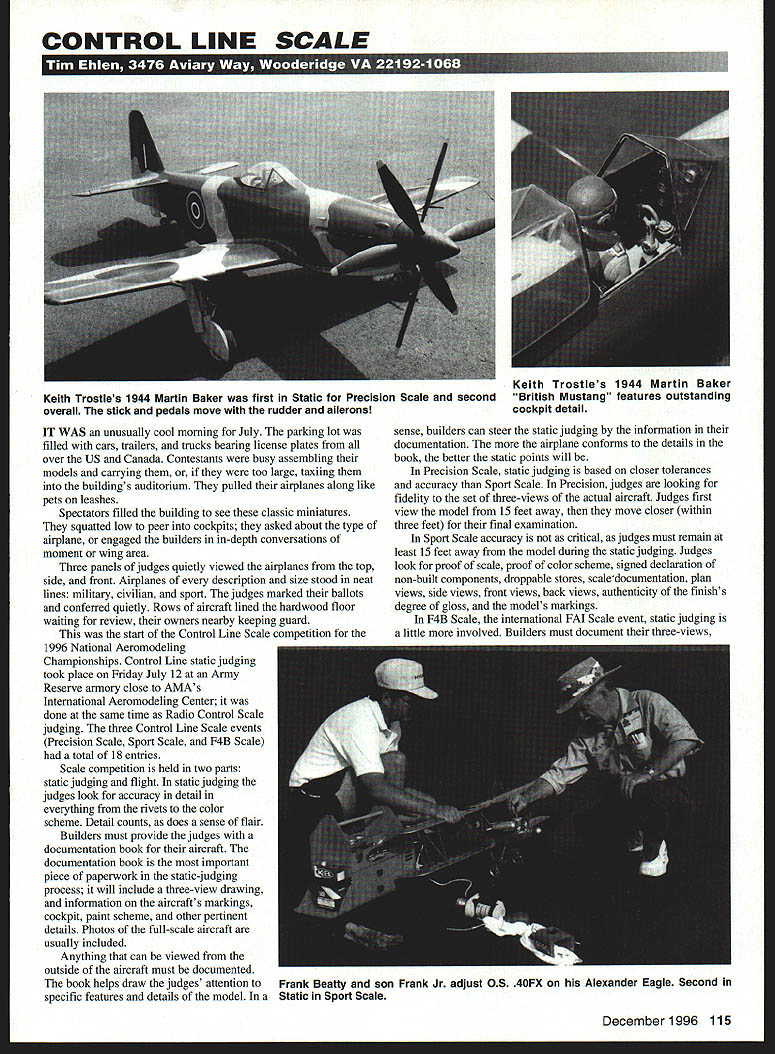
CONTROL LINE SCALE
Byline
Tim Ehlen 3476 Aviary Way, Woodbridge VA 22192-1068
Event overview
It was an unusually cool morning for July. The parking lot was filled with cars, trailers, and trucks bearing license plates from all over the U.S. and Canada. Contestants were busy assembling their models and carrying them, or, if they were too large, taxiing them into the building's auditorium. They pulled their airplanes along like pets on leashes.
Spectators filed into the building to see these classic miniatures. They squatted low to peer into cockpits, asked about the type of airplane, or engaged the builders in in-depth conversations about moment or wing area.
Three panels of judges quietly viewed the airplanes from the top, side, and front. Airplanes of every description and size stood in neat lines: military, civilian, and sport. The judges marked their ballots and conferred quietly. Rows of aircraft lined the hardwood floor waiting for review, their owners nearby keeping guard.
This was the start of the Control Line Scale competition for the 1996 National Aeromodeling Championships. Control Line static judging took place on Friday, July 12, at an Army Reserve armory close to the AMA International Aeromodeling Center; it was done at the same time as Radio Control Scale judging. The three Control Line Scale events (Precision Scale, Sport Scale, and F4B Scale) had a total of 18 entries.
Static judging
Static judging is one half of the Scale competition. In static judging the judges look for accuracy in detail in everything from the rivets to the color scheme. Detail counts, as does a sense of flair. Builders must provide the judges with a documentation book for their aircraft.
The documentation book is the most important piece of paperwork in the static-judging process; it will include a three-view drawing and information on the aircraft's markings, cockpit, paint scheme, and other pertinent details. Photos of the full-scale aircraft are usually included. Anything that can be viewed from the outside of the aircraft must be documented. The book helps draw the judges' attention to specific features and details of the model; in a sense, builders can steer the static judging by the information in their documentation. The more the airplane conforms to the details in the book, the better the static points will be.
Precision Scale
In Precision Scale, static judging is based on closer tolerances and accuracy than Sport Scale. Judges are looking for fidelity to the set of three-views of the actual aircraft. Judges first view the model from 15 feet away, then they move closer (within three feet) for their final examination.
Sport Scale
In Sport Scale accuracy is not as critical, as judges must remain at least 15 feet away from the model during static judging. Judges look for proof of scale, proof of color scheme, signed declaration of non-built components, droppable stores, scale documentation, plan views, side views, front and back views, authenticity of the finish's degree of gloss, and the model's markings.
F4B Scale
In F4B Scale, the international FAI Scale event, static judging is a little more involved. Builders must document their three-views and provide more detailed verification of authenticity.
Flight judging
Static judging is half the event; the beauties also have to get off the ground. According to Event Director Cathy Burnstine, airplanes have to look like the real thing and they have to fly like the real thing too. "Anyone can build a good-looking model," she said. "But it has to have flying characteristics like the original. If it's well built but too heavy or doesn't fly, you're not competitive."
In flight judging the craftsman becomes the pilot as the model takes to the air. Just as with static judging, models must scale and mimic the real thing. If the prototype dropped bombs, carried tanks, sky-wrote, used smoke, or had retractable gear, the model should too. Stunt maneuvers, however, are not required. Scale models are generally too heavy; hundreds or thousands of hours of building time are invested, and flying overhead in figure-eights is often too frightening for the builder to risk adding stunts. The flight portion of judging is the fun part of the Scale competition — seeing the airplanes fly.
Pilots must present judges a list of maneuvers they will perform, such as:
- begin taxiing
- complete a circle
- take off
- perform low flight
- perform high flight
- any other maneuvers the full-scale airplane might have done
Notable models and winners
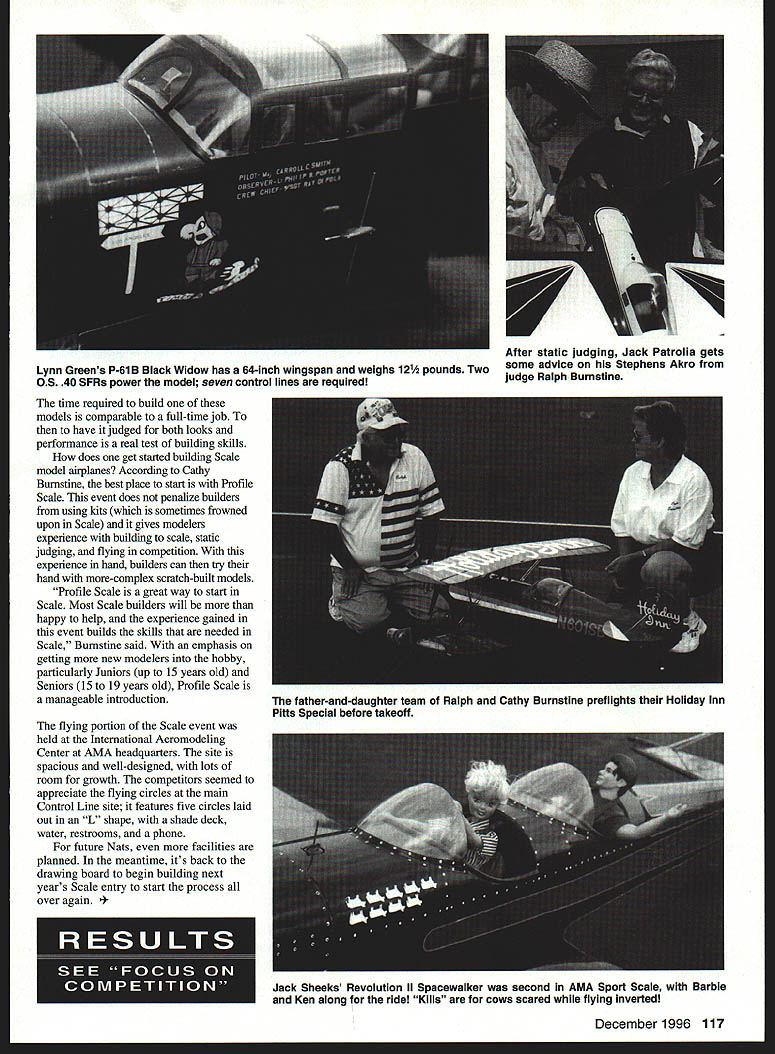
Lynn Green's beautiful P-61B Black Widow requires seven control lines to activate different components. Airplane flight features include elevator and throttle control, retractable landing gear, landing lights, tank drop, and flaps. The all-black twin-engine night fighter looked great in the air; the combination of static and flight scores determined the winners. Green is a tool-and-die maker; his scratch-built model took five years to complete. This shows in the detail of the front and rear cockpits. According to Green, there is only one Black Widow left in existence; it's in the Wright-Patterson Air Force Base Museum in Dayton, Ohio.
At the other end of the spectrum is the colorful Holiday Inn Pitts Special S2-S by Ralph Burnstine. This crowd-pleasing biplane sports the recognizable logo of the hotel chain. It stands out in static display and in flight. The model won Ralph first place in the Precision Scale category.
For the flight portion of the competition Burnstine skywrites with the model and performs a "tail wag," where he kicks in right and left rudder to do a little maiden sashay. Because Burnstine uses electronic control for all of the features on his airplane, he is not too concerned about line tension; should the lines go a little slack, he can add some throttle and right rudder (via the servo driver on his hip) and tighten the lines. In some of his ground demonstrations Burnstine will finish his flight by taxiing across the center of the flying circle to the judges with the limp control lines trailing behind the airplane. He steps in front of the judges and shuts down the engine — a dramatic finish for an unusual airplane.
This Holiday Inn Pitts placed third in international competition three years earlier, and is one of four Holiday Inn Pitts Specials that Ralph and his daughter Cathy have built. Occasionally father and daughter will do tandem air shows with their airplanes.
Other results: Precision Scale
- Ralph Burnstine — Holiday Inn Pitts Special S2-S (first place)
- Keith Trostle — British Martin Baker (second place)
- Bill Logan — (third place)
F4B Scale (international)
- Bill Logan — Italian Caproni bomber (first place)
- Charlie Bauer (AMA District VI Vice President) — Douglas Dauntless (second place)
- Lynn Green — P-61B (third place)
Sport Scale
- Jack Parrotta — Stephens Akro (first place)
- Jack Sheeks (Indianapolis, Indiana) — Spacewalker (second place)
- Michael Welshans — (third place)
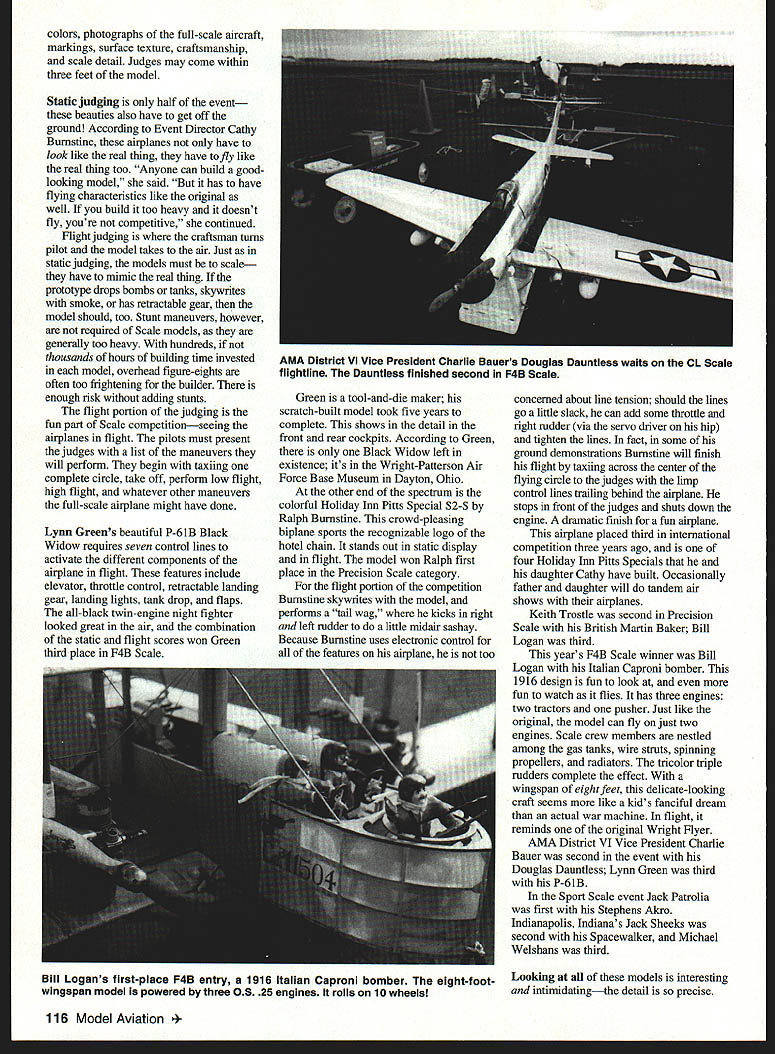
Bill Logan's Caproni bomber (1916 design) is fun to look at and even more fun to watch. It has three engines — two tractors and one pusher — and, like the original, the model can fly on just two engines. Scale crew members were nestled among the gas tanks, wire struts, spinning propellers, and radiators. The tricolor rudders complete the effect. With an eight-foot wingspan, this delicate-looking craft seems more like a kid's fanciful dream than an actual war machine; in flight it reminded one of the original Wright Flyer.
Getting started in Scale
Looking at all of these models is interesting and intimidating — the detail is so precise. The time required to build one of these models is comparable to a full-time job. To then have it judged for both looks and performance is a real test of building skills.
According to Cathy Burnstine, the best place to start is with Profile Scale. This event does not penalize builders for using kits (which is sometimes frowned upon in Scale) and it gives modelers experience with building to scale, static judging, and flying in competition. With this experience in hand, builders can then try their hand with more complex scratch-built models.
"Profile Scale is a great way to start in Scale. Most Scale builders will be more than happy to help, and the experience gained in this event builds the skills that are needed in Scale," Burnstine said. With an emphasis on getting more new modelers into the hobby, particularly Juniors (up to 15 years old) and Seniors (15 to 19 years old), Profile Scale is a manageable introduction.
Facilities and future plans
The flying portion of the Scale event was held at the AMA International Aeromodeling Center at AMA headquarters. The site is spacious and well-designed, with lots of room for growth. Competitors appreciated the flying circles at the main Control Line site; it features five circles laid out in an "L" shape, with a shade deck, water, restrooms, and a phone.
For future Nats, even more facilities are planned. In the meantime, it's back to the drawing board to begin building next year's Scale entry and start the process all over again.
Transcribed from original scans by AI. Minor OCR errors may remain.

