
CONTROL LINE SCALE
Bill Boss 77-06 269th Street, New Hyde Park NY 11040
Committee Activity
Committee activity seems to be a good way to get major projects implemented. In the past, Control Line Scale modelers from around the country worked together in committee on some great projects.
In the late 1980s a group of Scale modelers worked toward the implementation of a standard Sport Scale score sheet. That score sheet is now part of our CL Sport Scale competition rules.
In the early 1990s CL Scale modelers again got together on a project, and we now have a comprehensive Control Line Scale flight judging guide added to the AMA 1996–1997 Competition Regulations.
Once again it is being suggested that a group of Scale modelers be brought together to interface with the Scale Contest Board on rules-change proposals. In the latest issue of Replica, newsletter of the National Association of Scale Aeromodelers (NASA), President Bob Underwood noted that NASA has not taken an active role in the rules-change process, and perhaps it's time the subject should be considered.
In early 1996 a NASA Nats committee was formed to look into 1997 Nationals events, personnel, costs, etc. Underwood noted that consideration might be given to changing the committee's name to "NASA Competition Committee," and that it might include other competition concerns. One would be some sort of active role in the rules-making process.
It would seem that with the large number of NASA members there is enough expertise within the organization to provide assistance on an event-type basis (CL, RC, and FF) to the Scale Board. Assisting the Scale Board would seem appropriate; it consists of members who have varied amounts of experience in each of the three Scale categories.
Questions for Consideration
What are your thoughts? Should NASA consider getting involved in the rules-making process? Specific questions include:
- Should there be one committee, or one for each type of Scale event?
- How many members should be on a committee?
- How should committee members be chosen?
- What should be the extent of NASA involvement?
- Should NASA be able to submit rules change proposals?
- Should NASA review rules-change proposals before they go to Headquarters?
If you have any thoughts on this subject, Bob Underwood would like to hear from you. Send your comments to Box 40, St. Peters, MO 63376; or send them to me at the address at the top of this column. I’ll see that your comments are forwarded to NASA.
NASA Scale Data Source List
A huge thank you is in order for Gerald Deneau, Production Editor of the NASA newsletter. Gerald did a great job on the 1996 Scale Data Source List that was just issued by NASA. If you are a NASA member you know the value of the Data Source List, and I am sure you'll put it to good use.
If you're not a NASA member, the 47-page Scale Data Source List can be yours by sending a check (payable to NASA) to Burt Dugan at 11090 Phyllis Dr., Clio MI 48420. Prices:
- $8 U.S.
- $10 (Canada)
- $15 (overseas)
The Scale Data Source List will be sent to you as part of your membership package.
Workshop Tip
Kirk Kirkham of the Rocky Mountain Aeromodellers notes that a box of facial tissues is a must in his workshop. Uses include:
- Cleaning up spills and drops of glue.
- Cleaning paint brushes and similar cleanup tasks.
- Providing a soft, non-scratching support for the canopy area of an upside-down model when it is being repaired or cleaned.
Kirk also noted that a piece of the split foam insulation made for covering water pipes can be opened and put over the tip of the rudder to protect it while the model is inverted.
Model Size — "Big!"
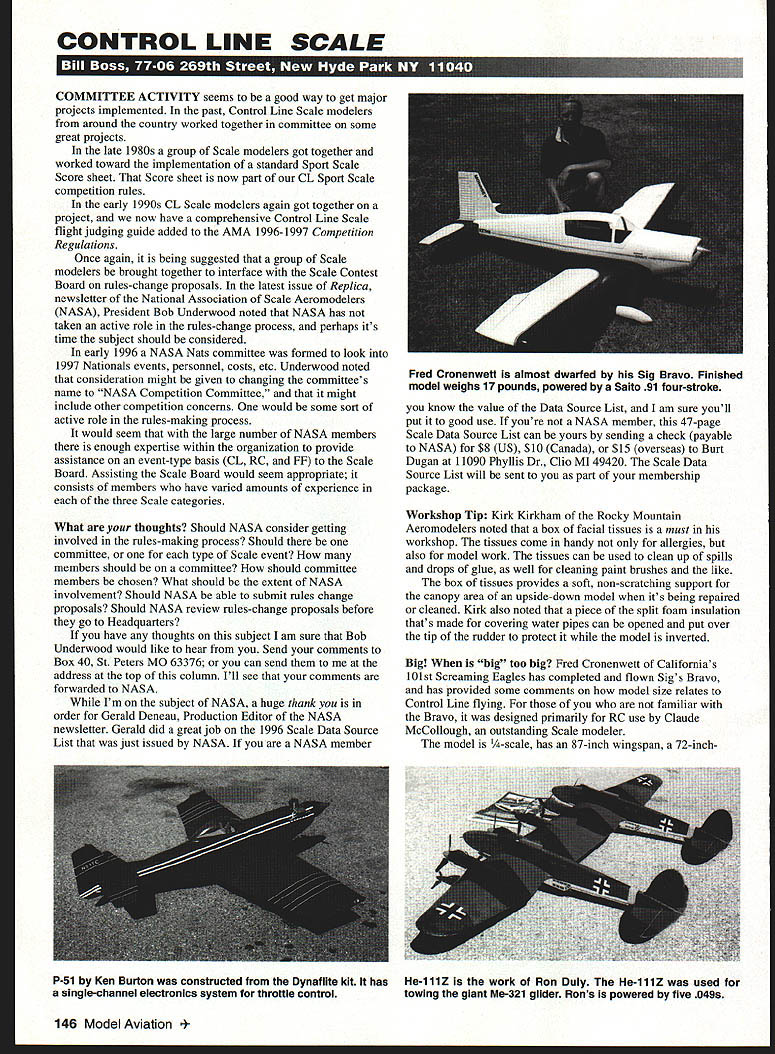
When is "big" too big? Fred Cronenwett of California's 101st Screaming Eagles has completed and flown Sig's Bravo, and he has provided some comments on how model size relates to Control Line flying.
The Bravo (designed primarily for RC use by Claude McCollough) as built by Fred:
- Scale: 1/4
- Wingspan: 87 inches
- Fuselage length: 72 inches
- Rudder height off the ground: 24 inches
- Completed weight: 19 pounds (Fred's finished model weighed 17 pounds)
- Power: Saito 91 four-stroke engine
- Controls: Multichannel electronic system for flaps, engine, and rudder
Fred uses rudder control to adjust for wind conditions during flight. While there may be advantages in flight performance and detailing possibilities with large models, "big" poses problems in handling and transportation.
Fred noted that comparing the Bravo's 87-inch span and 72-inch length to a 65-inch-span Hellcat, the 11-inch difference per wing panel doesn't seem so great on paper. However, size becomes a factor in transport: a six-foot truck bed is only 72 inches long, so Fred uses an eight-foot trailer that he and Grant Hensladt built to transport their models. On the field, an airplane of this size is not easily handled by one person—the model is pushed rather than picked up and carried.
Having built models with wingspans ranging from 36 to 87 inches, Fred feels the ideal size for Control Line models is in the 60–70 inch wingspan range. Models in this size range usually:
- Weigh 6–10 pounds
- Are easily transported
- Can be handled on the field by one person
- Have a greater variety of available equipment
Fred said the Sig kit was great. He obtained the model's documentation from Sig and used Sig's Koverall and paint to finish the model.
This Month's Photos
In addition to the Bravo, Fred Cronenwett submitted a couple of photos taken at the Roland Baltes Memorial Meet in March 1996.
- Ron Duly entered a unique profile version of the He-111Z Zwilling glider tug. The tug was made by twinning He-111s and adding a fifth engine at the center of the wing that joins the fuselages. The He-111Z was used for towing the Me-321 glider. Ron's He-111Z is powered by five .049 engines.
- Ken Burton's P-51 has a span of 50 inches and was built from a Dynaflite kit. Information on the model's unusual all-red color scheme and markings was obtained from Bob Banka at Scale Model Research. Ken took first place in the Sport event.
Please send ideas, notice of upcoming Control Line Scale events, contest reports, and especially photos of CL Scale activity to me at the address at the top of this column.
Transcribed from original scans by AI. Minor OCR errors may remain.

